For over a decade, much of the West has been pondering how to manage Ukraine’s inevitable subordination to Russia. Yes, we’ve said we stand with Ukraine. Yes, we’ve said that we will support Ukraine for as long as it takes. And yet we have consistently failed to give Ukraine the support it needs to win. We have even repeatedly discouraged Ukraine from using its own resources as effectively as possible to defend itself.
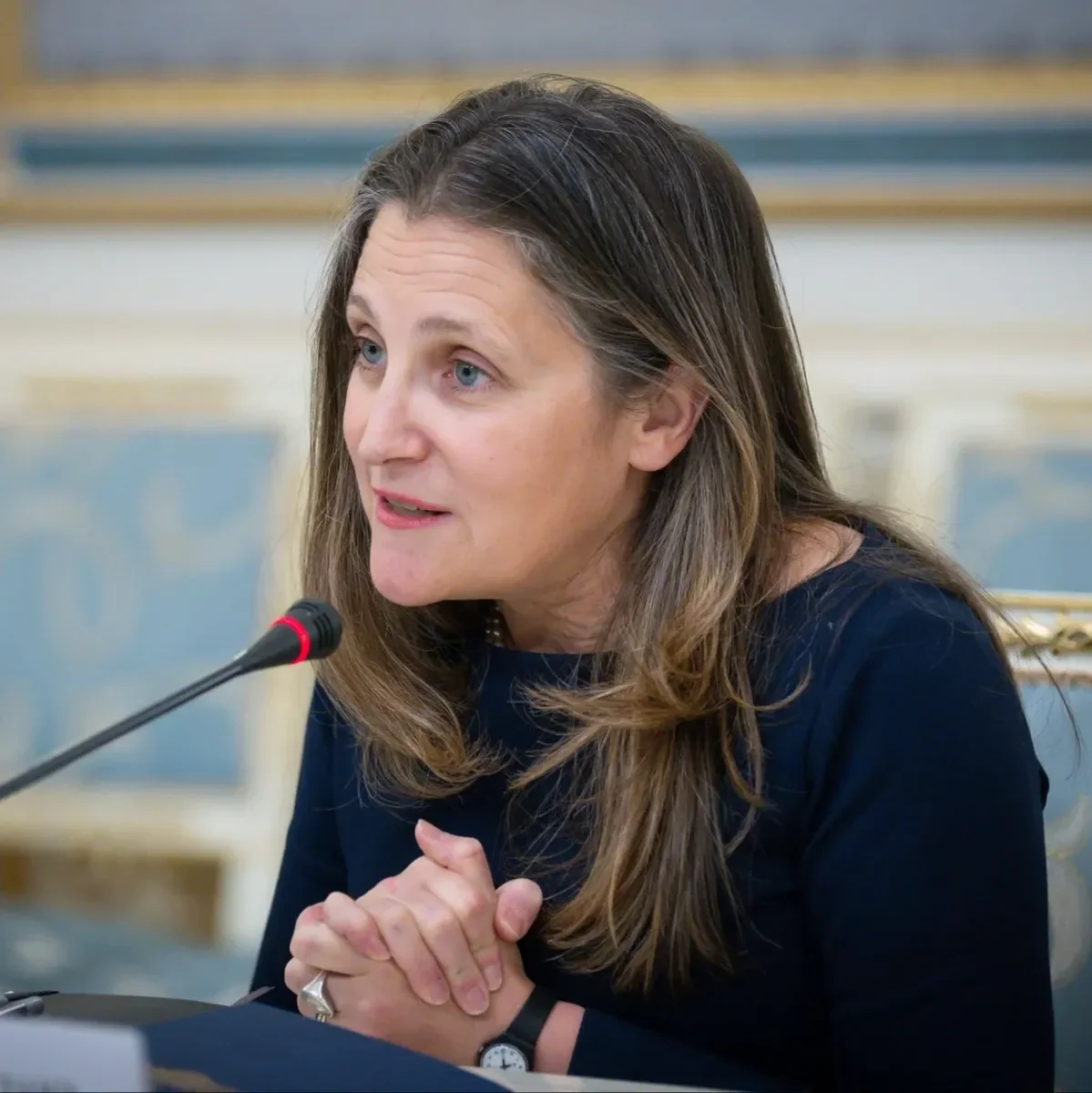
Chrystia Freeland
Former deputy prime minister, foreign minister and finance minister of Canada
It is time to change that half-hearted paradigm. We need to recognise that Ukraine can win and that a Ukrainian victory is in the interests of the geopolitical West, and if we don’t believe that, we should say so. And then we need to devise a plan for a Ukrainian victory.
Our defeatism started with the 2014 invasion of Crimea, when the West told Ukrainians to stand down and tacitly accepted Russian control of the peninsula. On the eve of the 2022 full-scale invasion, we prepared to support a long Ukrainian guerilla war against Russian occupation and were cautious about giving the Ukrainian government weapons that we assumed would only fall into Russian hands. As the Kremlin’s tanks crossed the border, we offered President Volodymyr Zelensky an escape route, so he could lead Ukraine’s government in exile.
Even after the Ukrainian people showed that they had the will and the strength not to be conquered, we have been collectively hesitant about giving them the tools that they need to win. Worse, we have even cautioned them against using their own weapons to maximum effect.
Ukraine can defeat Russia, and NATO allies and our Asian partners will be stronger if it does. So, it is past time to plan for success.
It is time to stop equivocating. It is time to stop settling for stalemate and planning for Finlandisation. Ukraine can defeat Russia, and NATO allies and our Asian partners will be stronger if it does. So, it is past time to plan for success.
It starts with Ukraine’s capacity for victory. Since the war began, Ukraine has consistently outperformed Western expectations. Kyiv did not fall. Ukraine, with no navy of its own, has destroyed much of the Russian Black Sea Fleet and broken through its maritime blockade. Ukraine has deprived Russia of control of the sky. And Ukraine has held Russia to an effective stalemate on the ground: in fact, Ukraine today controls more of its own territory than it did immediately after Russia’s full-scale incursion.
Ukraine, a country of 40 million, with an economy the size of the US state of Nebraska, is holding its own against Russia, with its 144 million people, oil production on par with Saudi Arabia, and the world’s second most powerful military, for the same reason the allies won World War II. Ukraine is a democracy, whose highly motivated and well-educated citizens refuse to be defeated.
In practice, this means that the future of war is being invented on Ukraine’s frontline and by technologists working in its remarkably vibrant cities. Ukraine has turned itself into the world’s leading inventor, producer, and user of drones, and is constantly developing new ones and new techniques. Recognising that the path to victory must include missile strikes that bring the war home to the Russian people — for example, by destroying oil refineries — and that hit Russia’s military arsenal and defence industries, Ukraine is developing and building its own missiles.
Ukrainian President Volodymyr Zelensky arrives at 10 Downing Street, London, 8 December 2025. Photo: EPA / TOLGA AKMEN
Ukraine can do so because this is a people’s war. Civilian donations are an important source of support for the military, and self-organised brigades, which compete to attract soldiers and financial support, are responsible for their own procurement and often manufacture their own weapons.
The West has consistently failed to see Ukraine’s strength because we are still largely in thrall to a sort of Cold War Orientalism. Our intellectual guides to the war are overwhelmingly scholars of Russia and the Kremlin, not of Ukraine. Our militaries are led by generals whose formative years were spent learning how to counter the Russian threat. Even more than 30 years after the collapse of the Soviet Union, it is hard for us to fully internalise the reality on the ground: that what we thought was the second-strongest army in the world is now the second-strongest army in Ukraine.
The one exception to this blinkered vision comes from countries that were part of the Soviet Union or the Warsaw Pact. They understand Russian power — and Russian weakness — deeply and intimately, having learned their lessons the hard way, from the inside and on the periphery. They understand that Ukraine can win, and that Ukraine’s victory is in our interest. We should be listening to them with greater attention and greater humility.
Ukraine’s victory is unequivocally in Europe’s interest. A victorious Ukraine would be Europe’s shield and its arsenal.
The real question is not whether Ukraine has the capacity to win, but whether that is what we want. We should. Ukraine’s victory is unequivocally in Europe’s interest. A victorious Ukraine would be Europe’s shield and its arsenal. Ukraine’s innovative defence industries and military doctrines are key to rearming Europe. A strong Ukraine guarding Europe’s eastern flank is the best guarantee that Europe will never need to use the weapons it is now building in a war of self-defence.
A strong Ukraine is in America’s interest, too. For one thing, America’s NATO commitments oblige it to defend its European allies, and the most effective and cheapest way to do that is to allow Ukraine to do the job. For another, Ukraine’s success is the best way to constrain China. A bipartisan consensus in the United States holds that China is the country’s main geopolitical rival. The surest way to check Chinese territorial expansionism is through the demonstration effect of Russia’s failure in Ukraine. The surest provocation for Chinese expansionism is for Russia’s invasion to succeed.
There is, of course, another possibility. It could be that we don’t actually want Ukraine to succeed. The reality is that Ukraine can win. The self-described realists who assert otherwise are effectively opting for a world where Vladimir Putin wins. They should be transparent enough to say so, and to explain why.
If we do want Ukraine to win — and we should — a plan for Ukrainian success starts with weapons. Ukraine has held out for so long because of its own military innovation and arms from the West. To end the war, it needs missiles to take the war to Russia; drones, robots, and AI to keep fighting at sea, on land, and in the air; and missile defence to protect Ukraine’s cities and energy grid from Russian attack.
Ukraine has never asked for foreign boots on the ground — unlike Russia, which has brought in the helot soldiers of its North Korean ally. But we could help Ukraine end the war by supplying the weapons it needs now to push Russia back: US Tomahawks or German Taurus missiles, and the intelligence support to target them; intelligence and supply-chain support for its drone fighters; and more Patriot and other air-defence systems.
Western missiles would help Ukraine to end the war the most quickly — the case Zelensky unsuccessfully made during his October visit to the White House. But money is just as important as weapons, and in many ways a proxy for them.
Western military support for Ukraine is limited more by money than by political will.
Ukraine’s domestic weapons production is financially constrained: a Ukrainian drone facility I visited this fall was operating at only 60% capacity because it lacked the wherewithal to buy inputs and pay workers producing at full strength. And Western military support for Ukraine is limited more by money than by political will.
President Donald Trump’s administration has made clear that US arms for Ukraine will need to be paid for by Europe. For Europeans, who are generally agreed that their own security is best served by a strong Ukraine, that makes the challenge mostly an economic one. At a time when European economies are facing tough — and in the case of countries like France, politically crippling — budget constraints, even as voters demand more action to address a cost-of-living crisis, finding money for Ukraine is a fiendish political challenge in even the most motivated European capitals.
That’s why German Chancellor Friedrich Merz’s proposal to use Russia’s frozen central-bank assets as collateral for a €140 billion loan to Ukraine is so important. It would enable European leaders to support the Ukrainian war effort without imperilling their own national finances or forcing their own voters to make unwelcome kitchen table trade-offs. Thanks to Ukraine’s own impressive and growing military production capacity, and America’s willingness to sell arms to Ukraine, money could be most of the answer to the country’s myriad military challenges.
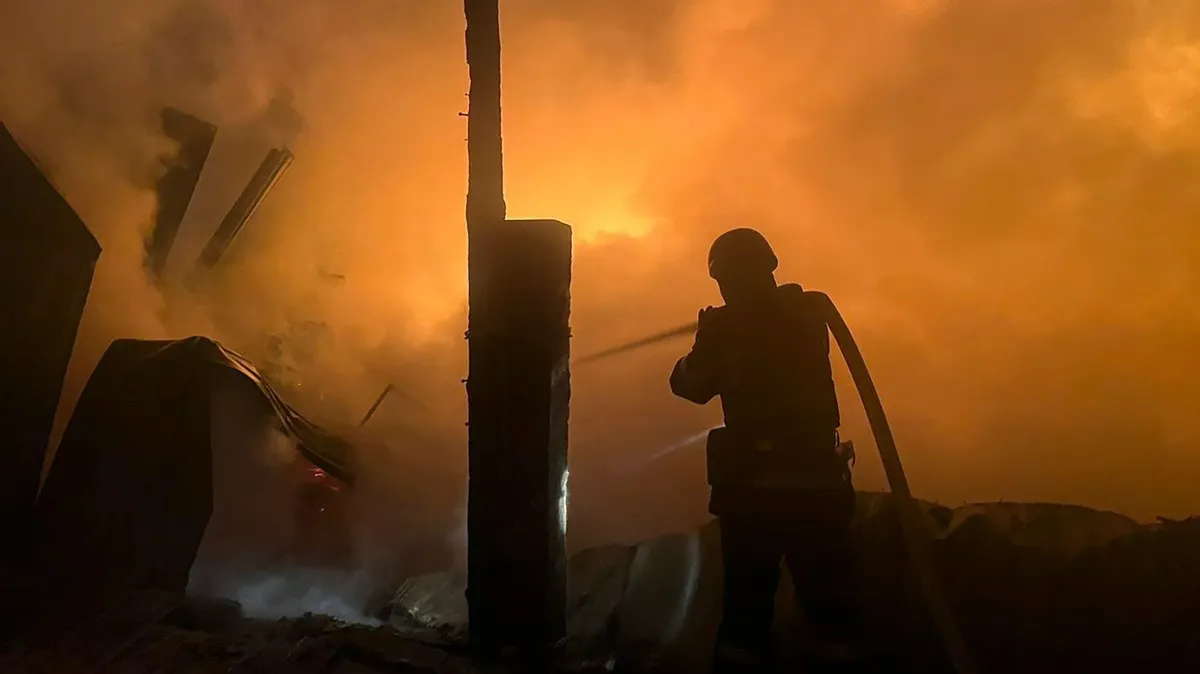
The aftermath as a drone hits a nine-storey building in Zaporizhzhia, Ukraine, 16 December 2025. Photo: EPA / STATE EMERGENCY SERVICE
As a bonus, using Russian assets to back Ukraine would enforce a powerful and important principle: the aggressor pays. That approach makes sense to Western tax-payers, and embracing it would help to deter future would-be invaders.
Finally, what Ukraine needs is a future. This war is not only, or even mostly, about holding the frontline in the Donbas, or keeping the lights and the heat on in the country this winter. Ukrainians are fighting for a future as a sovereign, secure democracy, with a path to joining the European Union, and the prosperity that EU accession promises.
This future is what Ukrainians voted for in their 1991 referendum on independence. It is why they overturned a rigged election with the Orange Revolution in 2004. It is why they came out and protested again on the Maidan in 2014, when their path to Europe was blocked. And it is why they are resisting Putin today. Ukrainians are fighting because they want what we have — capitalist democracy and the chance to determine their own fate, in their households and in their country.
Since 1991, every time Ukraine has taken a step towards a democratic and sovereign future, the Kremlin has undermined it.
Ukrainians also recognise that the fight against corruption at home is as essential to that future as the fight on the frontline against Russia. That is why they went back to the streets this summer to insist on independent and transparent anti-corruption investigators. They were right to do so.
Since 1991, every time Ukraine has taken a step towards a democratic and sovereign future, the Kremlin has undermined it, first through efforts to suborn Ukraine’s governments, and then with the invasions of 2014 and 2022. So, while the lines on the map that Zelensky and Trump discussed in the White House this fall matter, what matters more is buying into that Ukrainian vision, and the EU membership and security guarantees that would enable its realisation.
Ukrainians know their own history. That is why they know that this war can end only when they have the borders, army, and alliances they need to deter further Russian aggression and give their children a path to the prosperity they have watched their neighbours in Poland and the Baltic states build.
There is more than a little irony in the fact that Ukrainians are bleeding and dying for Western democracy and the EU at a time when so many are losing faith in both. But they are. And they have shown that they can win. Helping them do so will make us stronger, too.
This article was first published by Project Syndicate. Views expressed in opinion pieces do not necessarily reflect the position of Novaya Gazeta Europe.