StoriesPolitics

The Old Man and the Sea

How realistic are Putin’s threats to impose a naval blockade on Ukraine?

The Old Man and the Sea

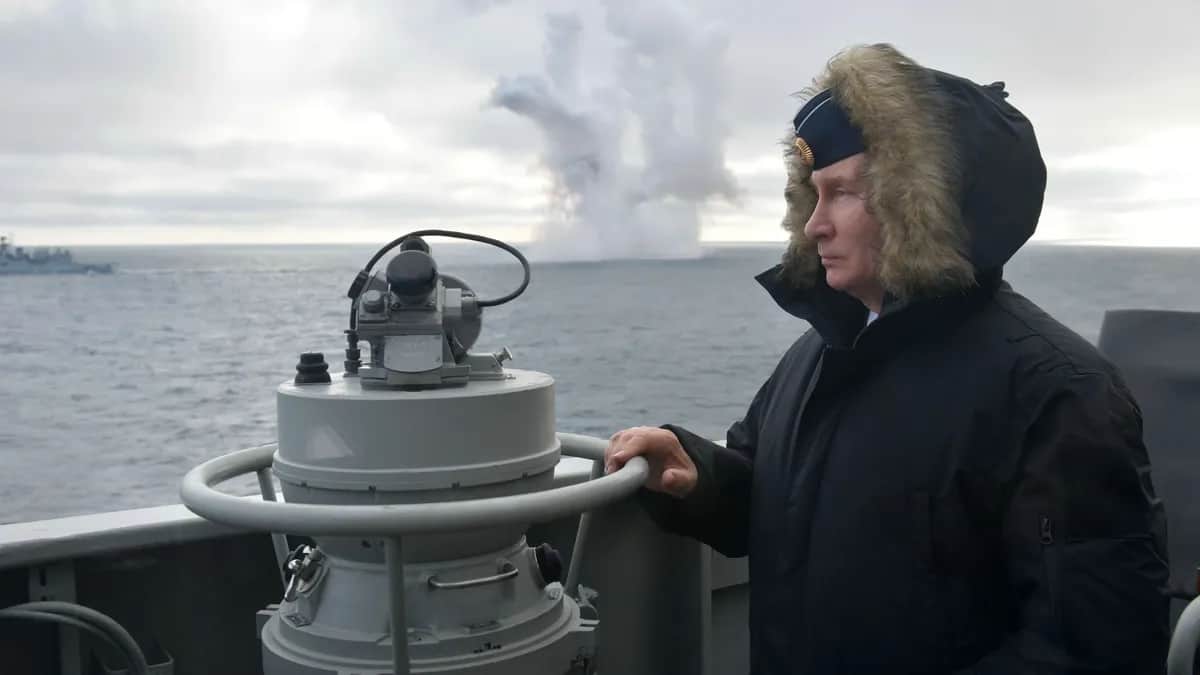
Vladimir Putin watches Russian naval drills in the Black Sea off the coast of Russian-annexed Crimea, 9 January 2020. Photo: EPA/ALEXEI DRUZHININ / SPUTNIK / KREMLIN POOL

The Black Sea once again finds itself thrust back into the limelight as a recent series of Ukrainian maritime drone strikes on oil tankers belonging to Russia’s shadow flight has incensed the Kremlin.

Similar attacks have occurred before, of course, though never so close to the coasts of third countries. Vladimir Putin has threatened to “cut Ukraine off from the sea” and to take retaliatory measures against countries “helping Ukraine to carry out piracy”.

What can Moscow really do about the past week’s military escalation in the region, and why is Kyiv so confident that its drone strikes on Russian tankers in no way breach international law?

Baby one more time

“The Armed Forces of Ukraine are now committing acts of piracy,” Putin told journalists stridently on Tuesday, referring to the Armed Forces of Ukraine (AFU) attacks on two tankers the previous week.

Two tankers — the Kairos and Virat, both of which are under Western sanctions for being part of the so-called shadow fleet Russia uses to circumvent the embargo on its oil — were targeted by Ukrainian drones on 28 November near the Bosphorus Strait.

According to unconfirmed Ukrainian media reports, the attacks were carried out using Ukrainian multi-purpose unmanned naval drones that operate on the surface of the water known as Sea Babies. These can either carry an explosive payload for a kamikaze attack or can be used to carry other hardware for more specialised tasks.

The Security Service of Ukraine (SBU) said in late October that its Sea Baby drones had been successfully used to strike 11 Russian ships, including frigates and missile carriers. It was this, the SBU claimed, that forced Russia’s Black Sea Fleet to begin relocating its headquarters from Sevastopol, in annexed Crimea, to the Russian port of Novorossiysk in late 2023.

The latest model of Sea Baby drones, whose increased range allows it to operate anywhere in the Black Sea, only became operational in late October.

The latest model of Sea Baby drones, whose increased range allows it to operate anywhere in the Black Sea, only became operational in late October. As well as being able to carry a heavier payload, it also uses AI guidance systems for greater accuracy. According to Ukrainian media, it was precisely these advanced drones that were used in the strikes in late November.

News emerged of another attack on Tuesday, when the Turkish Maritime Authority said that the MIDVOLGA-2 tanker, which sails under the Russian flag according to vessel-tracking website Marine Traffic, was attacked 80 nautical miles (148km) off the coast of Türkiye.

The Turkish authorities said the MIDVOLGA-2 was heading for Georgia, although that was subsequently denied by the Georgian Maritime Transport Agency. The ship likely suffered minor damage and managed to make its way into the Turkish port of Sinop.

Ukrainian soldiers stand in front of a Sea Baby marine drone during a presentation by the Security Service of Ukraine in Ukraine’s Kyiv region, 5 March 2024. Photo: Evgeniy Maloletka / AP Photo / Scanpix / LETA

Ukrainian soldiers stand in front of a Sea Baby marine drone during a presentation by the Security Service of Ukraine in Ukraine’s Kyiv region, 5 March 2024. Photo: Evgeniy Maloletka / AP Photo / Scanpix / LETA

Radical intimidation

Turkish President Recep Tayyip Erdoğan called the first two tanker attacks an “alarming aggravation” on Monday. “There is no way we can justify these attacks, which threaten the safety of navigation, life and the environment.” He added that Ankara was closely following the negotiations to end the war in Ukraine and was willing to contribute to the process.

Putin’s statement, however, did not focus on ending the war. “The most radical solution would be to cut Ukraine off from the sea, effectively making it impossible for it to engage in piracy at all. I hope that Ukraine’s military leadership, political leadership, and those who support them, will think again about whether to continue this practice,” Putin said in his speech on Tuesday.

“Russia cannot significantly scale up its presence in the Black Sea without Turkish consent, and the Black Sea Fleet is weakened.”

Military experts who spoke to Novaya Europe all expressed their certainty that the Russian armed forces were incapable of cutting Ukraine off from the sea, however. “They would have to fully capture the Kherson region, and the Mykolayiv and Odesa regions,” Russian military analyst Kirill Mikhailov told Novaya Europe. “At current rates, the Russian army would need years, if not decades, for that.”

Maxim Starchak, a researcher at the Centre for International and Defence Policy at Queens University in Canada, noted that “Russia could blockade Ukraine by closing the Kerch Strait and deploying ships near Odesa,” though he added that Kyiv would have numerous opportunities for to fight back.

“Russia cannot significantly scale up its presence in the Black Sea without Turkish consent, and the Black Sea Fleet is weakened. Russian ships can be attacked by drones, long-range missiles or coastal artillery. And the coast off Odesa could be mined.”

The Russian tanker MIDVOLGA-2 passes through the Bosphorus in Istanbul, Türkiye, on 15 August 2022. Photo: Yoruk Isik / Reuters / Scanpix / LETA

The Russian tanker MIDVOLGA-2 passes through the Bosphorus in Istanbul, Türkiye, on 15 August 2022. Photo: Yoruk Isik / Reuters / Scanpix / LETA

Blockade alternatives

Oleksandr Kovalenko, a Ukrainian military and political observer with the Information Resistance Group, which counters Russian misinformation, doubts that ships from Russia’s Black Sea Fleet would “dare venture out into the open sea from their bases, in view of the risk from Ukrainian drones”.

He did say, however, that Russia had “a whole range of means to attack ships sailing to Ukraine — maritime drones, aerial drones, and various missiles” and that the Russian Air Force could also play a role, making a blockade technically possible. However, “it would be a significant escalation, and it is unclear whether the Russian leadership has the political will for it,” says Mikhailov.

Putin has not dared attack Ukraine’s allies for almost four years, and it is unclear why he would risk doing so now.
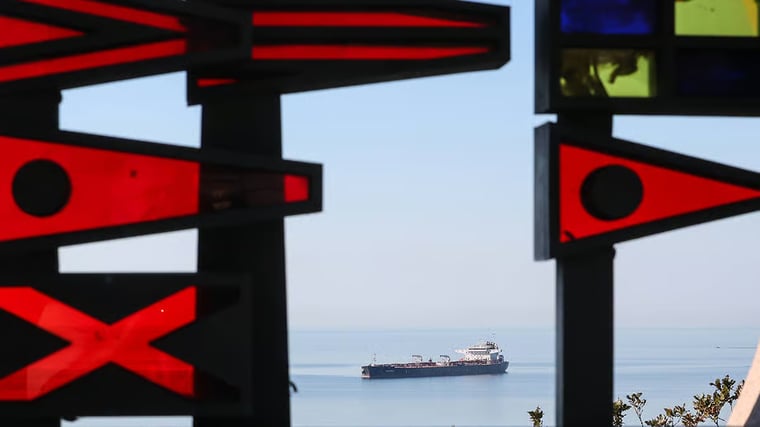
Meanwhile, Starchak said Putin had not dared attack Ukraine’s allies for almost four years, and it was unclear why he would risk doing so now. Putin’s bellicose statement, however, showed just how important the tankers are to him, Starchak continued, suggesting that the Russian leader could use the Ukrainian strikes “as a pretext” for the impossibility of reaching a peace deal with Kyiv.

Ukraine has previously attacked Russian tankers in the Black Sea, of course, but what makes recent events unique is that they occurred much further south, near the Turkish coast. Russia has also attacked civilian vessels on more than one occasion. However, those missile strikes were often targeting the ports rather than the ships themselves. In 2022, for example, six ships sailing under neutral flags were all impacted by Russian missile strikes, leading Erdoğan to condemn the Russian invasion of Ukraine as “unacceptable”, after an attack on the Turkish-owned Yasa Jupiter.

In September 2024, a Russian missile struck a cargo ship carrying Ukrainian wheat to Egypt as the ship passed through Romania’s exclusive economic zone, while just a month later, there were attacks on three more ships sailing under neutral flags. When the Palau-flagged Optima was hit, a Ukrainian port worker was killed and five foreign nationals were injured, while eight people were killed and nine injured when the Panama-flagged Shui Spirit was struck.

A frame from a video by the  Security Service of Ukraine (SBU) shows smoke rising from a burning cargo ship in the Black Sea off the coast of Türkiye on 29 November 2025. Photo: SBU / AFP / Scanpix / LETA

A frame from a video by the Security Service of Ukraine (SBU) shows smoke rising from a burning cargo ship in the Black Sea off the coast of Türkiye on 29 November 2025. Photo: SBU / AFP / Scanpix / LETA

When tankers become targets

Earlier this week, the UN Secretariat reiterated that “attacks on civilians and civilian infrastructure, including energy facilities, are prohibited under international law”.

The 1994 San Remo Manual on International Law Applicable to Armed Conflicts at Sea is more specific, saying that merchant vessels flying the flags of neutral states can be attacked if they act as auxiliary vessels to enemy armed forces, assist enemy intelligence or otherwise make an effective contribution to the enemy’s military action, such as by carrying military materials.

To Kyiv’s mind, at least, this covers the ships it attacked in the Black Sea last week. An unnamed reserve Ukrainian captain who previously served in military intelligence explained to Krym.Realii, the Crimean arm of Radio Free Europe/Radio Liberty, that since the proceeds from the sale of Russian oil goes directly to Russia’s state coffers, over 30% of which then goes on military spending, oil tankers are legitimate military targets.

Kovalenko stresses the “significant difference between merchant ships calling at Ukrainian ports and the Russian shadow fleet”, arguing that “tankers in Russia’s shadow fleet are actually outlawed” and are used illegally for smuggling Russian oil exports. Even if a Russian tanker on the sanctions list is flying the flag of another country, it is breaking the law and thus considered a legitimate target by the AFU.

“Although Ukrainian strikes on these tankers by sea or air may raise diplomatic issues with some countries, they are not violations of international law,” Kovalenko continues, concluding that Türkiye merely “expressed concern about what was happening near its territorial waters, but nothing more”.

shareprint
Editor in chief — Kirill Martynov. Terms of use. Privacy policy.