Four people killed in explosion at chemical hangar in St. Petersburg


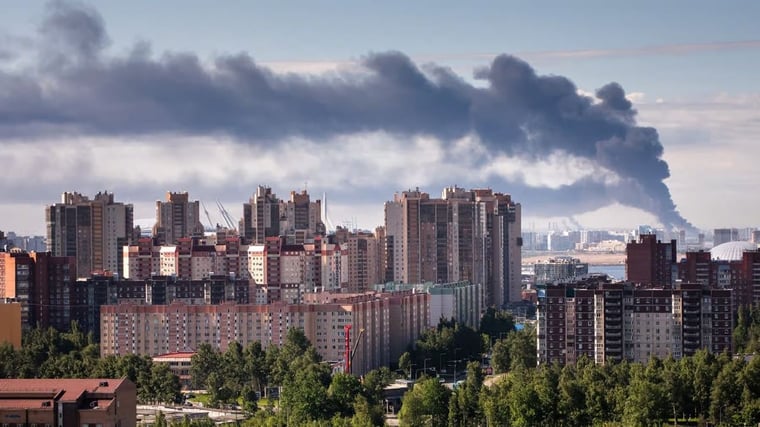
Four people have died in a fire at an industrial facility in St. Petersburg, Russia’s second city, after a chemical hangar at the site exploded on Monday evening, local news outlet Fontanka reported on Tuesday.
The initial explosion was reportedly caused by the ignition of acetone vapours due to improperly stored chemical products. The subsequent fire took nine hours to extinguish, and spread to an area of approximately 400 square metres.
Two of the deceased were working in the hangar at the time of the explosion, while another two were employed by state railway company Russian Railways at the nearby Finlandsky train station. A further two victims were taken to hospital with serious injuries.
The fire occurred near a plant operated by Russia’s national space agency, Roscosmos, which produces satellites, naval artillery, and rocket engines for the Russian military. A representative for the agency denied that the chemical hangar was attached to the Roscosmos plant.
Fontanka reported that the hangar was instead rented by a small chemicals producer with around six employees. It supplied chemicals to а polar research institute and a branch of the Russian Ministry of Natural Resources, among others.
According to the Russian financial analysis tool SPARK, the company was found guilty of three administrative violations by magistrates last year. Prosecutors have now opened a criminal investigation against the company regarding the explosion, alleging a violation of work safety regulations and death due to gross negligence.
The latest explosion in St. Petersburg comes after Ukraine launched large-scale drone attacks on the city during Russia’s flagship St. Petersburg International Economic Forum last week. On Saturday, the last day of the forum, Leningrad region Governor Alexander Drozdenko said that 141 drones had been shot down near St. Petersburg on Friday night.
Ukrainian President Volodymyr Zelensky told his followers on Telegram that “long-range sanctions” in the area — a euphemism for drone strikes — were targeting Russian naval bases and arsenals on the Baltic sea.