‘The dog lay down and died too’
In occupied Oleshky, a humanitarian disaster is unfolding as residents fall prey to shelling, landmines, and starvation

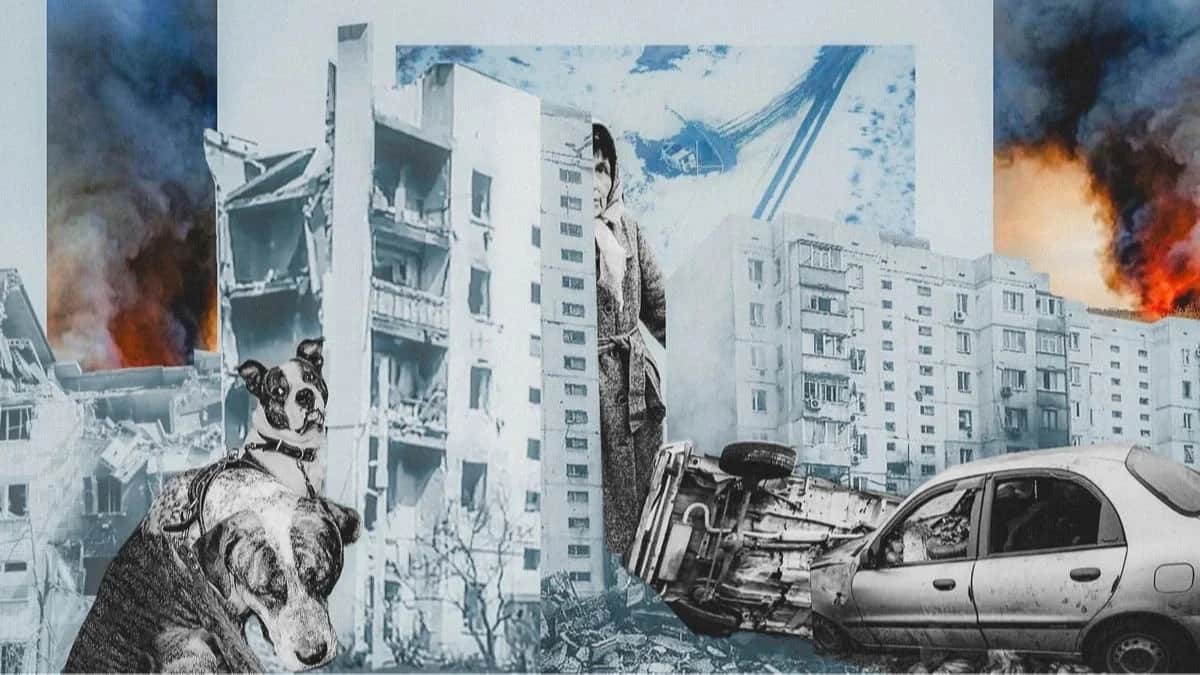

Located directly opposite the city of Kherson, on the eastern bank of the Dnipro River, the Ukrainian town of Oleshky has been under Russian occupation since late February 2022. Following the destruction of the Kakhovka dam in June 2023, Oleshky experienced devastating floods. Now, its remaining residents are being pushed to the brink of starvation. In the face of constant shelling, food deliveries and evacuations have ceased, and each day has become a struggle for survival.
‘Deliberate terrorism’
“Entry and exit from the city is closed. Food supplies haven’t been delivered again.”
“The evacuation van’s driver was blown up by a mine; he urgently needs money for surgery. There won’t be any evacuations for now.”
“A man named Volodymyr was killed today. He was around 35 years old. We need contact information for relatives to find out his date of birth for the funeral.”
These messages are from a private group chat for residents of Oleshky.
Before Russia’s full-scale invasion of Ukraine, the town was home to around 25,000 people. According to Tetiana Hasanenko, the exiled head of Oleshky’s military administration, only around 2,000 residents remain, including at least 47 children. “They have no food or medical care, and no way to leave the city,” Hasanenko reported on 20 March. “Right now, every [Ukrainian] official is focused on organising a humanitarian corridor and saving people. However, we are dealing not just with occupiers, but with criminals.”
In early March, Ukrainian Human Rights Commissioner Dmytro Lubinets appealed to his Russian counterpart, Tatyana Moskalkova, and to the International Committee of the Red Cross to open a humanitarian corridor to evacuate civilians and deliver aid to Oleshky, in accordance with the Geneva Conventions.
“The town of Oleshky isn’t living, but rather surviving,” Lubinets later wrote on Telegram.
“There’s a catastrophic shortage of drinking water, no reliable electricity or gas supplies, and limited medical care. People are forced to conserve every sip of water and every crumb of food.”
“There’s a catastrophic shortage of drinking water, no reliable electricity or gas supplies, and limited medical care. People are forced to conserve every sip of water and every crumb of food.”
According to Lubinets, “lethal dangers” on the roads leading to Oleshky have disrupted attempts to deliver food and left drivers dead. “This is not just a humanitarian crisis. This is deliberate terrorism against the civilian population by the Russian Federation,” he said.
Despite hopes that the Red Cross would help negotiate a humanitarian corridor, nothing has changed since Lubinets made his appeal. Evacuations from the city rely on volunteers and expensive “carriers”, and only a few dozen people manage to escape each month, if that. The explosion that killed the van driver mentioned in the group chat took place on 15 April. There have been no evacuations since.
‘People are buried in bags’
Halyna (name changed) lived in Oleshky her entire life, working as a teacher at a local school. Now 65 and retired, she managed to escape the occupied town in March 2026.
Finding a way out of Oleshky was “difficult and expensive”, Halyna said. She began planning to leave last summer, after her seriously ill husband passed away. “I didn’t manage to leave in the fall, and in the winter, in the cold, it was terrifying to set out on a long journey,” she explained. “People left, but they died after running over mines or coming under drone attacks.”
The winter was “terrible”, but Halyna considers herself lucky because she lived in a house with a wood-burning stove. “I haven’t had electricity and gas since the flood in 2023,” she said. “I sawed up everything I could to fuel the stove. Fruit trees, fences, furniture. All my textbooks and favourite books ended up in the fire.”
According to Halyna, local stores shut down immediately after the New Year’s holiday. “The road was blocked, and supplies of food and medicine were cut off,” she recalled. “People traded supplies. My neighbour gave me potatoes, beets, and carrots, and I gave her grains and canned goods.”
When bombings set buildings in the area ablaze, Halyna’s neighbours worked together to put out the fires and save nearby homes. “The blast waves often shattered windows, and shrapnel pierced the roof. My house is all patched up with plywood and plastic,” Halyna said. “During any strong explosion, even far away, it shakes as if hit by an earthquake.”
Locals also struggled to bury the dead. “There are no funeral services or coffins in the city. People are buried in polyethylene bags,” Halyna explained. “My friend cobbled together a coffin for his mother from scraps of boards. He couldn’t bury her in a plastic bag.”
Halyna recounted the story of another friend, who left Oleshky last year with her children, while her husband stayed behind with the family’s dog. “The man apparently suffered a heart attack, and the dog lay down next to him and died too. They were discovered only later, due to the strong smell,” she said.
The body of her friend’s husband was “put in a bag, and buried”, Halyna said. “It’s hard to say how many bodies of people who lived alone are still lying in their homes,” she added.
Halyna finally managed to evacuate to Ukrainian-controlled territory in the spring, with financial help from her children. It cost her 35,000 hryvnias (about 680 euros) — seven times her monthly pension. “It may seem strange, but I didn’t even feel any hatred toward the occupiers. In the constant struggle to survive, all that remained was indifference,” she reflected.
Halyna described some of the Russian troops occupying Oleshky as “boys” with “peach fuzz under their noses”. “We spoke with them, and the soldiers admitted that if they hadn’t gone to war, then they would’ve been shot or thrown in prison,” she said.
“And then there’s the old men in the Russian army, walking with canes. Some warriors they are,” she added, sarcastically.
“Sometimes, the soldiers would take townspeople away somewhere early in the morning, and nothing more would be heard of them,” Halyna said. “That’s why, if people did gather in a crowd somewhere — for example, in a line for food — they mostly talked about the weather and animals. No one could tell who was standing next to them: an [informant] or a trustworthy person.”
‘We have nothing to eat’
Kseniia Arkhypova fled Oleshky during the first year of the full-scale war. She now lives in nearby Mykolaiv and works as a volunteer, organising evacuations from the occupied territories. She sometimes manages to arrange deliveries of food and animal feed. But Kseniia barely sleeps; people message her around the clock saying, “We have nothing to eat, nothing to feed the dogs and cats.”
According to the volunteer, Oleshky residents have begun searching abandoned houses for canned food. Ever since the 2023 floods, there has been no electricity or gas, and almost no running water, except for in a few private homes with deep-well pumps. Dogs eat cats, and animals scavenge for human corpses in the streets. Residents who live near the river sometimes catch pheasants, but no one has eaten fish in years: civilians have been banned from accessing the water since the occupation began.
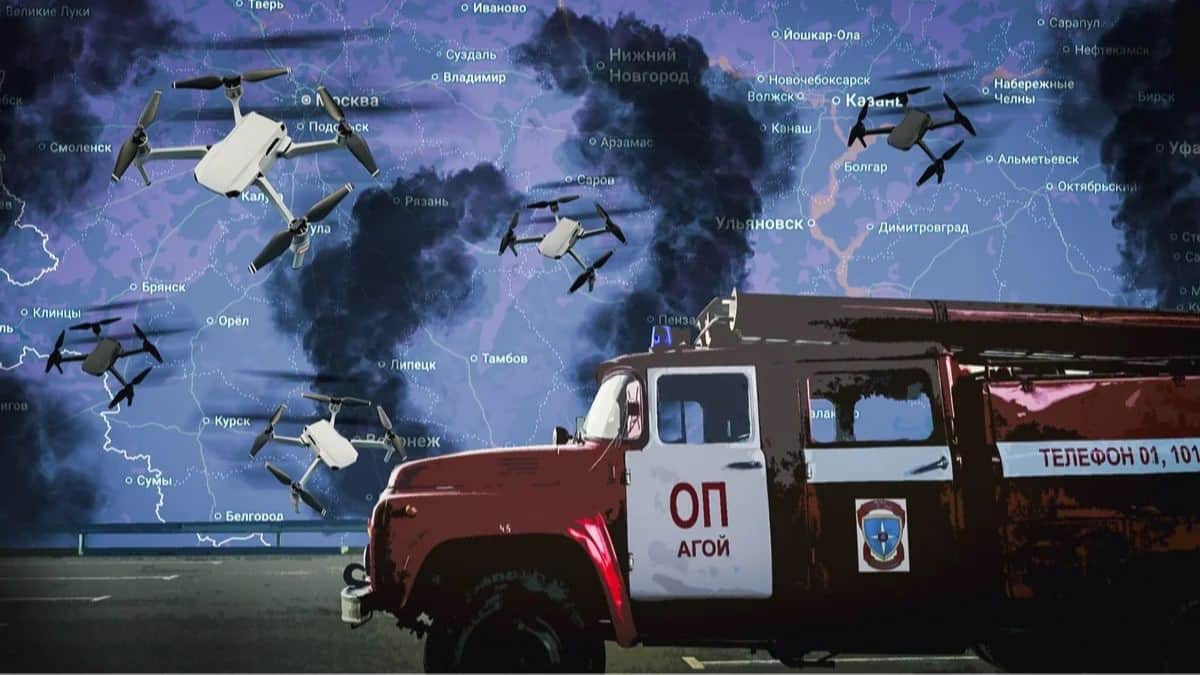
Kseniia recalled that on 10 February, three vehicles carrying food, medicine, gasoline, and pension cheques to Oleshky came under attack on the road near the village of Kardashynka. According to the local Telegram channel Kherson: Non Fake, one of the vehicles was hit by a drone strike, and a second was overturned. The third was later found not far from the scene; it had been looted, and the driver had been killed.
Video footage later showed the lifeless body of the driver of the first car lying among scattered loaves of bread.
“The same thing happened two weeks earlier: a drone dropped explosives on an ambulance carrying pension cheques for Oleshky residents who had taken Russian passports — three million rubles worth [€34,000],” Kseniia said. “The money disappeared, and the bodies of the dead were still lying on the side of the road.”
According to Kherson: Non Fake, the attack Kesniia described took place on 25 January. Together with a security guard and a nurse, the ambulance driver (whose name is known to Novaya Gazeta Europe) was transporting food, pension cheques, and diesel fuel for generators from Skadovsk to Oleshky. The same channel later reported that all three may have been killed with automatic weapons.
Pension cheques are no longer delivered to Oleshky or the nearby town of Hola Prystan. To collect their pensions, elderly residents must travel 90 kilometres south to Skadovsk, along a road that only ambulances can navigate. The ambulances usually travel in pairs, carrying the seriously ill and wounded to Skadovsk and bringing back diesel fuel for the Oleshky hospital’s generators, and food for the medical staff and patients.
The stores remain closed because there’s nothing to sell. Townspeople who still have cars can’t navigate the “road of death” on their own, but they can follow the ambulances to escape the danger zone.
In early April, 14-year-old Stepan (last name withheld) was taken to the hospital in Skadovsk after stepping on a “petal” mine. The shrapnel cut his face and seriously injured his shoulder and legs. Neither he nor his older brother, 15-year-old Ivan, has identification papers. The boys were living with their elderly grandmother. Their mother abandoned them before the war, and their father was killed a year ago (he accidentally drove his bike over a landmine). Ivan managed to earn a little money for food by working odd jobs and cleaning the local cemetery — one of the most dangerous places in town. Since their grandmother is not the children’s legal guardian, Kseniia is trying to arrange for them to be placed with a friend of hers in Crimea, who might be able to get them papers.
“Volunteers usually only evacuate people from Skadovsk, and only if they have a Russian passport,” Kseniia explained. Those who don’t have Russian documents need to be evacuated via a secret route at considerable expense, she added. “Since the carrier is also risking their life.” (Other sources from Oleshky corroborated the information Kseniia shared with Novaya Gazeta Europe.)
Fleeing on foot
The humanitarian crisis in Oleshky didn’t happen suddenly. It’s the cumulative result of four years of occupation and the lasting consequences of the 2023 floods. Now, the town is facing a total blockade. And the remaining residents are mostly elderly people — those with nowhere else to go, or who clung to the hope that “everything would work out”.
Still, the Kremlin-installed governor of the Kherson region, Vladimir Saldo, maintains that there is no humanitarian disaster unfolding in Oleshky. “Let me be frank: there are objective difficulties with deliveries of food and other necessities to frontline settlements, including Aleshky,” he wrote on Telegram in late March, using the town’s Russian toponym. “The reason is constant enemy attacks.”
Saldo blamed Ukrainian forces for striking delivery vehicles with drones and mining transport routes. “In such conditions, every trip is a risk,” he said. “Against this backdrop, deceitful Kiev propaganda is spreading a story about a ‘humanitarian catastrophe’ and shifting the blame to Russia. In fact, the delivery of food and essential goods to Aleshky continues,” he added.
Meanwhile, hunger is driving residents to flee Oleshky on foot. According to Novaya Gazeta Europe’s sources, three retirees in their seventies walked 30 kilometres to Hola Prystan in late March. They left early in the morning and prayed the entire way, walking down the middle of the road to avoid stepping on mines. Though they had no cover from drones, luckily, they weren’t attacked. They reached Hola Prystan in the evening and spent the night there. The next morning, they were driven to Skadovsk, where they continued their journey with the help of Ukrainian volunteers.
According to Tetiana Hasanenko, the exiled head of Oleshky, at least five settlements in the surrounding municipality have been “wiped off the face of the earth”.
Kseniia Arkhypova reported that the last two families living in Pidlisne, a village near Oleshky, left in April. “There are no residents left in Pidlisne, the village itself no longer exists,” she said. “Not a single vehicle will risk entering this territory, which is closely guarded by Russian troops. Even stopping near this settlement is dangerous — they might shoot.”
According to Arkhypova, a young mother with two children walked 24 kilometres to Hola Prystan, and an elderly couple travelled eight kilometres on foot to Oleshky. “They hope there will be an evacuation,” Kseniia explained.
The International Committee of the Red Cross has not responded to the appeal from Ukraine’s human rights commissioner, despite its obligations under the Geneva Conventions to monitor compliance with humanitarian law in the occupied territories.
For now, the “deliberate terrorism” Lubinets described continues. People in Oleshky are surviving — not living. Sip by sip, crumb by crumb, under the hum of drones and the fear that their next step will be their last.
Apart from Vladimir Saldo, no other Russian official has spoken publicly about the situation in Oleshky.