Even before Russian Foreign Minister Sergey Lavrov issued fresh threats against Kyiv over now largely rubbished claims of an attempted Ukrainian drone strike on Vladimir Putin’s Valdai residence, it was obvious that the Kremlin would ring in the new year by launching its now customary volley of drones and missiles at its neighbour.
Admittedly, the air raid warning that sounded at 10:41pm on New Year’s Eve was short-lived and the incoming drones were shot down. The second pleasant surprise was that, as the damage sustained in earlier Russian airstrikes was repaired, we had an uninterrupted power supply until morning.
Though Kyiv was spared, waves of drones still hit Odesa and Zaporizhzhia and even the western region of Volyn, with the bloody and pointless attacks continuing on New Year’s Day, when one airstrike on an eco-park near Ukraine’s second city Kharkiv injured both a volunteer and a lion, while almost all the park’s birds were killed when a Russian shell hit the aviary.

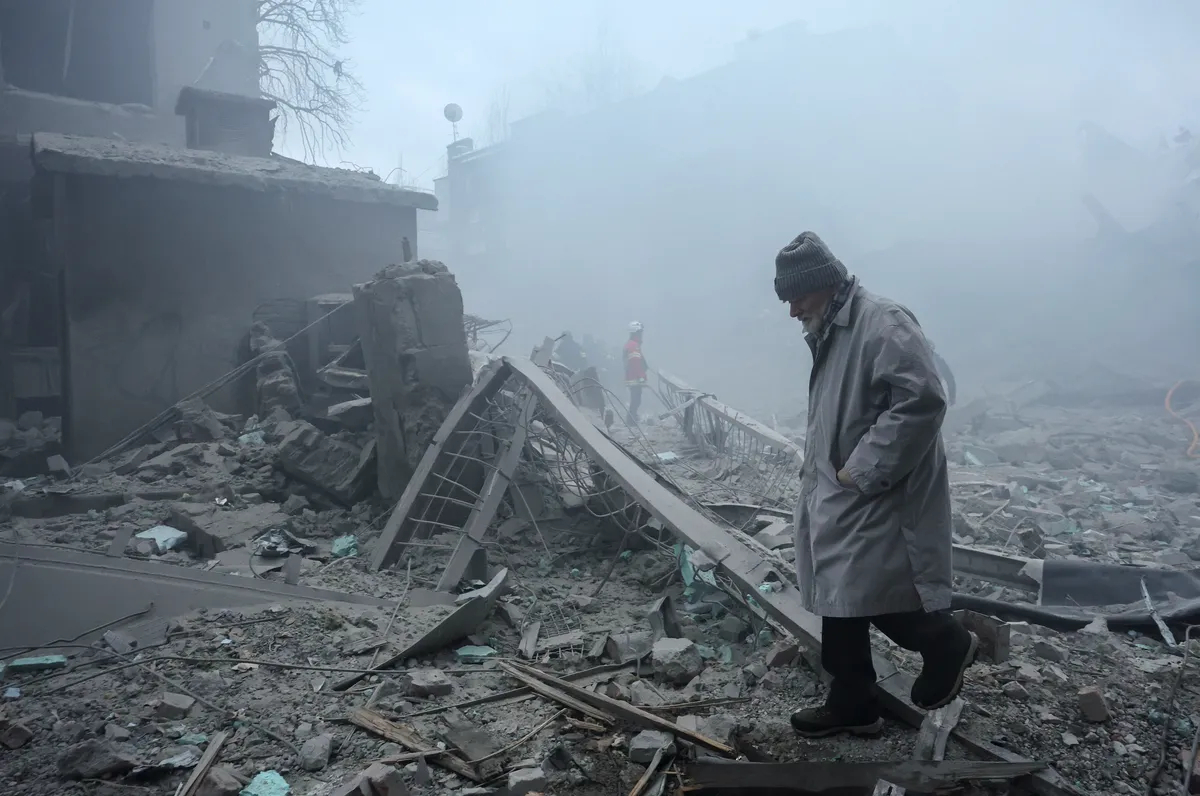
A man walks through the rubble after a Russian strike on a residential area in Kharkiv, northeastern Ukraine, 2 January 2026. Photo: EPA / Sergey Kozlov
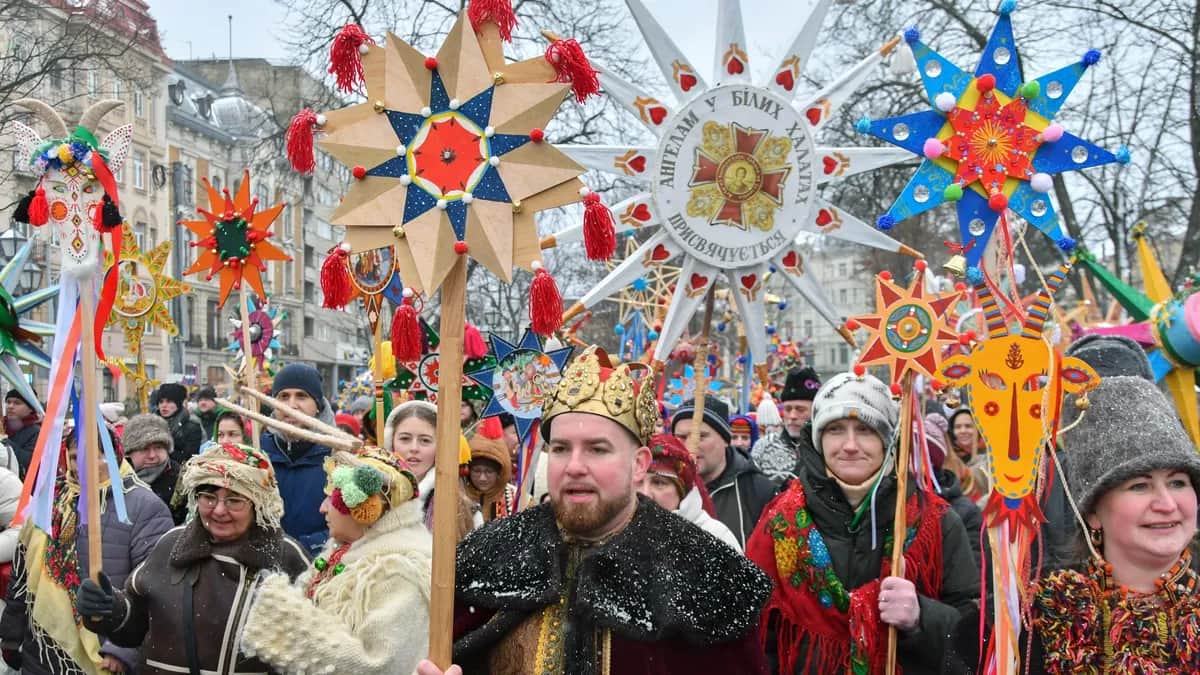
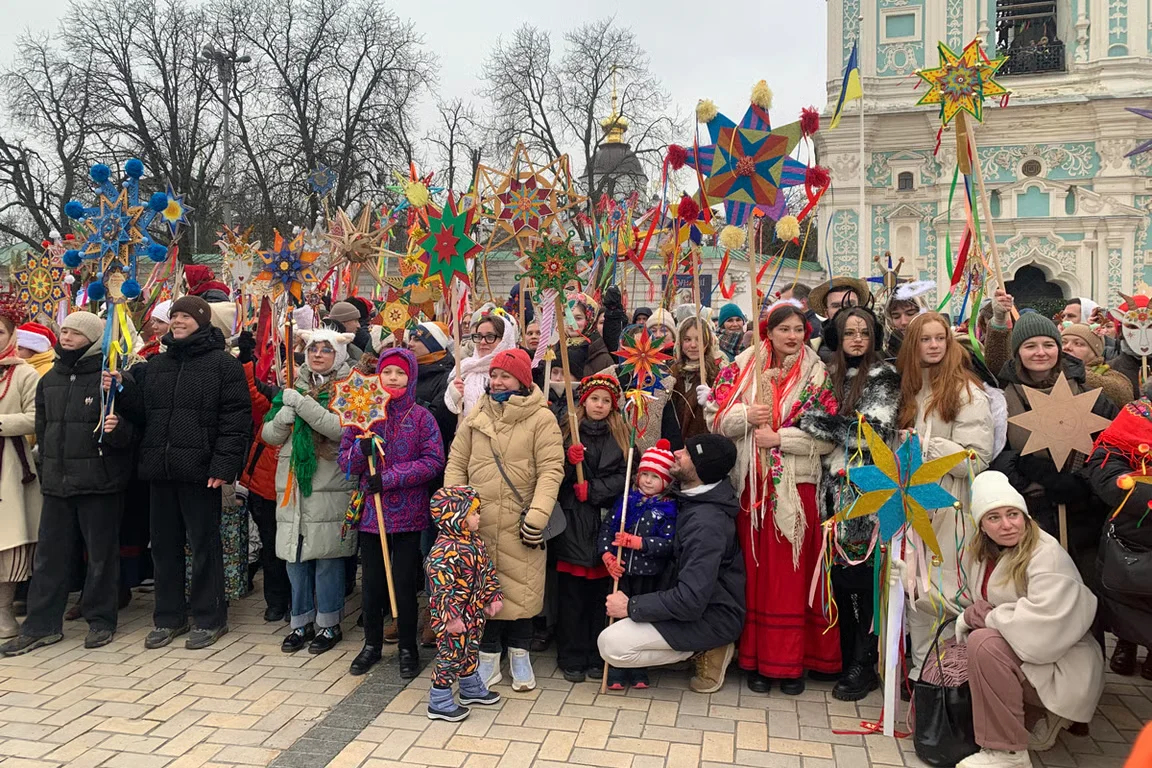
For the first time ever, Kyiv marked this Christmas with a parade. Responding to a call-out, folk groups turned out in impressive numbers, as did ordinary Kyivans donning national costume. At noon, they streamed onto St. Michael’s Square, ignoring the cold and looking incredible.
At midday, the air raid siren sounded, of course — after all, the Russian army going in for a kill on Christmas Day is nothing new — and the square promptly emptied out as people headed to the nearby metro station to take shelter until the all-clear was given.
Though supermarkets went all out on nativity paraphernalia this year, the number of home-made decorations was amazing to behold. Carols gave way to the national anthem and a minute of silence at the Independence Monument, next to flags honouring fallen soldiers, an organic memorial right in the heart of the capital.

Ukrainians celebrate Christmas on St. Michael’s Square in Kyiv, Ukraine, 25 December 2025. Photo: Olga Musafirova / Novaya Gazeta Europe
In the Kyiv region town of Bucha, now a sad byword for torture and mass execution thanks to its Russian occupiers, residents also took to the streets to parade that day, as they did in dozens other cities across the country. This was not about “reaffirming sovereignty”, as the first point in the latest peace plan calls it, but rather, on an emotional level at least, a way for Ukrainians to reaffirm their commitment to their national identity and their statehood, whether consciously or not.
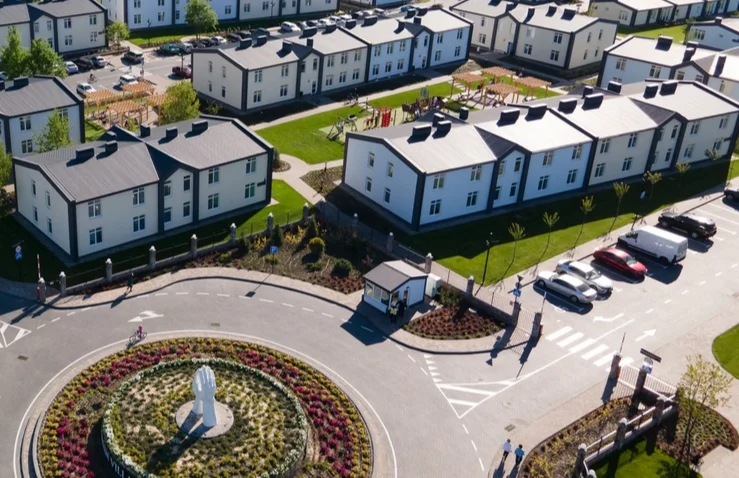
On one of the days between Christmas and New Year, I travelled to the village of Tarasivka, just outside Kyiv. The rural landscape ended as my car turned left into Hansen Village, a new planned community with streets of brightly painted one- and two-storey terraced houses with yards, surrounded by shrubs, trees and barbecue areas which wouldn’t look out of place in Denmark.
Dell Loy Hansen, an American millionaire, philanthropist and, some say, fan of Ukrainian President Volodymyr Zelensky, first visited the Kyiv region in early 2023, after which his charity set to work building houses for evacuees from frontline areas who had lost their homes in the fighting. The idea behind the new settlement was to offer internally displaced people a community rather than just a roof over their heads.

Hansen Village, in Ukraine’s Kyiv region. Photo: hum.giving
A fifth round of new buildings was unveiled in December: an apartment building for 16 families, a hostel for the elderly and vulnerable, and a shelter for women who had returned from Russian captivity.
The project has scaled up and now has over 900 houses for the town’s 4,000 people, as well as a school, a kindergarten, a hospital, a sports complex and an IT academy. It also has 12 shelters which double as public spaces. It would be the occupiers’ wet dream to bomb such American-style houses boasting heated floors, air conditioning and in-built household appliances at New Year. How dare those Ukrainians live such nice lives!
Nearly all of Zelensky’s New Year address, which the Ukrainian commentariat had scrutinised and analysed to death by the following morning, concerned what kind of security guarantees Ukraine could expect from its allies after over 1,400 days of full-scale war.
No more Budapest memorandums or Minsk agreements or anything else not worth the paper it’s written on. “Russia doesn’t end wars of its own accord. There is no war in history that they would have ended willingly,” Zelensky said, adding that “only pressure and coercion, which they would then call a ‘goodwill gesture’,” could get the country to bring a military conflict to an end.

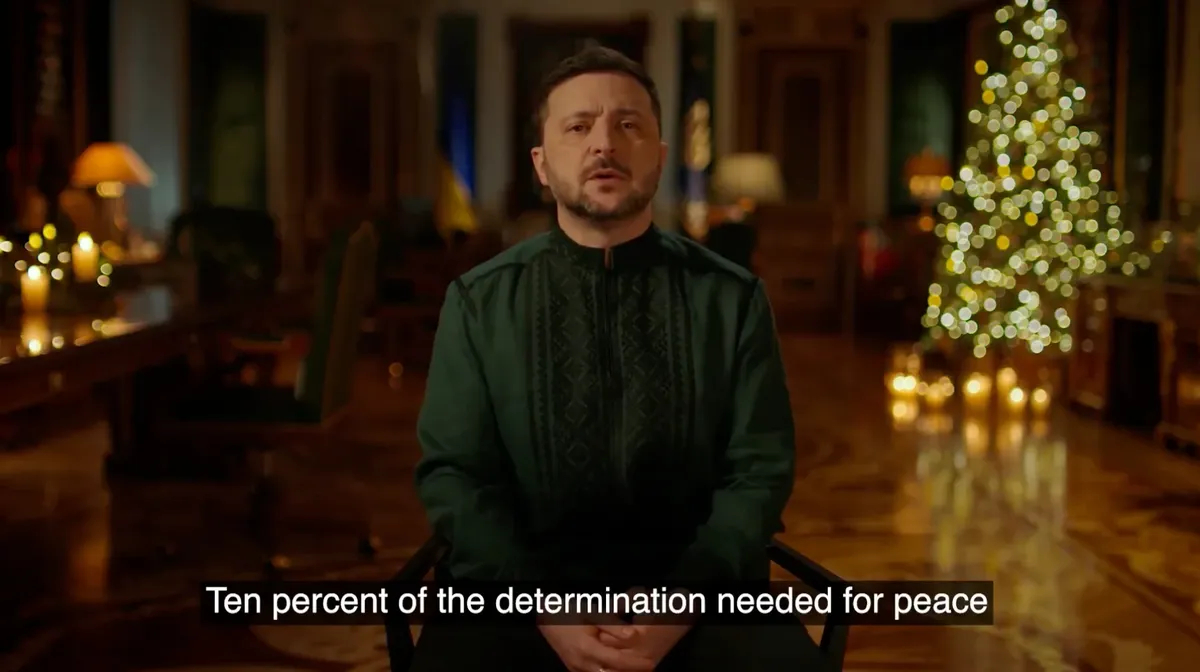
Ukrainian President Volodymyr Zelensky makes his New Year address, 31 December 2025.
After Putin’s shortest New Year’s speech since the start of the war, full of hope for further aggression and victory over Ukraine, and The Wall Street Journal writing that the US National Security Agency and the CIA had concluded that Kyiv didn’t attack Putin’s residence in Valdai after all — in other words, the Kremlin lied — Zelensky now has the best cards in his hand again, to be Trumpian about it.
Zelensky’s speech recalled his seven meetings with Trump in 2025, and he thanked him for them. We just need 10% more Ukrainian, American, European unity and wisdom for peace, he said. Almost like this New Year’s address was not so much for the Ukrainian people as it was for Trump himself.