‘A kind of schizophrenia’
How Russia’s parties have been campaigning for this weekend’s elections when all the real issues are off-limits

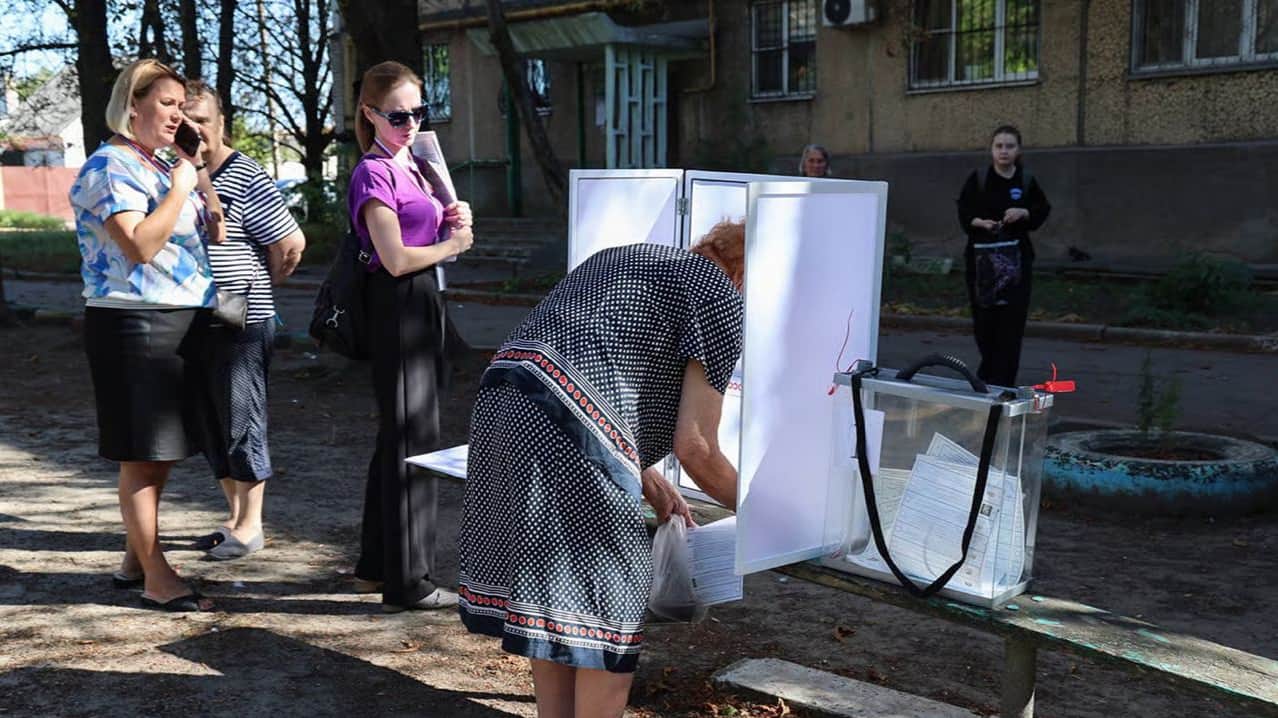
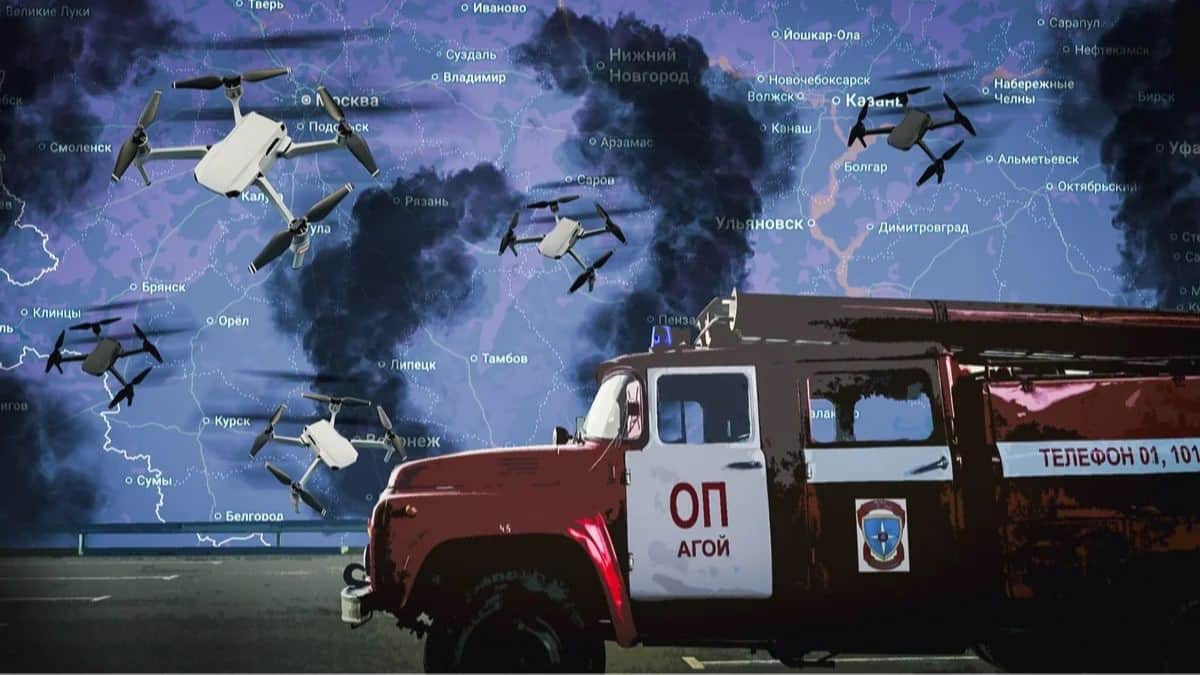
Because it’s effectively illegal in Russia to question the war in Ukraine — or indeed the Kremlin’s broader course — candidates running in the country’s upcoming elections are left with little to discuss. Still, with hundreds of seats formally up for grabs this weekend, the show must go on: authorities have held televised debates and parties have mounted elaborate campaigns to give the appearance of competition. The result is debates without debate (and sometimes without debaters), and meaningless fights between AI-generated mascots. Novaya Gazeta Europe looks at how campaign strategists are struggling to inject some life into an election seemingly designed to attract as little attention as possible and pass by unnoticed.
Debate without debates
Russia’s 2026 election campaign has, on the whole, been a listless affair that’s drawn little public attention. The loudest moments so far have been the anti-war Yabloko party’s “For Peace and Freedom” campaign and the social media wave it triggered, along with a string of high-profile disqualifications: those of Yabloko (from the State Duma elections) and the Communist Party’s most popular figure, Nikolay Bondarenko, who briefly even out-trended Vladimir Putin in online mentions.
Observers now say the campaign has settled back into its usual “depressive” state, with public interest fading once again.
Vadim Ternovoy, an electoral analyst with the independent group Atlas of Elections, told Novaya Europe that campaigning now exists in two parallel registers — television and Internet — so different from each other that it borders on “a kind of schizophrenia”.
On TV, Ternovoy says, the campaign is barely visible at all, and differences between parties are almost nonexistent: channels are working in a coordinated way to project an image of political unity behind the invasion of Ukraine and the Kremlin’s overall foreign policy course. In late July, for instance, channels aired closing addresses from party leaders marking the end of the eighth State Duma convocation — all nearly identical, built around state sovereignty, social unity and support for soldiers fighting in Ukraine.
“We looked at the broadcast data for the most recent week we’ve tallied, and it’s just dismal. The 2026 campaign is getting far less airtime from federal channels than the 2021 campaign did, and that one wasn’t exactly a spectacle either,” Ternovoy said.
Election law requires broadcasters to devote at least half their airtime to party campaigning and debates. This year, the debates that resulted from this policy were bizarre, to say the least.
Perhaps the most memorable were the debates in Ryazan, which not a single candidate bothered to show up for. But even debaters who did turn up often had nothing to say, delivering a few rehearsed lines and then sitting in silence for the rest of their allotted airtime. That’s what happened with Alexey Chernov of the Direct Democracy Party, who ran out of things to say after a couple of sentences about state support for large families, and with Ruslan Khugayev, who chose to spend his allotted minute in silence “in memory of the heroes of the special military operation”.
Oleg Likhachyov, also from the Direct Democracy party, opted to sing an original composition instead of engaging in political debate, with lyrics urging an oligarch to share his wealth with pensioners. On the same broadcast, he also performed the Russian communists’ anthem and a song about World War II veterans.
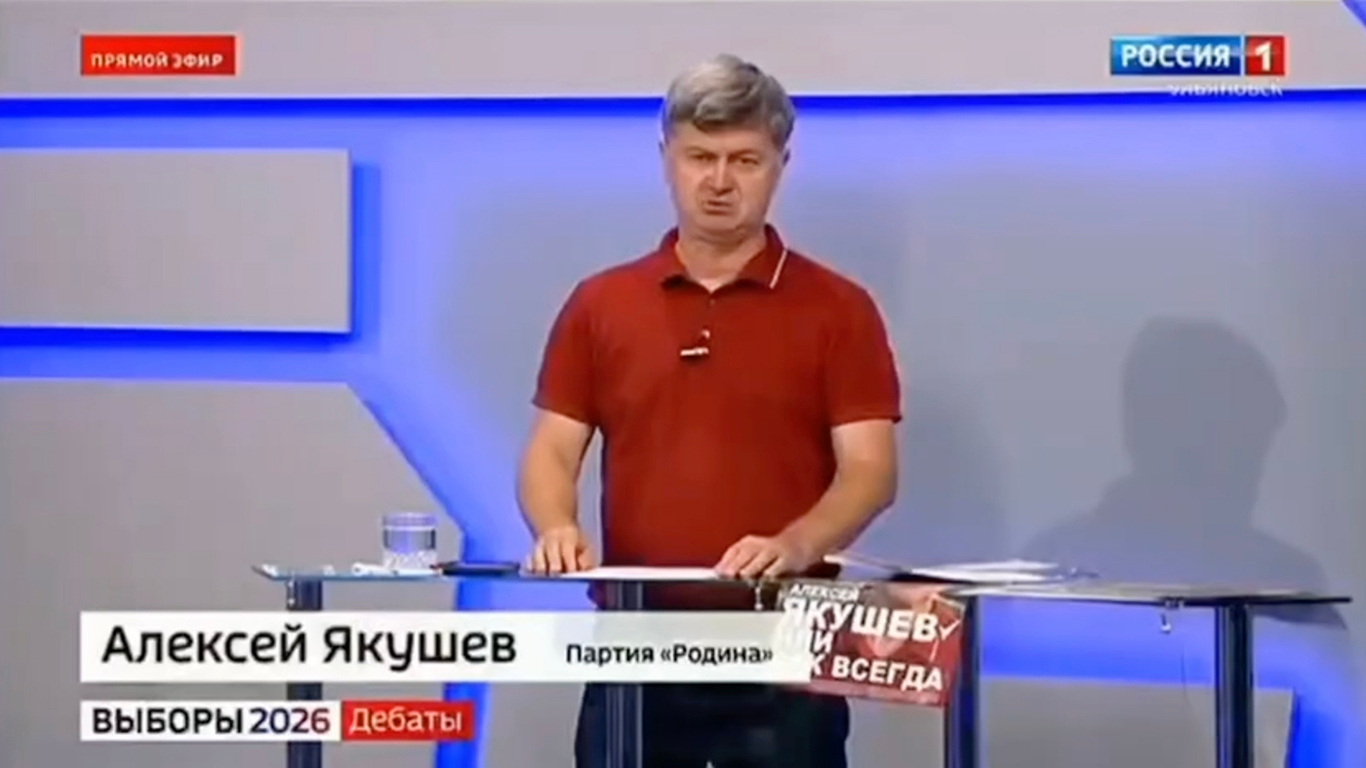
Against a backdrop like that, a speech by the Rodina party’s State Duma candidate Alexey Yakushev looked almost like a genuine cry from the heart. On 7 September, the farmer from Dimitrovgrad took part in regional debates on Rossiya 1 in Ulyanovsk against a candidate from the party A Just Russia.
He opened by warning that he would read from notes periodically “so as not to swear”, but he proved unable to hold back for long. In an uncensored tirade, Yakushev tore into officials and his political rivals, complaining about bureaucratic pressure on farmers, low grain prices, the closure of rural hospitals and schools, fines, and what he called totalitarian oversight. Pro-government Telegram channels dubbed him the “thug candidate”.
There were also a handful of genuinely sharp performances from Communist Party (KPRF) candidates too. Buryatian deputy Bair Tsyrenov ran on the slogan “When will the war end?” and at one point challenged his United Russia opponent to talk things out “man to man” — prompting broadcasters to cut away from the debate. Saratov communist Nikolay Bondarenko spoke bluntly about poverty and household debt, and the state of healthcare and education. His United Russia opponent, Pyotr Tolstoy, countered that Russia has held different priorities “since the time of [14th century spiritual leader] Sergius of Radonezh” and that its people have no room for “mercantile individualism”. Bondarenko was removed from the ballot shortly after that debate.
Ternovoy notes that skipping debates altogether is actually an old problem in Russian elections. “A good number of election ‘participants’ are simply going through the motions, or running as spoiler candidates with no interest in drawing too much attention,” he explains. “That fits with the presidential administration’s directive to keep turnout low.”
How AI and memes conquered Russia’s campaign season
Campaigning on social media as well as on Russian streets has told a different story, Ternovoy says. There, parties have barely mentioned the war at all, even in a positive light, focusing instead on issues like education, youth policy, the economy, and healthcare.
The KPRF’s online messaging has been fairly combative, according to Ternovoy. The right-wing Liberal Democratic Party of Russia has also shifted toward social issues, pushing its traditional nationalist themes into the background. The New People party has leaned into deregulation and small-business support, consumer rights, and civil rights more broadly, especially around domestic violence. A Just Russia, meanwhile, has in recent weeks been pushing anti-migrant rhetoric harder than any other party, apparently hoping it will help clear the 5% threshold to enter parliament.
Online, parties have also tried their hand at viral campaigning to court younger voters, producing what is essentially AI slop.
Space for the use of AI in campaigning narrowed considerably in May, when Vladimir Putin signed a law banning the use of AI-generated images and voices of real people in campaign materials, including fictional characters and the dead. This clipped the wings of the LDPR and the KPRF, both of which frequently relied on the images of the late populist lawmaker Vladimir Zhirinovsky and Vladimir Lenin, respectively. So campaign strategists turned to animals instead.
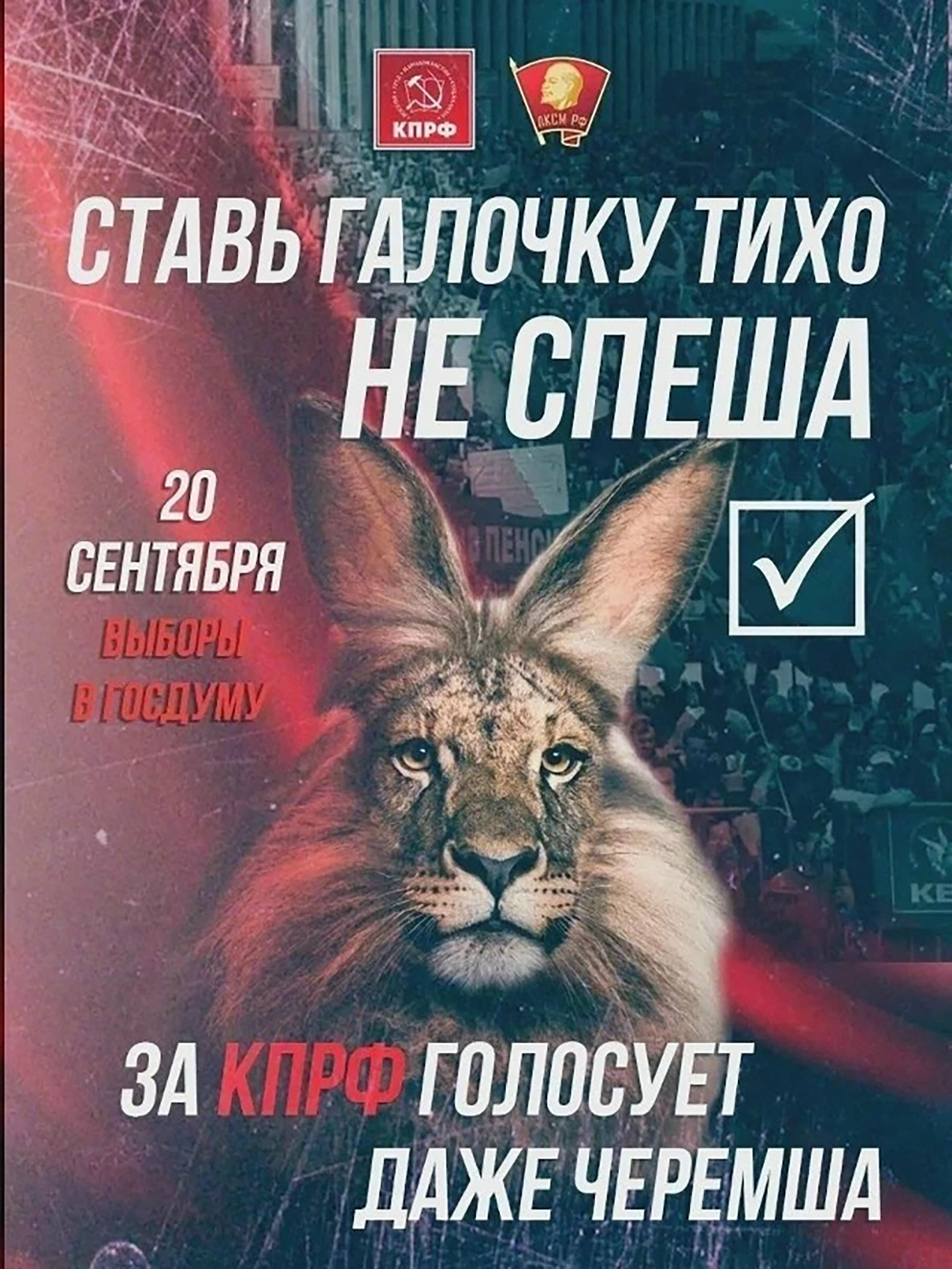
The undisputed frontrunner is Cheremsha, a half-hare, half-lion AI-slop creature that’s been appropriated by Russia’s Communists. State Duma deputy Sergey Obukhov, for instance, complained at a press briefing that other parties were blocking KPRF initiatives “quietly, unhurriedly, without any fuss” — echoing, almost word-for-word, TikTok videos about Cheremsha. (In the TikToks, the phrase is used to parody descriptions of life in the USSR. It rhymes, in Russian, with the name “Cheremsha”, which is why the creature became a mainstay of memes with the phrase.)
The Communists also created a cartoon AI influencer named Arisha, promoted by party leader Gennady Zyuganov himself. Her speciality is engaging young people not with nostalgia but with current issues like internet blackouts or shrinkflation. She hasn’t caught on much, though; at the time of writing, she had just 85 followers.
United Russia countered with its own AI-slop bear, Yermolai. In one of his more memorable clips, he rescues Cheremsha from a sewer manhole, where it was apparently dumped by its KPRF owners, then washes and warms up the frail creature like an older brother. The party has spent 128.8 million rubles (€1.3 million) on campaign materials overall.
The New People party has been more restrained on this front, sticking mostly to AI-generated kittens. It has, however, appropriated another popular internet meme: the phrase “Our elephant”.
“You often write ‘our elephant’ in the comments,” the party announced more than two years ago. “Now the elephant is our official campaign mascot.” Elephants have since become a fixture of its street campaigning; the party even sent a costumed elephant mascot to canvass informal youth in a well-known hangout square in Moscow’s Kitai-Gorod district. The animal carried a sign reading “Hug me if you’re against internet blackouts”.
Notably, the elephant meme owes much of its popularity to Vladislav Pozdnyakov, one of the war’s most vocal supporters and a prominent Russian-language far-right influencer known for organising harassment campaigns and mass denunciations of anti-war Russians still in the country. He uses the term “our elephant” for especially zealous war supporters as well as for people who voice support for the war against their own interests, such as pro-war Europeans. Pozdnyakov is also notably fond of New People and has repeatedly backed the party’s initiatives.
Meanwhile, a video that went viral from New People candidate Yury Kulikov showed him smashing a block of ice, meant to symbolise internet blackouts and censorship, with what looked distinctly like a Wagner-style sledgehammer.
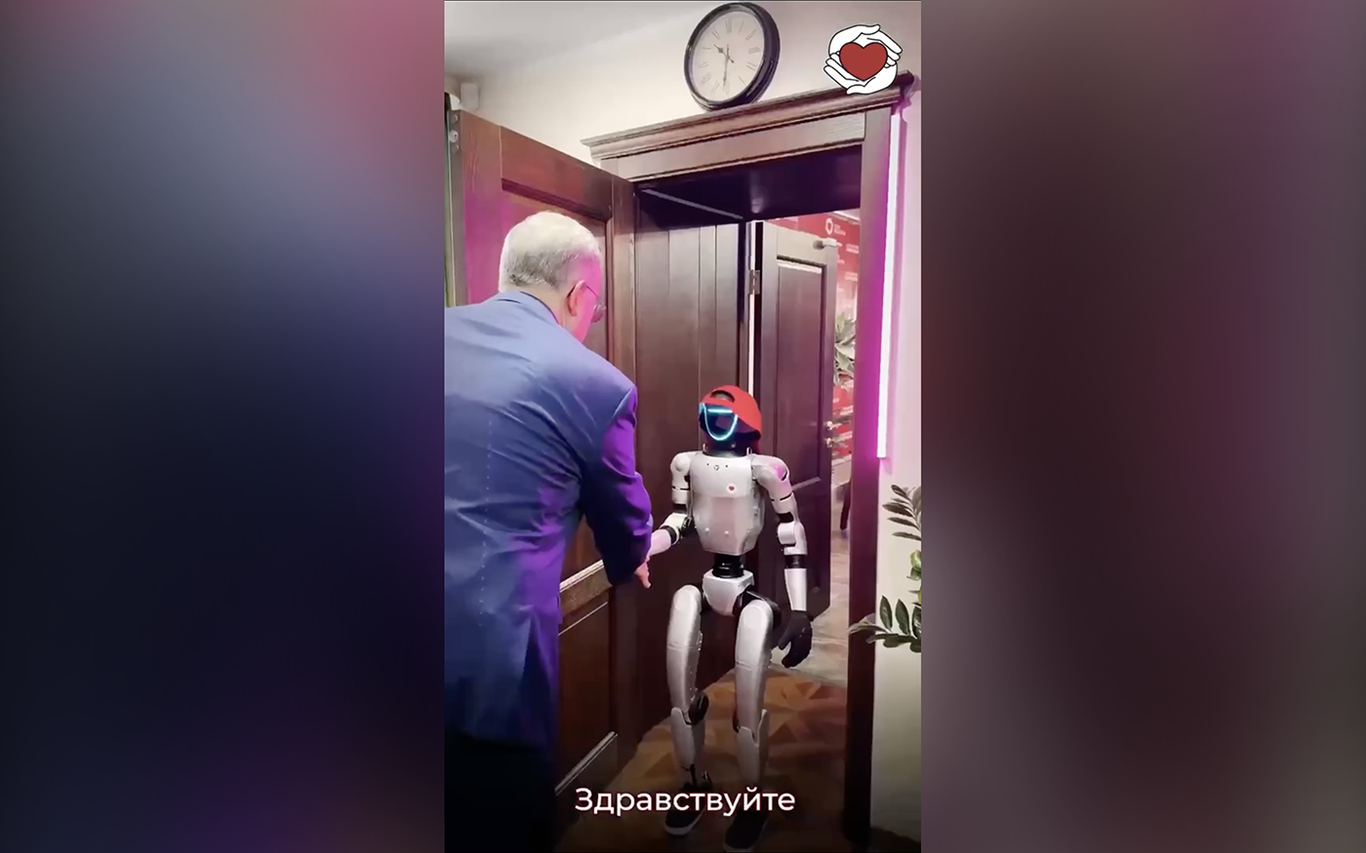
Also surprisingly active in the slop department was the Party of Pensioners, which posted footage of a robot named Ivan Ivanovich that it bills as “the first robot employee in the history of Russian political parties”. According to the party, the automaton helps prepare documents for State Duma candidates. The party also introduced “Granddaughter Varya”, a digital knitted-doll character who appeared in videos about expensive fish, medicine, the St. Petersburg International Economic Forum, and other topics.
At the same time, Ternovoy notes, since the Russian Supreme Court disqualified the Yabloko party over alleged copyright violations, the country’s other parties have reined in their AI experiments considerably.
“Mostly, everyone’s just trying to show they’re not falling behind the times and can do this too,” Ternovoy says. “In substantive terms, I don’t think it’s affected the campaign at all.”
Either way, the analyst concludes, neither the AI mascots nor the strange debates nor the attempts to co-opt memes have generated much genuine interest in the election. As Novaya Gazeta Europe has previously reported, that outcome fits the broader design of the Kremlin’s election architects: the goal is to draw as few random voters to the polls as possible, while maximising turnout among those dependent on the state, ensuring United Russia lands its projected 55–60%.