StoriesSociety

The rise of ‘drone studies’

Russian schools, universities, and kindergartens have spent nearly 16 billion rubles on UAVs since the start of the full-scale war

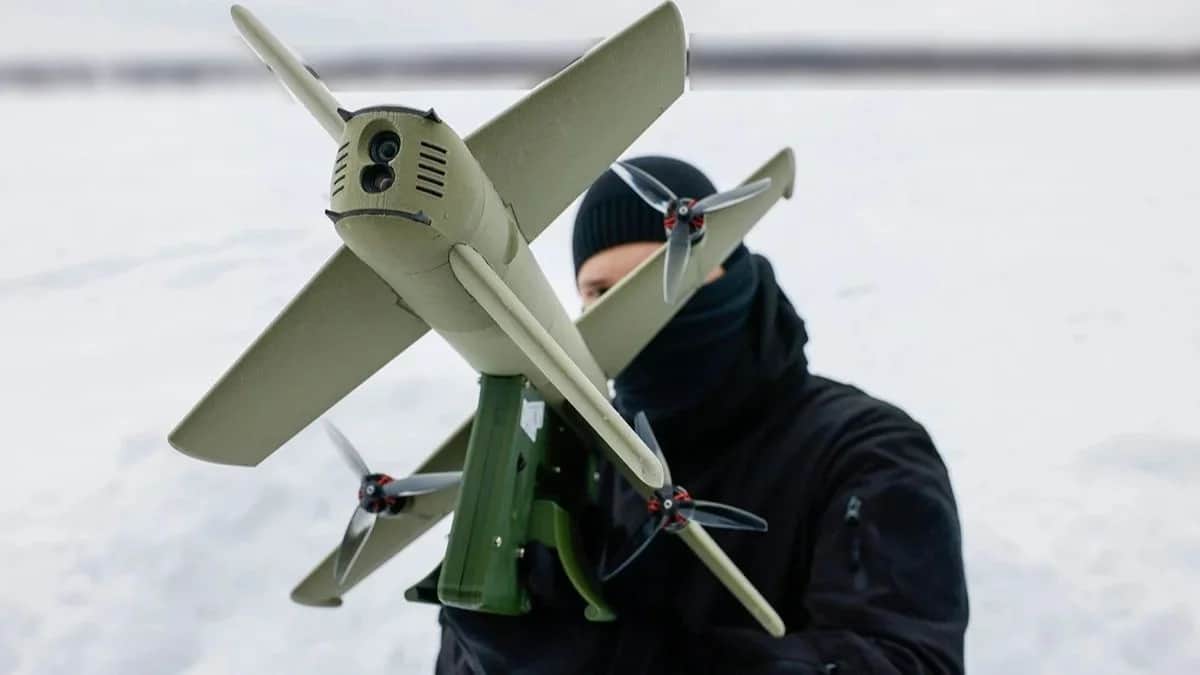
The rise of ‘drone studies’

A demonstration of Russia’s Yolka portable interceptor drone, 3 March 2026. Photo: Yulia Morozova / Moscow Agency

Over the past four years, Russian education institutions have spent nearly 16 billion rubles (€182.6 million) on drones and drone equipment, according to public procurement data. This number, which includes expenditures by schools, colleges and universities, and even kindergartens, is up from about 350 million rubles (€4 million) annually in the years before the full-scale invasion of Ukraine. Novaya Gazeta Europe examines what children are being taught in “drone studies” lessons — and who is profiting from Russia’s militarisation of childhood.

According to statements by Vladimir Putin, 140,000 drones were delivered to the Russian army in 2023, and 10 times as many — 1.4 million — in 2024. Operating such a large fleet demands enormous numbers of personnel: each drone still requires a human controller, and fewer than half of all sorties end in a successful strike, meaning operator skill and experience are critical.

To meet this demand, Russian authorities have turned to young people. Since 2025, educational institutions across the country have been actively recruiting students into unmanned forces — enticing them with high salaries, promising preferential admission, and in some cases deceiving or threatening them into signing contracts. Sources cited by independent news outlet Faridaily report that authorities currently plan to recruit around 44,000 students — roughly 2% of the student population.

But military drone training can begin even earlier than university. The Insider has reported that minors are being drawn into the development of unmanned technologies under the guise of educational clubs.

Students drone using simulators at the Dobro i nebo UAV school in Krasnodar, Russia, 19 March 2026. Photo: IMAGO / SNA / Scanpix / LETA

Students drone using simulators at the Dobro i nebo UAV school in Krasnodar, Russia, 19 March 2026. Photo: IMAGO / SNA / Scanpix / LETA

In the pre-war years of 2019–2021, Russian schools, colleges, and universities spent 300–350 million rubles (€3.42–€4 million) annually on drones and related equipment. By 2022, that figure had doubled to 600 million rubles (€6.84 million). In 2023 it rose to 2.6 billion rubles (€29.65 million), and in 2024 to more than 9.7 billion (€110.6 million). Spending dipped in 2025 — possibly because several multi-year contracts had already been signed — but still reached around 2.8 billion rubles (€31.9 million).

Before the war, drones were purchased mainly by technical colleges and universities. But during wartime, ordinary schools have become major buyers. The two largest contracts of the entire wartime period, totalling nearly 3.5 billion rubles (€39.9 million), were placed by two Moscow state institutions responsible for supplying the city's schools and colleges: the Centre for Technical Equipment and Modernisation of Education, and the Moscow Department of Education and Science. Regional education ministries are also among the largest customers nationwide.

Who supplies them?

Partners of Putin’s daughter Katerina Tikhonova: 2.1 billion rubles (€23.95 million)

The largest supplier of drones to Russian educational institutions is the St. Petersburg firm Geoscan, which has existed in its current form since 2011. Its principal owner is Alexey Semyonov. Until 2022, the company specialised in unmanned aerial photography, cartography, geoinformation systems, 3D modelling, and educational drones, which Geoscan itself positions as training tools for mastering UAV piloting.

After the start of the full-scale war — and especially following the 2024 launch of Unmanned Aerial Systems, a state programme to develop Russia's drone industry — Geoscan became a significant government contractor. The timing is notable: in 2023, shortly before this expansion, the National Intellectual Development Foundation (widely known as Innopraktika) became a shareholder in the company. Putin's daughter Katerina Tikhonova has led the foundation since it was established.
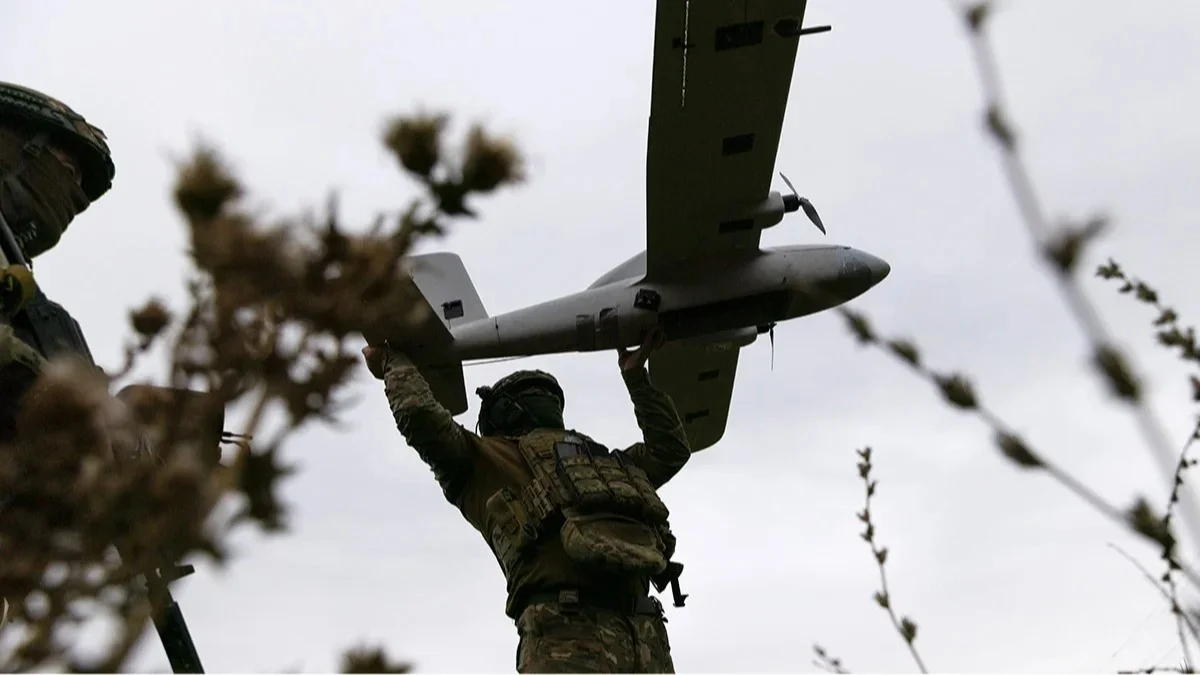
Against this backdrop, the company's finances surged: in 2024, revenue reached 4.74 billion rubles (€54 million) — 54% of it from government contracts — a 3.6-fold increase in a single year. The company’s profit grew sixfold.

Geoscan's largest contract came from the Moscow city government, and it goes beyond drone deliveries. Under the agreement, the company is guaranteed orders through 2030 totalling 1.7 billion rubles (€19.3 million), in exchange for investing at least 150 million rubles (€1.71 million) in UAV production in Moscow, including the construction or modernisation of manufacturing facilities. Beyond that, Geoscan received 52 further contracts from state educational organisations for drone supplies worth over 400 million rubles (€4.5 million). Many additional institutions purchased Geoscan equipment indirectly, through intermediaries.

Katerina Tikhonova, right. Photo: YouTube/ Russia24TV

Katerina Tikhonova, right. Photo: YouTube/ Russia24TV

Partners of Moscow Transport Minister Maxim Liksutov: 1.4 billion rubles

The second-largest supplier of drones to educational institutions is the company MT-Integration. It is already well known to Moscow residents as a major contractor for the city government: in particular, it develops video surveillance systems and transport geolocation systems in Moscow.

MT-Integration is a part of MaximaTelecom group, best known as the operator of the Moscow metro's Wi-Fi network, which has since expanded to commuter trains, airports, surface transport, and the St. Petersburg metro.

At various times, several MaximaTelecom shareholders have been partners or associates of Maxim Liksutov, the long-serving head of Moscow City Hall's Department of Transport. Among them was Alexey Krivoruchko — now Deputy Minister of Defence — who also came to public service from the transport sector.

Deputy Russian Defense Minister Alexey Krivoruchko (centre), 23 August 2020. Photo: Sofya Sandurskaya / Moscow Agency

Deputy Russian Defense Minister Alexey Krivoruchko (centre), 23 August 2020. Photo: Sofya Sandurskaya / Moscow Agency

MT-Integration had no prior involvement in drone supply. But in 2023 it won the largest single tender in this space: 600 UAV training kits for 78 Moscow schools, worth 1.4 billion rubles (€15.9 million), a contract that also included equipment for other robotics classes.

Putin ally Arkady Rotenberg’s Prosveshchenie group: 385 million rubles

The third-largest supplier is Trading House Prosveshchenie-Region, a subsidiary of the Prosveshchenie Group — Russia's dominant producer of school textbooks. The ultimate beneficiary of the company is likely Arkady Rotenberg, a long-time friend of Vladimir Putin. A quarter of Prosveshchenie is owned by Invest Pro, whose owner is a fund managed by FIN-Partner, a company Novaya Gazeta Europe has previously linked to Rotenberg. The remaining shares are held by the state entities VEB, Sberbank, and the Russian Direct Investment Fund.
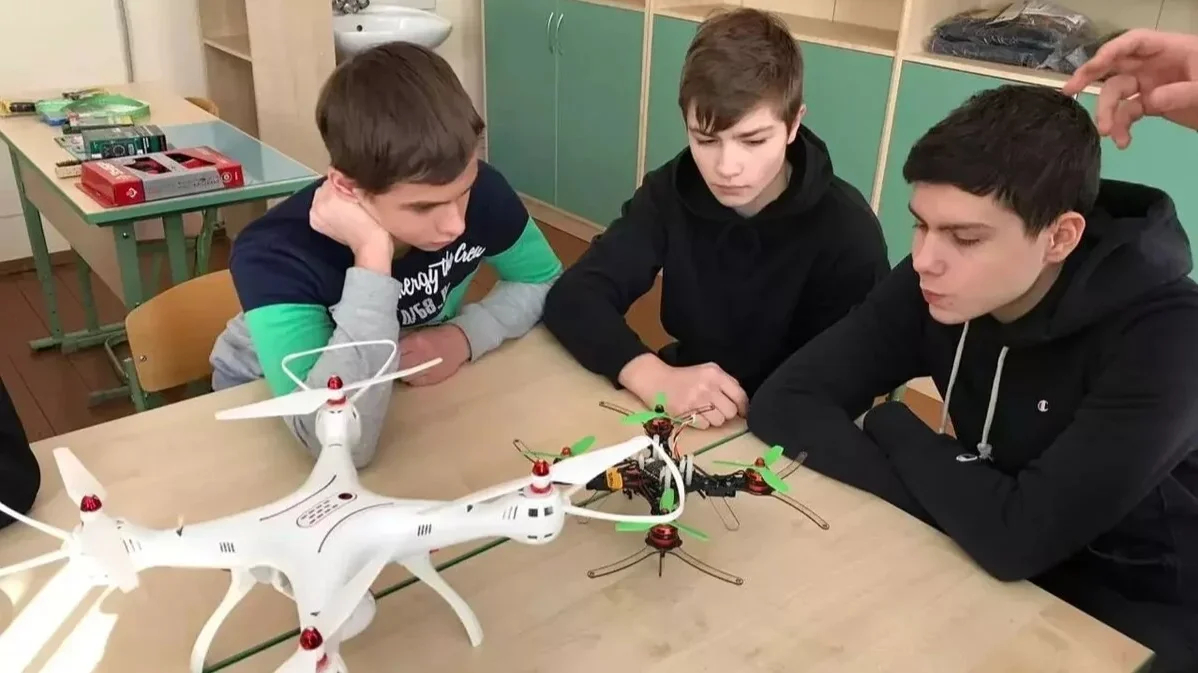
Prosveshchenie-Region earned most from two large contracts: one for 352 training drones and related equipment for the Education Ministry of Mordovia, and another for around 400 drones for the Education Ministry of the Chelyabinsk Region.

In 2024, drone instruction was formally added to Russia’s school curriculum under the subject Labour (Technology), with 15 hours allocated across grades 7, 8, and 9. The programme covers drone assembly, attachment of payload modules, programming, and operation.

Businessman Arkady Rotenberg, Moscow, 12 April 2018. Photo: Kirill Zykov / Moscow Agency

Businessman Arkady Rotenberg, Moscow, 12 April 2018. Photo: Kirill Zykov / Moscow Agency

The first school textbook on unmanned systems for grades 8–9 makes no mention of military applications. It lists drone shows, cargo delivery, fertiliser spraying, and aerial photography as the relevant professional fields, adding only briefly that drones are also used by law enforcement.

In practice, the picture is different. Teachers tasked with introducing schoolchildren to drones receive their own training at the Voin (Warrior) Centre for military and sports training — an organisation whose co-chairman, State Duma deputy Viktor Vodolatsky, has stated that three quarters of its instructors have combat experience in Ukraine. Voin delivers military and patriotic training to children as well as to adults expected to subsequently serve at the front.

The stand for the drone unit “Stalin’s Falcons” at the Festival of UAV Systems at Moscow’s Higher School of Economics, 24 February 2026. Photo: Artur Novosiltsev / Moscow Agency

The stand for the drone unit “Stalin’s Falcons” at the Festival of UAV Systems at Moscow’s Higher School of Economics, 24 February 2026. Photo: Artur Novosiltsev / Moscow Agency

Military content also enters through the compulsory subject OBZR (Fundamentals of Security and Defence of the Motherland), a more militarised successor to the former OBZH (Fundamentals of Life Safety), taught from grades 8 through 11. According to the offiical curriculum, one lesson in grade 10 must be dedicated to drones, with the title: “Unmanned aerial vehicles (UAVs) as an effective means of armed combat (basics of technical training and communications).”

However, defence policy expert Pavel Luzin argues that despite its impressive scale of spending, Russia’s school drone programs are unlikely to have much effect.

“You have a class of 30 students coming in for two hours a week, half of which is spent maintaining discipline, and only the other half can actually be used for instruction,” he told Novaya Europe.
“This federal standard was designed either by complete idiots who have never worked in schools but believe it is feasible, or by quite realistic people who are simulating bureaucratic activity in line with political expediency, allowing schools and regional administrations to imitate busy work. I’m inclined to take the latter view.”

shareprint
Editor in chief — Kirill Martynov. Terms of use. Privacy policy.