InterviewPolitics

The art of war

When 12-year-old Masha Moskalyova drew an anti-war picture at school, her father ended up in prison. Both are now free in France.

The art of war

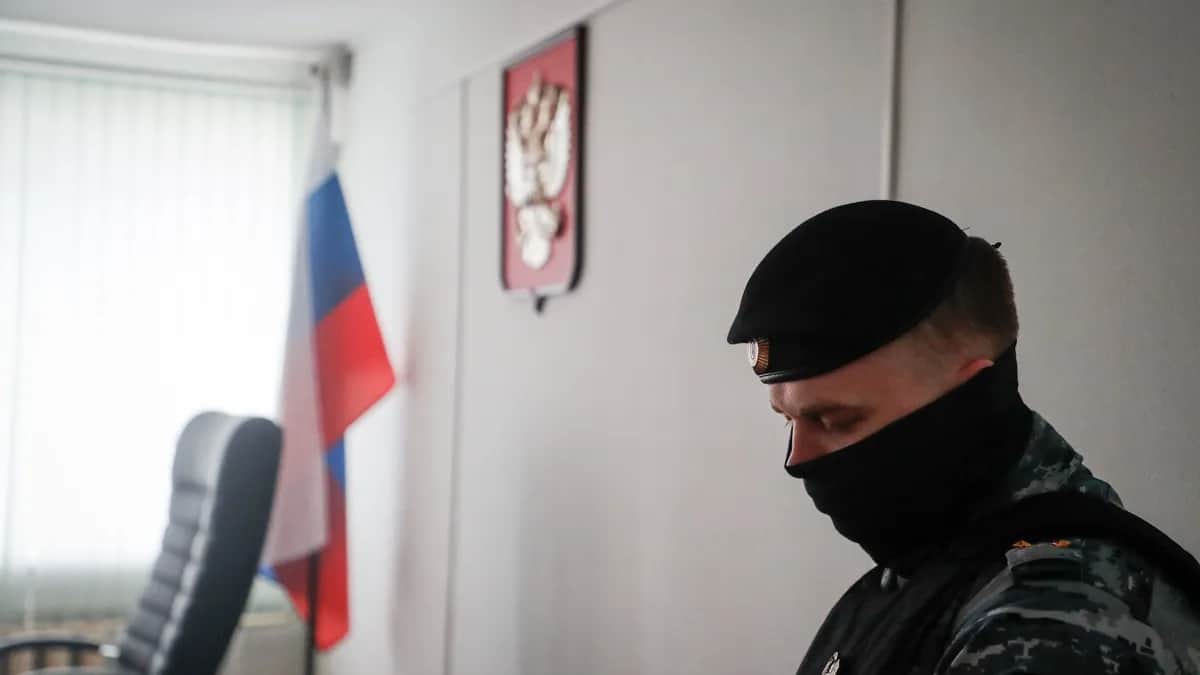
A policeman guards the courtroom during Alexey Mosklayov’s trial for “discrediting the armed forces” in Yefremov, Russia, 6 April 2023. Photo: EPA / MAXIM SHIPENKOV

“I don’t even know who I’m supposed to be meeting,” confesses 16-year-old Masha Moskalyova apologetically as she arrives an hour late for our interview in Paris. With her father in tow, she appears to be in charge of getting the pair to the flurry of media engagements they’ve been doing since they finally reached in France in early March.

Masha is no ordinary 16 year old, it’s safe to say. Aged just 12, she very unexpectedly made headlines in Russia and beyond when the principal of her school in central Russia’s Tula region reported her to the authorities for an “anti-Russian” drawing she did of a woman with a Ukrainian flag defending a little girl from a Russian rocket.

The police investigation that followed ultimately led to her father Alexey Moskalyov, somebody who had already spoken out against the Russian invasion of Ukraine online, being charged with “discrediting the armed forces” and sentenced to two years in a prison colony. Meanwhile Masha was sent to an orphanage, before going to live with her estranged mother until her father was released.

In conversation, Masha quickly eases out of her organisational role and becomes just like any other young person, raving about how much she loves Paris. That she doesn’t much miss her home town of Yefremov is clear, and she tells me that the only thing she remembers about it fondly is her best friend, although even she “isn’t the same person anymore”, she admits. ”She’s grown up and now we have almost nothing in common. She has a completely different vibe.”

Maria Moskalyova. Photo: Yulia Kanyeva / Novaya Gazeta Europe

Maria Moskalyova. Photo: Yulia Kanyeva / Novaya Gazeta Europe

When asked about the fateful drawing she did that changed both their lives forever, Masha sighs and says that she’s “told the story hundreds of times”, before dutifully going on to do so once again. “We had an art class one day at school. The teacher told us to draw something political, even though that was usually forbidden. She said we should draw something to show our support for the troops, the war, and the president.”

“I drew the picture, and then after the lesson one of my classmates, whose father is a policeman, came over to me. She was interested in what I had drawn and started to ask questions. Though she was only 12 at the time, I shouldn’t have been fooled, she was no innocent child."

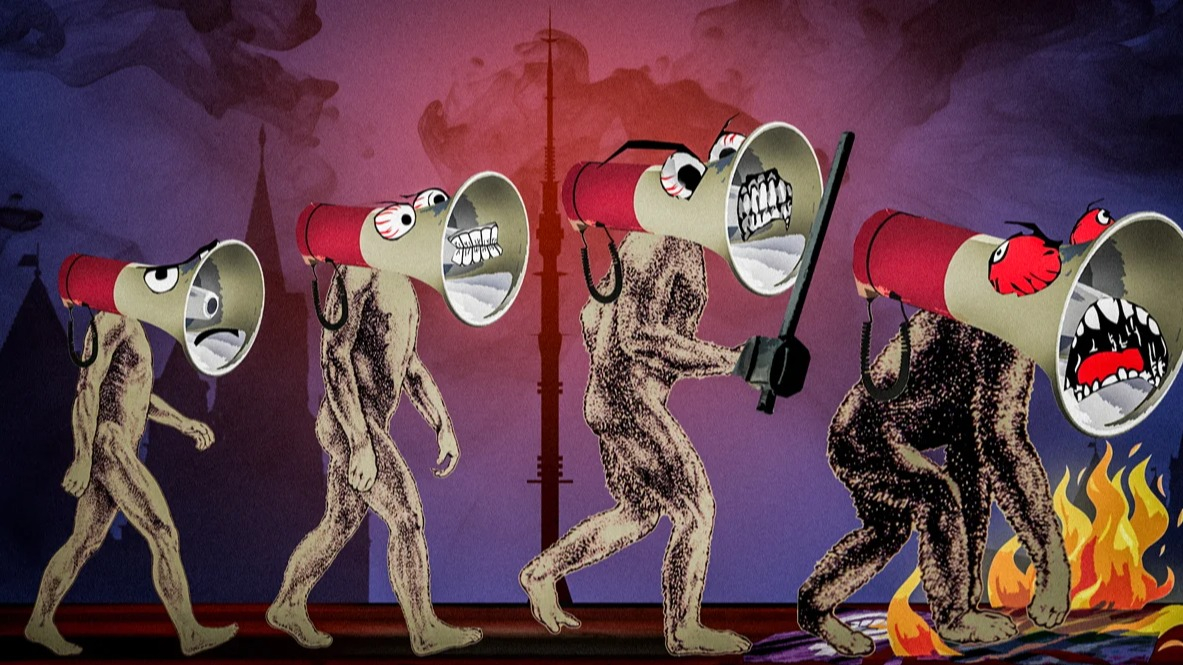
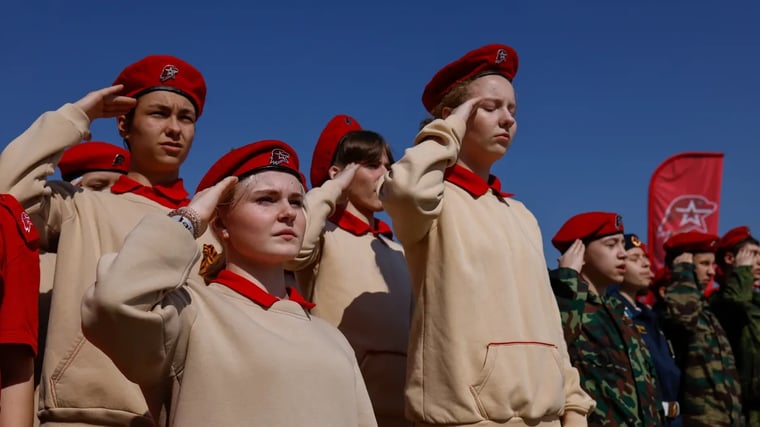
Masha’s classmate first told their teacher about the drawing, then the school principal, and then finally the police, who came to the school two days later. While they questioned Alexey in one room, in another they attempted to convince Masha to join the local pro-war youth movement. She refused.

Masha’s fateful drawing.

Masha’s fateful drawing.

The single father

After their apartment was searched in December 2022, Alexey and Masha moved to the town of Uzlovaya, some 100km from Yefremov, in the naive hope that the authorities would forget about them. However, within a week, Alexey had been detained and placed under house arrest, while Masha was sent to an orphanage. The prosecutors in the case requested the court hand Alexey a three-year sentence for his online criticism of the war.

However, on the day he was due to be sentenced, Aleksey, who had been placed under house arrest rather than in pretrial detention ahead of the court’s verdict, broke his house arrest and fled across the border into neighbouring Belarus. He’d done this with the help of human rights activists who had assured him that they would be able to help Masha leave the country herself in due course.

Even breaking his house arrest would prove to be far more difficult than he had expected, Alexey says. “I was guarded by four cars: special forces, police, traffic police and the FSB. They had surrounded my flat to ensure I didn’t do a runner. I had some binoculars at home, and could see them standing around, smoking, and waiting for me.”

A supporter of the Moskalyov family holds up a paper heart during Alexey’s trial in Yefremov, central Russia, 20 April 2023. Photo: EPA / YURI KOCHETKOV

A supporter of the Moskalyov family holds up a paper heart during Alexey’s trial in Yefremov, central Russia, 20 April 2023. Photo: EPA / YURI KOCHETKOV

“When the pre-arranged time for me to leave my apartment came, it looked like it would be impossible for me to leave undetected,” he says, adding that he waited until 4:30am to call a taxi and then slipped out into the night. “The cars just remained where they were in front of the building. It seemed that I had done it — the officers had apparently fallen asleep. They’re only human, after all.”

After being driven the 320km to Moscow, Alexey was met by human rights activists who helped him to remove his electronic bracelet and bought him a train ticket to the Belarusian capital Minsk, aware that the border between the two countries is not tightly controlled. Rather foolishly, however, Alexey says that he kept his ankle tag as a souvenir, believing that it would only work within the bounds of his apartment.

He was wrong, of course, and the Belarusian security services apprehended him in Minsk the following day and returned him to Russia, where he was placed in a Tula region prison colony.

“They found any number of reasons to punish me; either I didn’t address the guards properly, or I wasn’t holding my hands in the correct way or something else like that. As I understand it, they received a call from the FSB telling them to put pressure on me,” Alexey says.

Masha and Alexey Moskalyov in Paris. Photo: Yulia Kanyeva / Novaya Gazeta Europe

Masha and Alexey Moskalyov in Paris. Photo: Yulia Kanyeva / Novaya Gazeta Europe

“The punishment cell is a tool for breaking someone’s resolve. I didn’t always have a mattress, and I often had to sleep on just the uncovered bed frame, wrapping the thin blanket around my head to protect myself from rat bites. I was worried that they would give me a nasty infection.”

A month later, he was placed in “slightly more comfortable” conditions, although things didn’t improve much. On the second day of his new prison regime, riots broke out when prisoners were prevented from receiving cigarettes. The guards sprayed the inmates in Alexey’s cell with a fire extinguisher before sending in riot police.

“They said that they were going to beat us up for what had happened,” Alexey recalls, adding that one terrified prisoner had even attempted suicide. “He was covered in blood, and they asked us to come out into the corridor. How could we? This poor guy was bleeding out. They shouted: ‘We’ve seen hundreds like him before, we don’t care.’ We stood in the corridor with our arms out in front of us for two hours, but luckily no beating came.”

Family ties

As Alexey speaks, Masha sits nearby scrolling on her phone, clearly having already committed every line of her father’s story to memory. Nevertheless, the obvious closeness between the two also belies tensions elsewhere in the family dynamic, with Alexey and Masha’s mother Olga separating shortly after their daughter was born, something he ascribes to their characters being “rather incompatible”.

“I let her go and live on her own,” Alexey says, while he lived with Masha and her older half-sister Dasha until Dasha went to live with her own mother when she was 10 years old.

Despite having had little contact with her daughter during her formative years, Olga came to collect her from the orphanage where she had been temporarily placed by the authorities following Alexey’s arrest. Though human rights activists had paid off Olga’s debts and provided her with money each month to cover Masha’s expenses, the years in which they hadn’t been close had taken their toll and the pair remained estranged today.
Masha says that staying with her mother long term was never an option: “Where had she been for the past 10 years? It doesn't really bother me — we were never in contact with each other, so there was no point in starting now. We are just very different people.”
Masha was allowed no contact with her father for the first year and a half of his prison sentence. “After hundreds of visits to the prison administration, they finally allowed me to have a telephone card. I will never forget what happened next,” Alexey recalls. “Masha picked up the phone … I asked if she knew who it was, there was a pause, then silence and then I could hear crying on the other end. She was in hysterics, so much so that she cried through all of the minutes I had paid for, despite my attempts to calm her down.”

It was only on the day he was released from prison that Alexey was finally able to hold his daughter in his arms again, and even then he recalls how that fleeting moment of pure joy was swiftly replaced by fears that the authorities would arrest him again. Indeed, the FSB agents had warned him that they wouldn’t forget him once he got out of prison. Soon afterwards, the pair left Russia for Armenia.

Freedom at last

Alexey makes a point of expressing his gratitude to Russian-Israeli businessman Leonid Nevzlin, who supported the pair financially while they were in Armenia and continues to help them out today in France. Having attempted to claim political asylum in Germany, the pair decided late last year to abandon that plan and to apply for a French visa instead, which they received earlier this month.

“I never expected us to make it out of Armenia, as they have an extradition agreement with Russia and I was worried that at any minute the authorities would send us back. We were very lucky to get out when we did,” Alexey says.

Masha’s old school in Yefremov, in central Russia’s Tula region. Photo: EPA / MAXIM SHIPENKOV

Masha’s old school in Yefremov, in central Russia’s Tula region. Photo: EPA / MAXIM SHIPENKOV

Neither father nor daughter ever wants to have to deal with the authorities in Yefremov again, and Masha says that returning to Russia would only be possible for them once there has been a change at the very top, which she doubts will happen anytime soon.

She is referring to the same administrative workers who helped to break the family up and worked with child protective services to restrict Alexey’s parental rights. There are also the building managers who turned off the family’s gas while Alexey was under house arrest.

Though both Alexey and Masha understandably feel great resentment towards the entire administrative apparatus that was used to split them up and to restrict Alexey’s parental rights, Masha says she reserves particular disdain for teachers who denounce their own pupils to the authorities. Such people will always be a staple of life in Russia, she says.

shareprint
Editor in chief — Kirill Martynov. Terms of use. Privacy policy.