Hostile environment
The EU is turning down ever more asylum claims from queer Russians fleeing violence at home

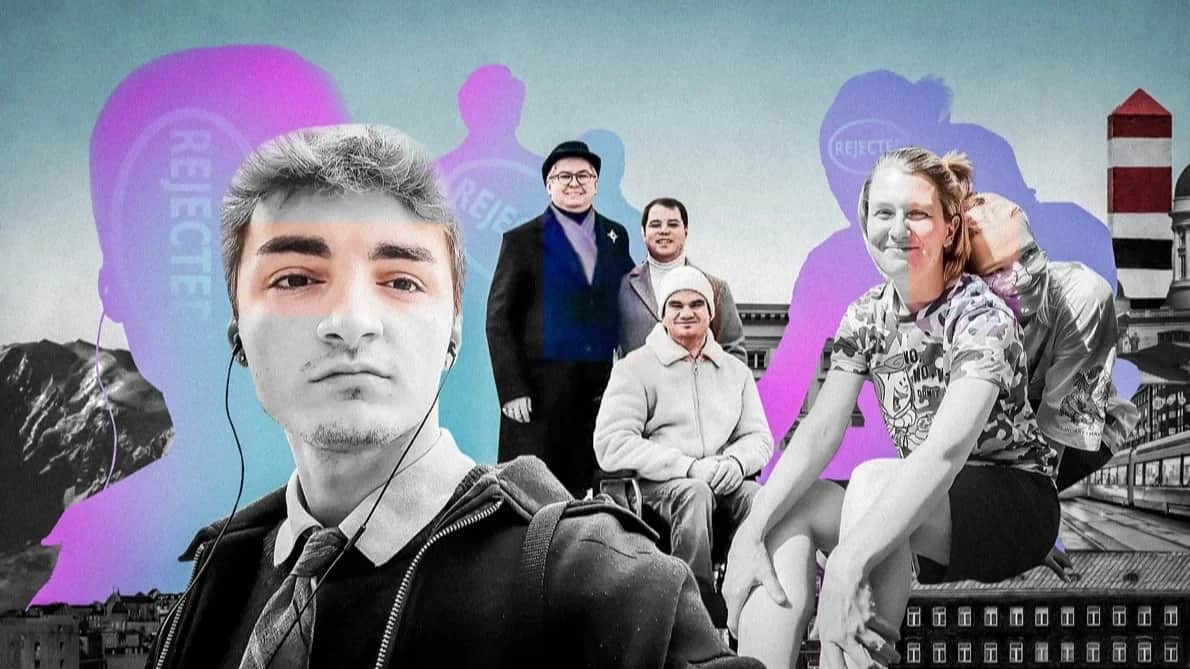
Obtaining refugee status in Europe is becoming increasingly difficult for queer Russians fleeing their homeland, despite the vast amount of carefully documented evidence proving the omnipresent threat of discrimination and violence facing members of the country's LGBTQI+ community.
In Germany, one same-sex couple was almost split up from their disabled child when only the parents were granted asylum by the authorities, while in Finland, another couple has fought for years to overturn a decision denying them asylum due to an error in their application.
Frightened off by the sheer proportion of applicants that have their asylum claims rejected, some queer refugees are now actively avoiding the EU altogether when choosing where to apply for asylum. Novaya Gazeta Europe spoke to three queer Russian refugees about their experiences of claiming asylum in Europe.
Insufficiently queer
Artur Maksimov, his husband Rudolf, and their adopted son Viktor were forced to wait for over three years to learn the outcome of their asylum claim. Upon their arrival in Germany in August 2022, they were forced to live in a refugee camp, from where they submitted their application, having had nearly all their cash seized by the state.
Under German law, all asylum seekers must declare their assets, the total amount of which generally determines their eligibility for state benefits. The amount of cash an individual asylum seeker is permitted to bring into the country is also tightly controlled, with any excess being confiscated. In Bavaria, for example, an asylum seeker may bring no more than €200 in cash with them.
There was definitely no place for LGBT people in our camp in Bamberg — almost everyone there held very negative opinions about queer people.
According to Artur, his family’s first year as asylum seekers in Germany was a living hell. “We were saved from the camp by the human rights group Quarteera, which was able to find us safe accommodation. Time after time the camp administration placed us with religious families, which naturally led to conflict. Radically-minded neighbours demanded that we be housed elsewhere as soon as they found out that we were a gay couple.”
“We were moved three times in the middle of the night to new temporary accommodation, where refugees stay for a day at a time while they recheck documents and find a new place for them to live. We stayed there for weeks, and the fourth time we were moved to a really dangerous place where the police would be called every day to break up fights.”
“There was definitely no place for LGBT people in our camp in Bamberg — almost everyone there held very negative opinions about queer people and had chosen to double down on their pre-existing homophobic views rather than adapt to their new surroundings.”
Moving to a new flat made things easier for the trio, but it was still far from ideal. Viktor, 26, lives with learning difficulties and has a serious form of cerebral palsy. Artur first met him 14 years ago while filming a documentary in his children’s home. Since then, Viktor has become Artur’s ward and calls him dad. Artur, who met his partner Rudolf five years ago, has in turn dedicated his life to fighting for Viktor’s rights to proper care and treatment.
Of the over 8,000 asylum claims made by Russian refugees in 2024, Germany’s Federal Office for Migration and Refugees (BAMF) granted just 414, rejecting 3,652, and putting another 4,000 on hold pending the provision of further information, a 19% decrease from 2023.
The current policy on migrants is in direct contradiction of the 1951 Refugee Convention, as they are breaking families up into separate cases to make it easier for them to reject applications.
Things became easier for Artur, Rudolf and Viktor in March 2025, when both Rudolf and Artur’s asylum claims were approved. However, a few weeks later, the German authorities wrote formally rejecting Viktor’s own asylum claim, reasoning that as Viktor himself was not LGBTQ+, he was not considered at risk in Russia. Since then the family has been left in limbo.
“To this day, our son is still considered an asylum seeker,” Artur explains, adding that they’re appealing the ruling. “The current policy on migrants is in direct contradiction of the 1951 Refugee Convention, as they are breaking families up into separate cases to make it easier for them to reject applications. According to them, we were not able to prove that a young man with a severe disability and no support network in Russia would be in danger if he was forced to return.”
Arthur and Rudolf got married in Germany and have been awarded joint custody of Viktor until 2030. The denial of Viktor’s asylum claim seems even more suspect when taking German law into account, where a person in the care of their relatives is legally considered a child until the age of 25 and therefore cannot be separated from their legal guardians. As Viktor was still 25 when BAMF rejected his asylum claim, the agency appears to have simply ignored the fact that, legally, his case should have been considered alongside that of his adoptive father.
The ramifications of this situation have inevitably been far reaching, and the German authorities shortly afterwards withdrew their social housing without offering any guidance on what to do with their mobility-impaired son.
The family nevertheless managed to find a new apartment in Nuremberg, but were ultimately unable to move into it due to Viktor’s status as an asylum seeker. The three are currently still living in social housing albeit in an awkward legal limbo.
The whole process was like some tragic comedy. The representative from the migration authorities came several hours late due to the snow, and it turns out that our translator held certain anti-LGBT views.
Artur can hardly contain his emotions when discussing their situation. “They issued Viktor a temporary stay of deportation order, which didn’t have a specific timeframe. How would immigration enforcement react to that? We know how these authorities work very well — they break down the door in the middle of the night and march people out at gunpoint.”
On 29 January, Viktor’s case went to court. His adoptive family are hoping for a miracle, but they have little faith in the justice system. When the date of the hearing was decided in December, the trio received a foreboding notification, stating that free legal aid would be withdrawn, as the court did not foresee a positive outcome in their case.
“Quarteera arranged some support for us at the courthouse. Around 34 people came, mainly from German human rights and student groups. It was a really big boost for us,” recalls Artur. “The whole process was like some tragic comedy. The representative from the migration authorities came several hours late due to the snow, and it turns out that our translator held certain anti-LGBT views. She couldn’t even bring herself to say the word ‘gay’ for the first half of the hearing. She described us as ‘belonging to that LGBT party,’ which made people whisper and laugh.”
Artur says that despite everything, he remains hopeful. “We just want to be safe and happy. I am grateful that Germany has accepted our family. I had fought the system for so long and spoken out so much against the war and against Putin that becoming refugees became our only option. We are hoping to stay here and that justice will win out.”
Maria & Kristina
Maria and Kristina’s life has been an endless series of asylum claims and rejections since the couple left Russia for Finland three and a half years ago. Having always been out in Russia, not to mention posting war-critical content online, both women were accustomed to receiving threats. Indeed, by the time Maria fled to Finland, the Russian police had already paid her parents a visit and questioned her mother about her daughter’s whereabouts.
Meanwhile in Finland, Maria had her claim for asylum rejected, after a court ruled that she had been unable to prove that staying in Russia would be dangerous for her. “We were completely blindsided by the decision. We were sure that everything would be fine because we had a strong case, but when our claim was rejected we discovered that our legal aide hadn’t filled out the paperwork correctly, meaning that the court didn’t consider a lot of our evidence.”
“For example, my mother’s testimony about the visit by the police was not taken into account. We therefore think that the court is at fault for not providing us with adequate legal assistance.”
As is the case with nearly every failed asylum bid, Finland’s Supreme Court refused to review Maria and Kristina’s case, and so the couple decided to submit a fresh application, this time including documents and testimony confirming their public statements, including their support for independent Russian media.
In February last year, the couple submitted their second asylum claim, before being sent to a deportation processing centre. “We expected the migration service’s decision on 15 December, but we heard nothing. Our lawyer has reassured us that this time around they will grant us asylum. If we are refused again, the court will be on our side. The more absurd the decision the migration authorities take, the greater our chances are that it will be overruled by the courts.”
A message from murderers
Mark Yakovlev was born in Makhachkala, in the republic of Dagestan. He is now 19, but fled Russia as soon as he became an adult. While he was still in college, one of his tutors publicly insulted Mark. The teacher was subsequently fired, but the other students turned on Mark and bullied him. They threatened him, filmed him admitting under duress that he was a homosexual and leaked the clip online along with his picture and home address. When Mark filmed a suicide note on top of an 18-story building, he received a message saying, “Hooray, one less gay in Dagestan!” Thankfully, he was saved that night.
At 16, Mark moved from Makhachkala, the capital of the ultra-conservative republic of Dagestan in Russia’s North Caucasus, to St. Petersburg where he became involved in LGBT activism, started his own blog about queer rights and began giving regular media interviews. At 18, he left Russia for Yerevan, from where he applied for a humanitarian visa in France, which was ultimately rejected.
Mark’s friend Aishat Baymadurova, a refugee from Chechnya, was murdered in Yerevan in autumn 2025, having been stranded there after the German humanitarian visa she had applied for was rejected. On the same day they strangled Aishat to death, her killers sent Mark a message from one of her social media accounts promising that he would soon be found himself.
This was not the first time Mark had received death threats since his arrival in Armenia, however, where aggressive responses to his involvement in local queer campaigns over the previous year both online and in his daily life had become the norm. The denial of his asylum claim by the French authorities forced him to reconsider his options. “I flew to Sarajevo, and from there I was sent to Bihać, a town on the border with Croatia,” recalls Mark. “The Bosnians let me go, and the Croatians refused to accept me. I described my situation as an LGBT activist but they didn’t choose to listen, because it was a Saturday of all reasons. They told me to come back on Monday.”
“I found a hostel in Bosnia and waited until Monday, but at the start of the week my mother called me; she said that the police had come and informed her that I was wanted for discrediting the Russian military. They said that it would be better to return to Russia and deal with the police directly. I don’t know whether it was just an idle threat or a genuine one. I checked and there was nothing on both the old and new versions of the court website. This is probably because they are still gathering evidence. I will only find out for certain if I go to the police myself.”
Mark suspects that his anti-war content, which has garnered millions of views, is the reason for this alleged investigation.
After receiving his mother’s news Mark consulted with a human rights organisation and decided to return to Yerevan, to submit a second humanitarian visa application. He had heard awful stories from other refugees in Croatia; for example, a gay couple from Russia were threatened with murder and psychologically pressured in a refugee camp in Zagreb, with the guards being aware of the situation but not intervening.
Mark says he remains hopeful that he will eventually be granted asylum in Europe and that he can live safely there. For now though, he is living with friends in Yerevan and attempting to find work, though he says that his “typically gay appearance” has made that difficult, in the service industry at least.