StoriesSociety

Toppling Goliath

Members of Russia’s Finno-Ugric ethnic minorities discuss their reasons for joining the Armed Forces of Ukraine

Toppling Goliath

A member of the AFU’s NORD unit on combat training manoeuvres in Ukraine, July 2024.

Finno-Ugric peoples have historically inhabited large swathes of modern-day Russia, having a particularly strong presence near the country’s border with Scandinavia. However, after decades of migration, brutal repression, policies of Russification and cultural erasure, their numbers have diminished severely.

Even in Karelia, a republic on the Finnish border that’s home to Karelians and Vepsians, 86% of the population identifies as Russian today. Nevertheless, there are still those who preserve their distinct identity. Discontent with Moscow’s policies and the vision of a centralised imperialist Russia, some of them have chosen to join the side of Ukraine in its David and Goliath contest with Putin.

Indeed, the number of Finno-Ugric men enlisting to fight for Ukraine on ideological grounds has become significant enough for Ukraine to create NORD, a unit of Finno-Ugric soldiers defending Ukraine.

NORD combat group soldiers hold up the Karelian flag during a mission on Ukraine’s Black Sea coast in winter 2025.

NORD combat group soldiers hold up the Karelian flag during a mission on Ukraine’s Black Sea coast in winter 2025.

Continuing the Continuation War

In 2023, Finno-Ugric fighters in the Armed Forces of Ukraine (AFU) founded NORD, a military unit under the command of the Defence Intelligence of Ukraine. Though it began life as a Karelian-only unit, it subsequently relaxed its membership criteria and now allows all Finno-Ugric and Scandinavian peoples into its ranks.

NORD members see their mission as continuing the struggle for Finno-Ugric independence, which led to Finland’s independence from revolutionary Russia in the early 20th century, even though efforts to make Karelia and Ingria sovereign nations ultimately failed.

Until January, NORD was part of the Russian Volunteer Corps (RVC), which, alongside other foreign volunteer formations such as the Freedom of Russia Legion, and the International Legion, is overseen by Ukraine’s Defence Intelligence.

NORD disbanded as a singular military entity, and since then its members have been integrated into different branches of the AFU while remaining bound by their common heritage.

NORD spokesperson Vladislav Nobel-Oleinik told Novaya Europe that the unusual pairing of non-Russian ethnic minorities from Russia with Russian nationalists had been one born of necessity. “NORD took advantage of the opportunities for armed resistance that were available to it at the time,” Nobel-Oleinik explained, adding that NORD had since left the RVC and no longer had “any association” with the group today.

On the third anniversary of its formation, NORD disbanded as a singular military entity, and since then its members have been integrated into different branches of the AFU while remaining bound by their common heritage and their shared support for Karelian independenceN

NORD unit members do weapons training in Ukraine, summer 2024.

NORD unit members do weapons training in Ukraine, summer 2024.

Changing worldviews

Despite having Finno-Ugric ancestry, the man in his late 20s who goes by the callsign Goth is not someone you would ordinarily expect to find fighting for Ukraine, having been raised in what he describes as “the spirit of Russian patriotism” — Orthodox Christianity, Victory Day cultism, hatred for the West and disdain for liberal values — all things that he says are nowadays “par for the course in Russia”.

As all the surviving Finno-Ugric minorities living in northwestern Russia are so small, Goth asked Novaya Europe not to specify which ethnic group he belongs to to protect his family.

Growing up, Goth was told virtually nothing about his own people’s history or traditions, nor was he taught their language, though some of his family members did speak it. He now says he deeply regrets the decision made by his relatives on his behalf to voluntarily assimilate into Russian society.

At first Goth refused to believe the Kremlin would launch a full-scale invasion of Ukraine, considering it “too senseless and too destructive” even for Putin.

He was, however, exposed to plenty of Kremlin propaganda, which he believed until adulthood. A few years before the full-scale Russian invasion of Ukraine began, his worldview shifted radically, and he became “pro-European, pro-Ukrainian, and anti-imperialist”, having come to see the Russian Federation as a “criminal and aggressive state that suffocates freedom both at home and abroad”.

Goth says that at first he had refused to believe that the Kremlin would launch a full-scale invasion of Ukraine, considering it “too senseless and too destructive” even for Putin. Eventually, though, he realised he had been mistaken.

“I realised about two days before it started that the war was inevitable. When it happened, I was appalled, I couldn’t think about anything else. My decision to join the AFU was a near-instant one.”

Indeed, Goth’s only real choice was which side he would end up fighting for. As he had completed his compulsory military service, he began receiving summons from his local military recruitment office, and though this was before Putin declared partial mobilisation in September 2022, and despite technically being exempt from the draft as a student, it was clear that the Russian military already had him in its crosshairs.

While he admits to facing many challenges during those years, fighting against his compatriots was never one of them.

Cognisant of that fact, Goth fled Russia, after which, once the necessary background checks had been carried out, he was able to enter Ukraine with the help of Ukraine’s Defence Intelligence.

Though he has now left the military, during his time in uniform Goth fought in the key battles of Vovchansk and Kupyansk, as well as in the Black Sea, and took part in daring raids behind the Russian front lines.

Nonetheless, he remains an active member of NORD and a supporter of Karelian independence whose convictions were only strengthened by the war. While he admits to facing many challenges during those years, fighting against his compatriots was never one of them.

“They chose their fate, to be murderers, rapists, looters, and occupiers. We chose to defend people,” Goth says. “For it to be difficult, we would have to have something that unites us, and what could we possibly have in common?”
One of the few

Though he is now an AFU fighter on the front lines in Ukraine, Alexander* was still a minor when Russia’s full-scale invasion of Ukraine began four years ago. He is also part of one of Russia’s tiniest minorities, the Tver Karelian ethnic group, who today number fewer than 3,000 people, according to Russia’s last census.

“My entire family is Tver Karelian. I used to pay no attention to that fact, even though my older relatives spoke the really rare Tver Karelian dialect. Then, when I was about 14, I got interested in Finno-Ugric culture as well as in my own roots,” Alexander says.

Though he says he was “undoubtedly opposition-minded” before the war started, Alexander admits he had never been particularly political, and it was his interest in learning about his roots and Tver Karelian history that led him to conclude that Russia treated its regions — where “all the money flows to Moscow” — unfairly.

Alexander decided to join the AFU, leaving Russia as soon as he turned 18, aware of the fact that were he to stay, he could be drafted into the Russian military at any moment.

When the war started, Alexander initially planned to remain in Russia to join the Northern Brotherhood, a Finno-Ugric partisan organisation opposed to Russian rule.

However, he was quickly dissuaded from the life of a partisan when Andrey Vasurenko, a 19-year-old Karelian independence advocate, was arrested in 2023 and charged with treason and terrorism over his alleged attempts to recruit Russians to join the AFU, for which he was ultimately handed a nine-year prison sentence.

Instead, Alexander decided to join the AFU, leaving Russia as soon as he turned 18, aware of the fact that were he to stay, he could be drafted into the Russian military at any moment.

Once outside Russia, Alexander made contact with NORD, whose members helped him join the AFU. By late 2024 he was sent into combat and now serves as an infantryman in a Ukrainian defence unit.

Goth during the battle for Vovchansk, eastern Ukraine, in autumn 2024.

Goth during the battle for Vovchansk, eastern Ukraine, in autumn 2024.

Old guard

Vladimir Grotskov is the only NORD member who agreed to speak with Novaya Europe using both his full name and call sign — Kandalaksha — the name of the small Karelian town where he was born. Grotskov is a member of the Karelian Pomor ethnic group, which is of mixed Slavic and Finno-Ugric ancestry.

Unlike his far younger comrades who enlisted to fight in 2022, the 51-year-old Grotskov has had a long military and political career, and took part in Russia’s largest anti-Putin protests in Moscow in 2011 and 2012 while “gradually disliking what was going on in Russia more and more”.

He will continue fighting even if a peace treaty is signed to end the war, determined that “we must all work towards dismantling the criminal Moscow regime”.

In spring 2015, he joined a far-right military unit fighting the pro-Moscow insurgency in eastern Ukraine, though he stresses that he’s personally a right-wing liberal who supports Karelian independence from Moscow despite his ties to Ukrainian nationalists.

Though Grotskov eventually returned to civilian life and became fluent in Ukrainian, as soon as the full-scale invasion got underway in 2022, he decided to re-enlist.

“In its current form, Russia is an evil for everyone,” Grotskov tells Novaya Europe, adding that he can’t “feel at peace” as long as such malevolence exists in the world. He says that he will continue fighting even if a peace treaty is signed to end the war, determined that “we must all work towards dismantling the criminal Moscow regime”.

Combat patrol on a tower on Ukraine’s Black Sea coast, winter 2025.

Combat patrol on a tower on Ukraine’s Black Sea coast, winter 2025.

On the edge

Having served as a reconnaissance specialist and an assault brigade trooper, Denis*, in his early 20s, is now a drone operator on the cutting edge of modern automated warfare.

Born and raised in Siberia, his family is half Ukrainian and half Mokshan, a Finno-Ugric group with some 12,000 members, according to Russia’s last census. His father’s ancestors were deported to Siberia in the 19th century and his family has since been heavily russified and assimilated.

Nevertheless, Denis says his roots influenced how he acted once war broke out. “I was very happy when it became clear that there wouldn’t be a blitzkrieg, after Ukraine withstood the first weeks of the full-scale invasion,” he says.

Fleeing Russia before he could be drafted into the military in 2023 — “They didn’t catch me in time,” he grins — Denis travelled from Russia to Ukraine via Georgia with the help of Ukraine’s Defence Intelligence. Once there, he joined the AFU, where he now serves as an infantryman, a role he describes as the hardest in modern warfare.

Though he already identified as an anti-imperialist well before the full-scale invasion of Ukraine began, Denis says that he has “become more strongly opposed to the Russian World” since then.

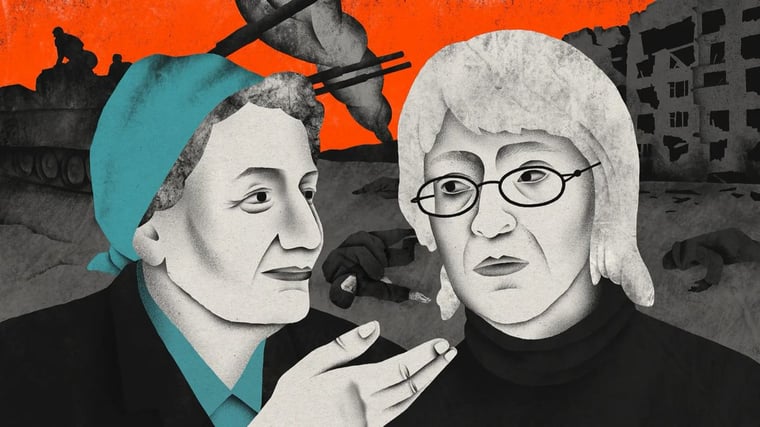
“You have to watch your step, expecting mines. You have to watch the sky, expecting drones. You have to watch ahead, expecting enemy contact. You have to duck in time for mortar fire and artillery shelling, and get up immediately to maintain mobility. All this while carrying equipment, wearing protective armour, and carrying ammunition.”

Though he already identified as an anti-imperialist well before the full-scale invasion of Ukraine began, Denis says that he has “become more strongly opposed to the Russian World” since then, blaming it for the death of so many of his friends and comrades.

“I think this is one of those wars where there is no clear victory or defeat. The main thing is to preserve the nation and defend its sovereignty, and Ukraine has already done that,” Denis says.

“The number of deaths will forever remain a terrible tragedy for the Ukrainian nation, the number of Ukrainian heroes who lost their lives is worth more than the entire population of Russia. Yet from a purely spiritual point of view, by choosing freedom over slavery at the cost of war and death, we have already won.”

*Name changed for safety reasons

shareprint
Editor in chief — Kirill Martynov. Terms of use. Privacy policy.