CommentPolitics

NATO’s next test

The alliance must face down the Russian threat in places where deterrence is most fragile, such as the Suwałki corridor

NATO’s next test

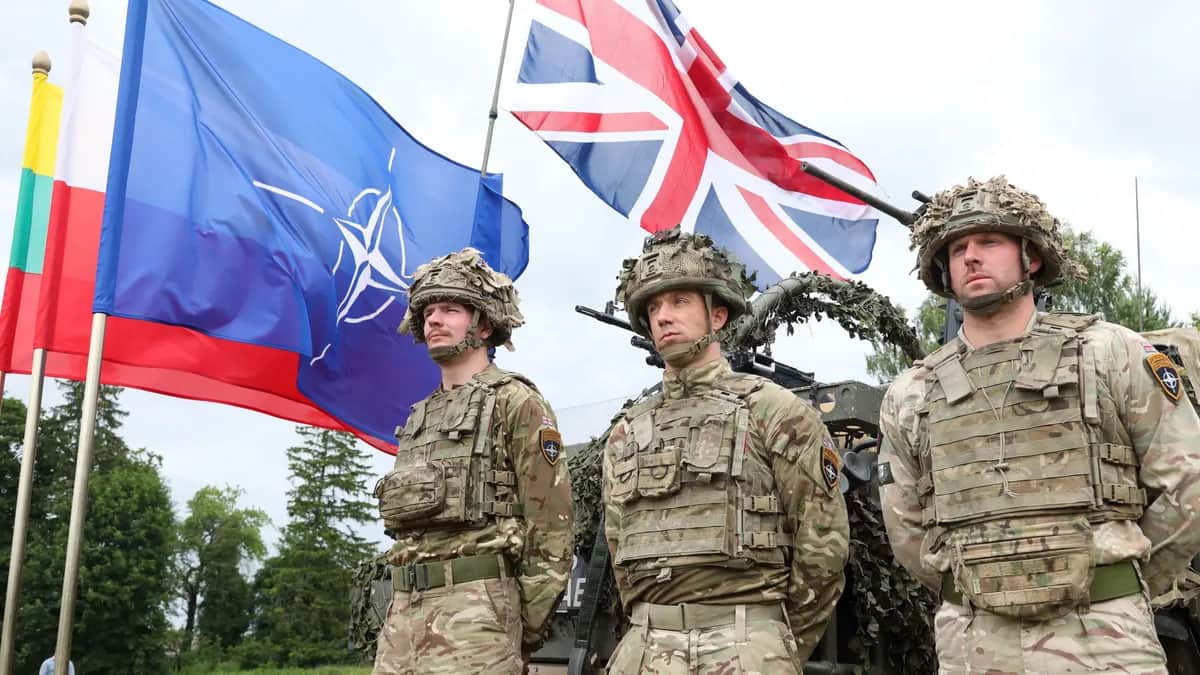
NATO troops in the village of Szypliszki in Poland’s Suwałki corridor, 7 July 2022. Photo: EPA / Artur Reszko

In response to intensifying Russian activity along NATO’s eastern flank, the US Congress recently approved $200 million in security assistance for Estonia, Latvia, and Lithuania. By preserving the US Baltic Security Initiative despite earlier efforts within the Pentagon to eliminate it, the new measure underscores congressional concern about NATO’s eastern border.

Agnia Grigas

Senior fellow at the Atlantic Council

But appropriations alone do not guarantee deterrence. The question now is how the renewed commitment will be implemented on the ground, particularly in places where the alliance is most exposed.

Few regions will test NATO’s resolve more severely than southern Lithuania, along the narrow land corridor connecting Poland to the Baltic states. Lithuania’s decision to build a new military training polygon near Kapčiamiestis — close to the Suwałki corridor between Belarus and Russia’s Baltic Sea exclave — offers a timely test of whether US support and European statements add up to genuine readiness along NATO’s eastern flank.

As a security analyst who has written about these risks for more than a decade, and who now lives in Vilnius, the Lithuanian capital, this debate is not merely theoretical for me. It is about whether NATO is taking deterrence seriously in the place where it will be tested first.

Two JAS-39C Gripen fighter aircraft take part in a NATO training exercise at Lithuania’s Siauliai Air Base, 12 November 2025. Photo: EPA / Robert Hegedus

Two JAS-39C Gripen fighter aircraft take part in a NATO training exercise at Lithuania’s Siauliai Air Base, 12 November 2025. Photo: EPA / Robert Hegedus

The Suwałki corridor is NATO’s only land route linking Poland to Lithuania, Latvia, and Estonia. Roughly 65 kilometres wide, it sits between Russia’s heavily militarised Kaliningrad region and Belarus, which, since Russia’s full-scale invasion of Ukraine, has become a de facto forward-operating platform for the Russian military. In a crisis, control of the corridor would determine whether NATO could reinforce the Baltic states by land, or whether these allies would be cut off. For years, it has featured prominently in alliance planning precisely because it combines strategic importance with geographic vulnerability.

Lithuania’s planned training site near Kapčiamiestis reflects this reality. The country’s other two main training areas — Pabradė, which regularly hosts rotational US Army units, and Gaižiūnai, near Rukla, the home to Germany’s forward-deployed brigade — are used intensively but are geographically distant from the Suwałki region. By contrast, Kapčiamiestis allows for battalion- and brigade-level manoeuvres, live-fire drills, and reinforcement training on terrain that mirrors where NATO would face its most direct challenge. Hence, Polish defence officials have also expressed an interest in training there, reflecting Poland’s broader push to strengthen deterrence along NATO’s eastern flank.

The military pressures on the corridor are no longer hypothetical. Kaliningrad hosts elements of Russia’s Baltic Fleet, advanced air-defence systems, and nuclear-capable Iskander missiles. To the southeast, Belarus has hosted Russian troops, aircraft, and missile systems since 2022. Together, these positions compress NATO’s room for manoeuvre at precisely the point where the alliance’s land connectivity is most fragile.

Whereas Russia makes its military plans on the basis of terrain and timelines, democracies must plan with an eye toward maintaining legitimacy and alliance cohesion.

Of course, Lithuania’s decision has sparked debate at home, as expected in a democratic society. Local communities have raised concerns about land use, the environmental impact, and disruptions to daily life. These worries deserve attention, but they also must be weighed against the fact that delays are costly in this security environment. As Lithuania’s chief of defence, Raimundas Vaikšnoras, acknowledged, “we live in a liberal society where people have different opinions, but the security situation means this polygon is inevitable — the question is no longer whether it will be built, but when.”

This tension between democratic processes and strategic urgency is not unique to Lithuania. Whereas Russia makes its military plans on the basis of terrain and timelines, democracies must plan with an eye toward maintaining legitimacy and alliance cohesion. The challenge, then, is to ensure that openness and debate do not become vulnerabilities that adversaries can exploit.
In this context, allied recognition may matter as much as allied resources. Visible NATO engagement, particularly a US acknowledgement of the site’s strategic importance, would reinforce deterrence, signal unity, and help situate the project within a broader alliance framework. Lithuania is not asking others to defend it alone. It is leading the investment in its own defence, consistent with the burden-sharing demands that the United States has made in recent years.

Polish soldiers install barbed wire along the country’s border with the Russian exclave of Kaliningrad, near Lenkupie, northeastern Poland, 7 November 2022. Photo: EPA / Artur Reszko

Polish soldiers install barbed wire along the country’s border with the Russian exclave of Kaliningrad, near Lenkupie, northeastern Poland, 7 November 2022. Photo: EPA / Artur Reszko

Even the most recent US National Defence Strategy states plainly that “Russia will remain a persistent but manageable threat to NATO’s eastern members for the foreseeable future,” placing greater responsibility on European allies.

The greatest risk along NATO’s eastern flank is ambiguity. Deterrence does not erode when defences are visible, but when preparation lags behind threat recognition, and when political resolve appears uncertain. Training gaps, untested reinforcement routes, and ambiguous signalling create openings that adversaries can exploit without crossing the threshold of open conflict.

The implications are clear. If NATO is serious about managing the Russian threat identified in its own strategy documents, and highlighted repeatedly in reporting on Europe’s security, it must focus its efforts where deterrence is most fragile. The Kapčiamiestis polygon is not merely a local training ground, it is a measure of whether the alliance can turn commitments into capability, and align strategy with geography, before a crisis forces its hand.

This article was first published by Project Syndicate. Views expressed in opinion pieces do not necessarily reflect the position of Novaya Gazeta Europe.

shareprint
Editor in chief — Kirill Martynov. Terms of use. Privacy policy.