


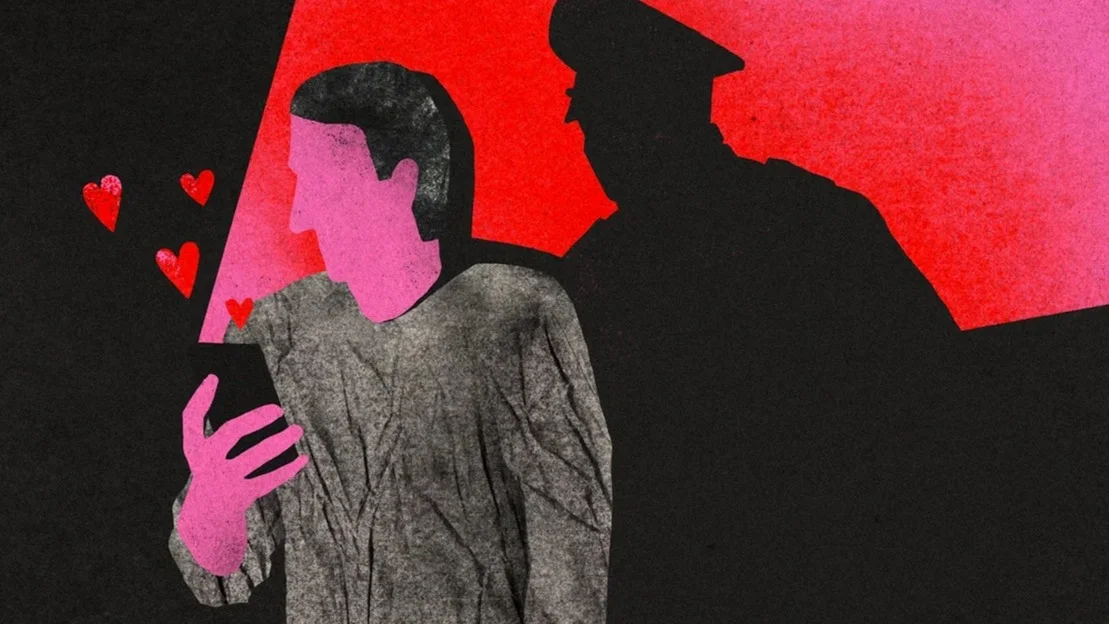
In late October, police in Moscow reported detaining a group of teenagers who were attacking queer men. The gang would apparently beat up, rob and even throw firecrackers at its victims. It also filmed each violent encounter.
Though the group’s members were detained after the police were alerted of the gang’s activities by some of their victims’ neighbours, within days, Kremlin-aligned channel REN TV had reported that an “organised crime group” was “fighting sexual extremists”.
Novaya Gazeta Europe looked at how the criminal entrapment of queer people has been growing in Russia in recent years and why.
Moscow kiss
In 2025, 17-year-old Muscovite Mark* arranged to meet a man he had befriended on a gay dating app. When Mark arrived for the date, his date looked completely different from the photo of the person he had corresponded with. Realising that something was wrong, he attempted to turn away from the encounter but the stranger ran after him. Luckily for Mark, he was carrying pepper spray with him, which he used on his would-be assailant, allowing him to make good his escape.
“You communicate with someone online, a real person, not some bot, but behind that there are people with different intentions entirely,” Mark told Novaya. “The person writing to you only does so to get you to meet. He’ll try anything to get you to come. They’ll come to your neighbourhood if that’s more convenient, but they’ll beat you up anywhere.”
Illustration: Lyalya Bulanova
Two years ago, Russia’s Supreme Court recognised the “international LGBT movement” as extremist. Homophobic laws, combined with a growth in online dating, have led to an enormous increase in individuals being catfished, even though the practice is not new.
When Gleb*, from the remote city of Neryungri, in Russia’s Far Eastern republic of Sakha, was 18 in 2004, internet access wasn’t yet commonplace, and state media hadn’t yet deliberately attempted to stoke homophobia. Therefore, most queer people used the lonely hearts section of the local newspaper to find romance.
“It usually took over a month from sending in the ad to the first date,” he recalls. “First the letter reaches the newspaper and they publish the ad, then you receive letters at the post office from those interested in you, then you need to reply and arrange a meeting.”
“I’m still happy that I emerged without any major consequences, bar losing my faith in humanity,” Gleb recalls.
Most people in Neryungri didn’t include photos with their letters in order to keep their sexual orientation secret from strangers.
Gleb received several responses, chose the person he was most interested in and suggested meeting live. The men agreed a time and place and that Gleb would carry a newspaper. The men agreed in advance that they would go for a walk and then go to the second man’s house for sex.
“I was going on a date,” Gleb says, "so I took two big bottles of beer with me and put them in a bag over my shoulder. They saved me later on.”
They went for a walk around town, and then turned off a brightly lit street into a courtyard. The date put a hand on Gleb’s shoulder, who put his hand round the man’s waist in response and went to kiss him. At which point the man punched him in the face
An injured gay rights activist is surrounded by police after being attacked at a Gay Pride event in St. Petersburg, 29 June 2013. Photo: EPA / Anatoly Maltsev
“At that exact moment, three other people appeared and were walking towards us. Without thinking, I took off the bag with the beer in it and whacked him with it in the face. I scarpered. I surprised myself by jumping over some kind of fence, like in an action film.”
He decided not to contact the police.
“I’m still happy that I emerged without any major consequences, bar losing my faith in humanity,” Gleb recalls. “On the one hand, the heterosexual community shouts at us: ‘We don’t care who you fuck! Do whatever you want behind closed doors. Just don’t ram it down our throats.’ And then they do that sort of thing.”
The Tesak saga
Vladimir*, a lawyer for an LGBT organisation that continues to work in Russia despite the ever-worsening political climate, told Novaya Europe that catfishing queer people with the intention of robbing, assaulting or blackmailing them is sadly something that happens the world over, even in countries where LGBT rights are protected by law.
“There is currently a shift to the right and an attack on the rights of LGBT people all over the world,” he said, adding that so-called “fake dates” usually follow a pattern. The assailant creates a profile on a dating app, writes to a potential victim and then invites them to meet at their home or at another, usually quiet, location such as a park. When the victim arrives, they are beaten up, humiliated, degraded and filmed so that they can be blackmailed. Many victims have even been murdered.
In Russia, the phenomenon developed in far-right circles after neo-Nazi Maxim “Tesak” Martsinkevich set up the Occupy Paedophilia movement, which existed from 2011 to 2014. Originally, the group arranged fake dates, which they called safaris, with suspected paedophiles. Footage of the victims being beaten up and humiliated were then posted online to “ruin their lives”.
Illustration: Lyalya Bulanova
After Tesak was arrested, his followers created the less well-known Occupy Gerontophilia movement, which targeted queer teens looking to meet people who were significantly older.
Though hardly liberal, the 2010s were a totally different era in Russia during which the police would still actively investigate crimes against members of the LGBT community. In 2014, Tesak was charged with incitement to hatred and placed on the state’s list of extremists, before it was co-opted by the Kremlin to be a tool it could use against its political enemies.
In 2016, a St. Petersburg court found the so-called “gay hunters” guilty in a high-profile case, though it did give one of the gang members a suspended sentence, and released them in the courtroom.
Since the start of the war in Ukraine, the “hunt” for LGBT people has become even more active. “Videos of any attacks, including on queer people, have become much more common online,” Gennady*, a researcher of Russian far-right movements, told Novaya Europe.
Police officers lead a gay rights activist away after clashes with anti-LGBT protesters in St. Petersburg, 12 October 2013. Photo: EPA / Anatoly Maltsev
Vladimir agreed, telling Novaya Europe that such content had gained great popularity in recent years due to a growing public appetite for extreme violence.
“When Tesak was attacking members of the LGBT community in the early 2010s, he had a comprehensible ideology: he was a neo-Nazi who needed to exterminate the LGBT social group,” Vladimir says. “Then neo-Nazis were attacking LGBT people on fake dates with supposed minors. Now the fake dates are set up precisely so that the footage can be recorded. It isn’t about ‘exposing’ people. It’s about extreme violence.”
In 2023, Gennady and his colleagues found 30 videos online in which violent attacks on LGBT people were filmed by neo-Nazis. By 2024, that number rose to 62, and in 2025 to 68. However, this is just the tip of the iceberg, he says. The main objective of the far-right is to organise fake dates to make money by blackmailing the victims.
“Footage of most fake dates doesn’t appear online because the criminals’ attempts at blackmail are largely successful. The victims don’t go to the police as they fear problems with the law themselves. And if the press does learn about the robbery or assault, it often doesn’t say the victim was a member of the LGBT community,” Gennady explains.
Police provocations
In some parts of Russia, primarily in the deeply conservative North Caucasus, the security forces are even complicit in initiating fake dates.
“The goal is to catch someone, then blackmail them, ask for money from his family or look for other gay men through him in order to trump up criminal cases against them,” says Alexandra Miroshnikova, a spokesperson for North Caucasus SOS (NC SOS), a human rights organisation working in the region.
The level of cruelty and creativity in persecution vary from one Russian republic to the next. In Chechnya, gay men can face civil or criminal prosecution and testimony is often extracted under torture. In neighbouring Dagestan, gay men are frequently charged with the production and distribution of pornography.
The detention of Moscow adult content provider Matvey Volodin in the Dagestani capital Makhachkala in the summer of 2024 caused a furore among the republic’s LGBT community. The security forces used Volodin’s phone to arrange dates with other gay men in Dagestan and invite them to an apartment, where they then took the men’s phones and blackmailed them to cooperate, threatening those who refused with criminal charges.
Illustration: Lyalya Bulanova
One victim told Kavkaz.Realii, the North Caucasus affiliate of US-funded broadcaster RFE/RL, that he agreed to cooperate after the security forces recorded a video of him admitting that he was himself gay.
“It was my job to make contact with gay men and invite them to this one apartment. I was meant to be paid. I was also meant to find out if any of them had access to weapons or drugs, to dig deep within the gay community. ... If a video ends up on local forums, you could be killed or sent to an illegal ‘rehabilitation’ centre. There have been cases of an elder brother being sent to the mullah to remove the ‘jinn’. If you’re gay, you’re firewood for hell, in some religious people’s thinking.”
According to NC SOS, the Volodin case led to one Dagestani being placed in pretrial detention and being given a suspended sentence. He is now a free man again.
“Imagine a Muscovite being convicted for exchanging nudes with his partner. If the police in Dagestan want to bring a homosexual to justice, they can use pornography charges even if they find just one naked photo on their phone,” says Miroshnikova.
NC SOS says that individuals also set up fake dates in the North Caucasus to take advantage of people’s justified fear both of the authorities and of being outed in a very conservative society.
In the summer of 2025, NC SOS recounted the story of a 30-year-old from the southern Russian city of Vladikavkaz, who went on a fake date and was then blackmailed by robbers who introduced themselves as members of the drug squad. Zaur* was taken to a cemetery, and the assailants tried to organise a loan from his phone all night, but couldn’t due to his poor credit rating.
Having given up on extracting money from him, the criminals left him after demanding he give them details of other gay men of his Ossetian ethnicity. The following day, Zaur contacted human rights activists and told family members to whom he was out about the incident. Lawyers advised Zaur to warn the blackmailers that he had made a statement to the police, at which point they stopped responding to him.
“Three or four days later, something strange happened. Zaur received another call, and an unknown man asked a single question, whether he had made the statement to the police the previous day. Zaur said he hadn’t and the man hung up. No one has contacted him since,” NC SOS said.
“He thinks the caller was one of the fake ‘police officers’ checking whether he had made a statement about them. The men probably didn’t work in law enforcement and only pretended to in order to extort money. They were not in uniform that night, did not take Zaur to a police station, covered the details on their badges and were spooked when he threatened to make a statement,” according to NC SOS.
An abuser’s playground
Vladimir says that while it’s rare for law enforcement officers to be involved in entrapment schemes elsewhere in Russia, cases of assailants pretending to be members of the security forces are more frequent.
Marina*, a transgender sex worker from Siberia, told Novaya Europe that one man had answered her ad offering sex for money on a public dating site and invited her to his home. “He came across as very suspicious straight away. He was too smooth, wanted to be the perfect client,” she said.
Despite her misgivings, Marina went to his home. The man promptly took out a gun, claimed to be from the Investigative Committee, threatened to press charges against Marina for promoting LGBT propaganda, discrediting the armed forces and sex work, and then raped and robbed her.
Marina contacted human rights activists and then law enforcement. A criminal case was opened, the offender was detained and placed in pretrial detention for the duration of the investigation.
“It was very difficult, mentally, making the statement and enduring all the standard procedures,” Marina recalls. “It’s hard to say now which was worse: the crime against me or my dealings with the authorities.”
LGBT activist Nikolay Alekseyev is attacked by a homophobe while campaigning for the authorities to allow a Moscow Pride parade, 30 May 2015. Photo: EPA / Sergei Ilnitsky
The investigation revealed that Marina was not his only victim. Vladimir, whose organisation provided Marina with assistance, called the man who raped her a “serial monster”.
“He attacked trans women, mostly sex workers. Posing as a law enforcement officer, he acted out recruitment scenes and even demanded [victims] sign paperwork on keeping state secrets, threatened them with weapons, handcuffed them, demanded protection money, demanded information on other trans people for subsequent attacks and then raped his victims,” Vladimir says.
The alleged rapist’s defence strategy was to blame the victims, Vladimir continues. His lawyers tried to demonstrate that his crime was less dangerous, from a societal point of view, as his victims were “extremists”, i.e. members of the LGBT community. The case has now stalled.
“There have been multiple investigators, constant transphobia and attempts … to persuade the victims to change their testimony,” he complains.
“The Russian LGBT community is facing an internal social rupture,” says Vladimir. “People are communicating less, interacting less.”
Vladimir regularly handles cases of fake dates and advises victims to go to the police, but also to enlist the support of human rights activists beforehand to minimise contact with homophobic police officers, or, at least, to force them to act correctly in the presence of a legal professional.
He says that since Russia’s Supreme Court recognised the international LGBT movement as an “extremist organisation”, people have even become afraid to report homophobic assaults and robberies, even to human rights activists.
“The Russian LGBT community is facing an internal social rupture,” says Vladimir. “People are communicating less, interacting less. It’s more difficult for us lawyers to uncover new fake date events, because people don’t communicate. They live in their own little world.”
“Though it’s easy to find evidence of fake dates. It often affects several people, and there are many other victims who can identify the attackers. But the police often don’t want to take the time or make the effort necessary to investigate hate crimes against LGBT people.”
*names have been changed for safety reasons


