Since its November premiere, Canadian TV series Heated Rivalry, which follows a years-long gay love affair between Canadian ice hockey star Shane Hollander and his Russian archrival, Ilya Rozanov, has catapulted its two young leads, Hudson Williams and Connor Storrie, to global superstardom.
Based on Rachel Reid’s Game Changers series, the show has been lauded in particular for Connor Storrie’s performance as Rozanov, for which he learned to speak Russian so well that some native speakers didn’t even realise he was American at first. The series quickly became HBO’s top show of the year, with viewers worldwide binge-watching the series and an unusually passionate fandom being created.
While in Canada, Canadian Prime Minister Mark Carney was photographed on the red carpet with Hudson Williams wearing one of his jackets from the show, in Russia Heated Rivalry has received significantly less publicity, not least as in 2022 Russia extended its 2013 law banning the dissemination of so-called “LGBT propaganda” to minors to include adults as well, and in 2023, it ruled the non-existent “international LGBT movement” to be an extremist organisation, effectively making it illegal to make any public display of support for the rights of queer people.
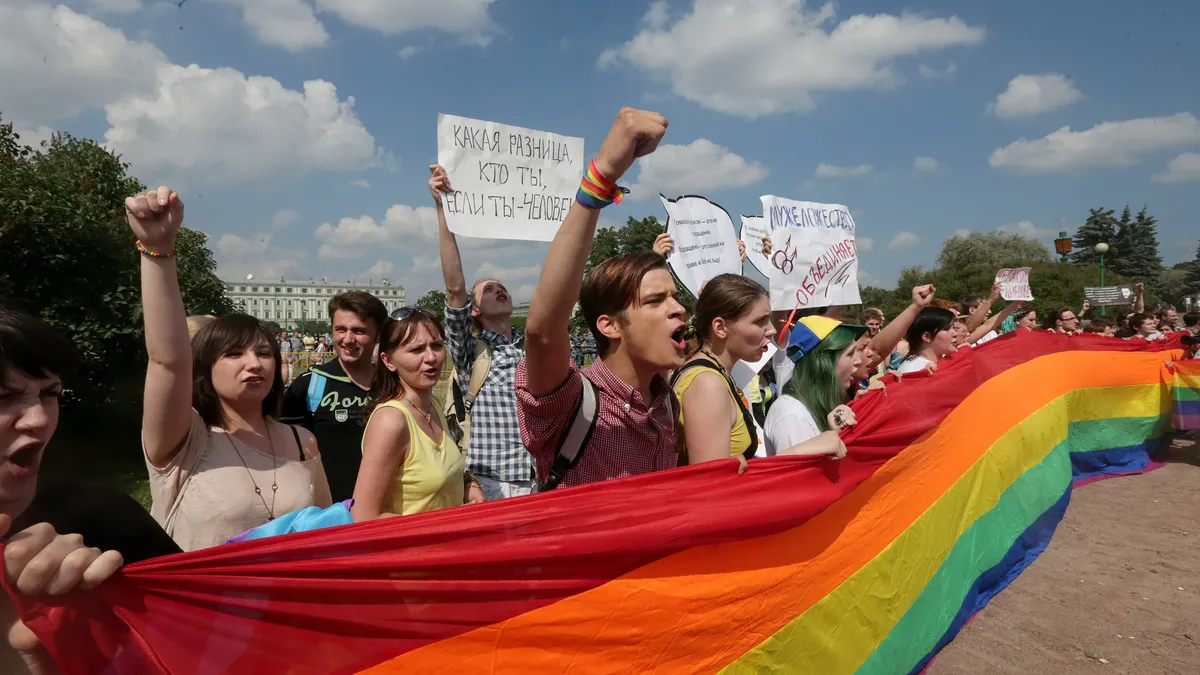
Though the Russian government has not commented publicly about the show, the Russian Orthodox Christian group Sorok Sorokov announced that it would petition the Prosecutor General’s Office and Russian media regulator Roskomnadzor to ban the series from Russian streaming services, referring to it as “propaganda of unnatural debauchery”.
Novaya Gazeta Europe asked Russian fans of the show why it appears to have resonated with young people in Russia so much and how its depiction of the country has been received both at home and abroad.
Popular propaganda
Yet even Russia has not totally managed to avoid the Heated Rivalry craze. The show has an 8.4 rating on Kinopoisk, the Russian equivalent of IMDB, and many fans have relied on streaming websites to watch the show, and, in particular, Telegram channels, where all six episodes of the show are available with Russian subtitles.
One such channel, which currently boasts over 45,000 subscribers, organised online watch parties as the episodes were released, which brought thousands of Russian fans together to create a real sense of community for the show’s newfound fandom.
Connor Storrie as Ilya Rozanov in Heated Rivalry. Photo: HBO Max / Crave
Talking to Russian fans online, it immediately becomes clear that the fact that one of the two lead characters was Russian was key to its popularity. For one of them, the protagonist being Russian felt like a “miracle”, especially given “the current political context”.
All the Russian fans who agreed to speak to Novaya Gazeta Europe about the show also highlighted the extraordinary performance by Connor Storrie, many even admitting that they thought the Texas-born actor, who learned Russian especially for his role, was a Russian native speaker. “I was stunned by Storrie’s acting,” said one viewer, “the way he talks, his facial expressions — everything convinced me he had Russian roots.”
Another fan said that “learning Russian from scratch for a role is already a challenging task, but speaking it with confidence while also conveying the character’s personality is even more difficult.” For Russian fans, Storrie’s remarkable commitment to the role made Rozanov “authentic”, and they were happy to see Russia represented “with respect and accuracy”, and almost no stereotypes. “Ilya feels like one of our own,” one fan said.
Slavic Rogozine as Alexey Rozanov in Heated Rivalry. Photo: HBO Max / Crave
Russian-born Canadian actor Slavic Rogozine, who plays Ilya Rozanov’s brother Alexey in the series, told Novaya Gazeta Europe how Russian culture had been “a topic for stereotypes in film and television for decades”, adding that Russians are typically portrayed as “tough as nails boogeymen who like to drink vodka, … have the same six names in rotation amongst the population and it’s always snowing there.”
He adds, however, that over the past 10 years “some projects have made an effort to step away from this and round out Russians as more than a stereotype.” According to Rogozine, “it was refreshing to see not a caricature of what a Russian person has been depicted to be on screen, but a real, three-dimensional human being, someone alive and vulnerable.”
Yet, according to cultural commentator Andrey Sapozhnikov, the show hasn’t managed to avoid stereotypes entirely, and he points out that Ilya’s first line in the show is a gruff “ok”, when Shane tells him he’s not allowed to smoke around the hockey grounds. For Sapozhnikov, this is a typical “oh, these Russians!” moment, which is confirmed by the next line he speaks, which is an insult directed at his own team’s goaltender, something which Sapozhnikov calls “not entirely normal”.
“Russianness is entirely synonymous with reticence, severity, and a refusal to follow the rules.”
Sapozhnikov believes that Heated Rivalry does actually reproduce well-established clichés, in which “Russianness is entirely synonymous with reticence, severity, and a refusal to follow the rules”, and says it’s still too premature to assume that Ilya isn’t supposed to represent the image of the Russian as a “cold, willful loner who demonstratively violates rules and — ideally — possesses a traumatic background, a strong sense of justice, and a chain with an Orthodox cross”.
Rare representation
But of course, Rozanov is not just a Russian man, but a queer Russian man, and this is what sets him apart from other “stereotypical” Russian characters portrayed in foreign cinema.
As one Russian fan explained “in Russia, where the question of LGBTQ+ rights and their acceptance in society is truly complex, the emergence of characters like Ilya constitutes an important cultural phenomenon”.
“It felt very emotional to recognise myself in Ilya as a queer Russian woman”, said another fan of the show. Overall, the show appears to have created an online safe space for queer Russians, in which they don’t have to hide themselves, and where they can discuss their sexual orientation without judgement. “This fandom is the best thing that’s happened to me in a long time”, one fan told Novaya Gazeta Europe. “We’ve truly become one big family.”
Hudson Williams as Shane Hollander in Heated Rivalry. Photo: HBO Max / Crave
Sapozhnikov echoes these testimonies, explaining that for queer Russian people, a bisexual Russian character in a TV show with global reach is “an important act of solidarity”, especially “under conditions in which they have effectively found themselves outside the law”.
“The Russian LGBTQ+ community is enormous”, Sapozhnikov says, “and in the toxic environment in which it exists, any artistic representation is perceived as significant psychological support”.
For Sapozhnikov, the period in which the show is set also plays an important role in how Russian audiences have reacted to Heated Rivalry. “The show is set in the late 2000s, which in the context of recent Russian history is a period of relative timelessness and freedom from political associations.”
“Ilya’s speech in episode five, in which he confesses his love for Shane, made me cry, not just because of the scene’s beauty, but precisely as it was in Russian.”
“Rozanov is no longer a Soviet hockey player of the Cold War era … but also not a ‘post-Crimea’ native of a country defined by triumphant revanchism.” Because of this, by 2026 standards, the character’s “Russianness” is perceived as less pronounced than in other films, Sapozhnikov adds.
Linguistic triumph
The significant amount of Russian dialogue in the series has been another important draw for its Russian fans. “Hearing the main character speak Russian in a foreign TV show immediately made me emotional”, one fan told Novaya Europe. “Ilya’s speech in episode five, in which he confesses his love for Shane, made me cry, not just because of the scene’s beauty, but precisely as it was in Russian.”
“The language is so attractive, and it was nice to have so much of it present in the show,” Rogozine says. “Hearing Connor Storrie deliver that gut-punching monologue in Russian was so amazing.”
Ksenia Daniela Kharlamova and Kaden Connors as Svetlana and Sasha in Heated Rivalry. Photo: HBO Max / Crave
The show’s depiction of Russia has penetrated far beyond the country’s borders, too. Driven by their love for the show and their emotional connection to the characters, many fans have begun learning Russian, and have started to take more interest in Russian culture in general. As one fan enthusiastically put it: “Now people are learning Russian and love ‘our’ Ilya!”
This wider cultural interest in Russia was an unexpected consequence of the show’s success, Rogozine says: “I didn’t think the show would attract so many people to learn more about Russia, its culture and language, but that makes me so happy to hear. It’s a little emotional actually, that folks watching the show saw something that resonated with them, and it drew them in to want to learn more. The culture in Russia is so rich and beautiful, and I’m excited at the idea that there are people who want to dive deeper into it.”
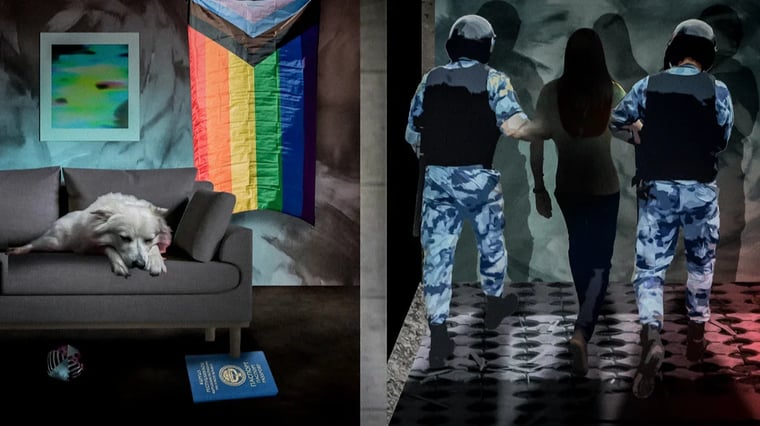
This is not to say that the show portrays Russia in a positive light: after all, Ilya’s main struggle is being unable to come out due to entrenched Russian homophobia, and a fear of being ostracised not only by his friends, his family, and the hockey world, but also by his own homeland.
In a time of political tension and uncertainty, rebranding Russia from a political reality to an aesthetic is not without its dangers.
Yet, the significant amount of screen time given over to dialogue in Russian coupled with the show’s immense global success, has allowed Russian culture to enjoy a completely different form of exposure than that the war in Ukraine has limited it to for the past four years. Viewers are granted an intimate glimpse into Ilya’s life at home, which serves to humanise those Russians whose identities are typically overshadowed by the authoritarian and heavily militarised state of which they are — willingly or not — a part.
In a time of political tension and uncertainty, rebranding Russia from a political reality to an aesthetic is not without its dangers, Sapozhnikov says. Though not intrinsically bad, an overall tendency to portray Russia in a positive light also runs the risk of misinterpretation, especially when the institutions that prop up the global rules-based order have been so frequently painted as unfit for purpose, the destructive nature of Russia’s invasion of Ukraine can easily fall by the wayside.
“Unlike in 2022, expansionist Russia is now perceived more as a symptom of a more general, deeper crisis than as a mad, solitary swindler”, making Vladimir Putin appear almost “rational” against the background of Trump’s chaotic second term as president. Enhancing Russia’s reputation by increasing the popularity of its culture can contribute to this reframing of narratives, and Sapozhnikov notes, “Kremlin political technologists will do everything in their power to ensure that this is exactly how things turn out”.