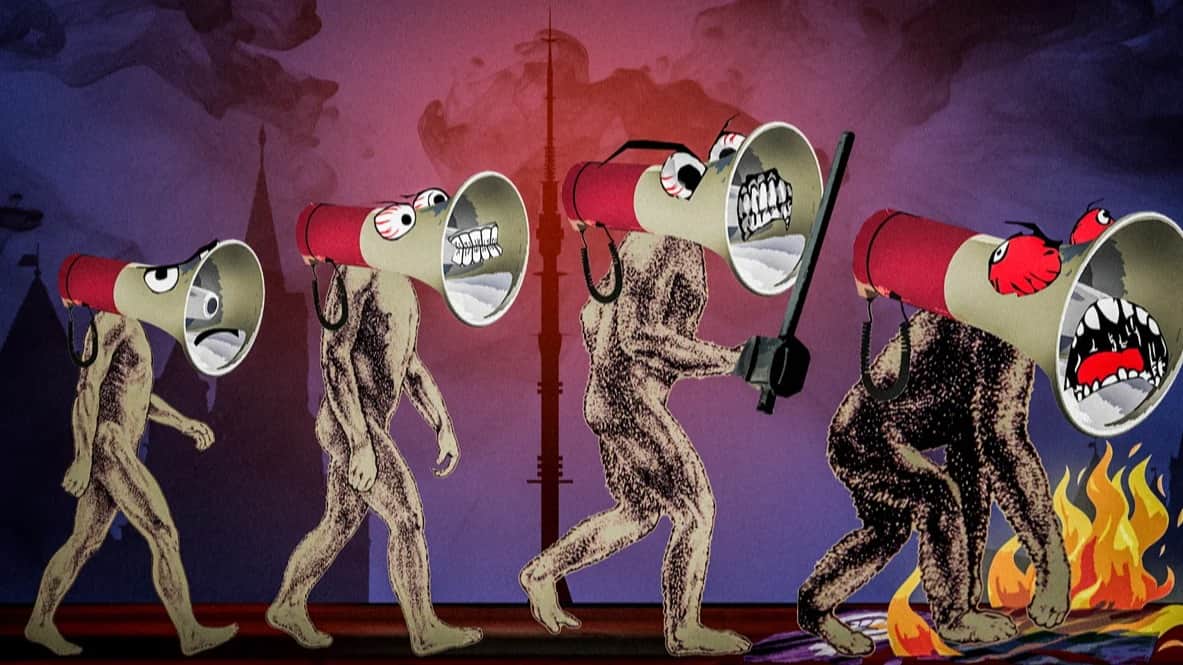
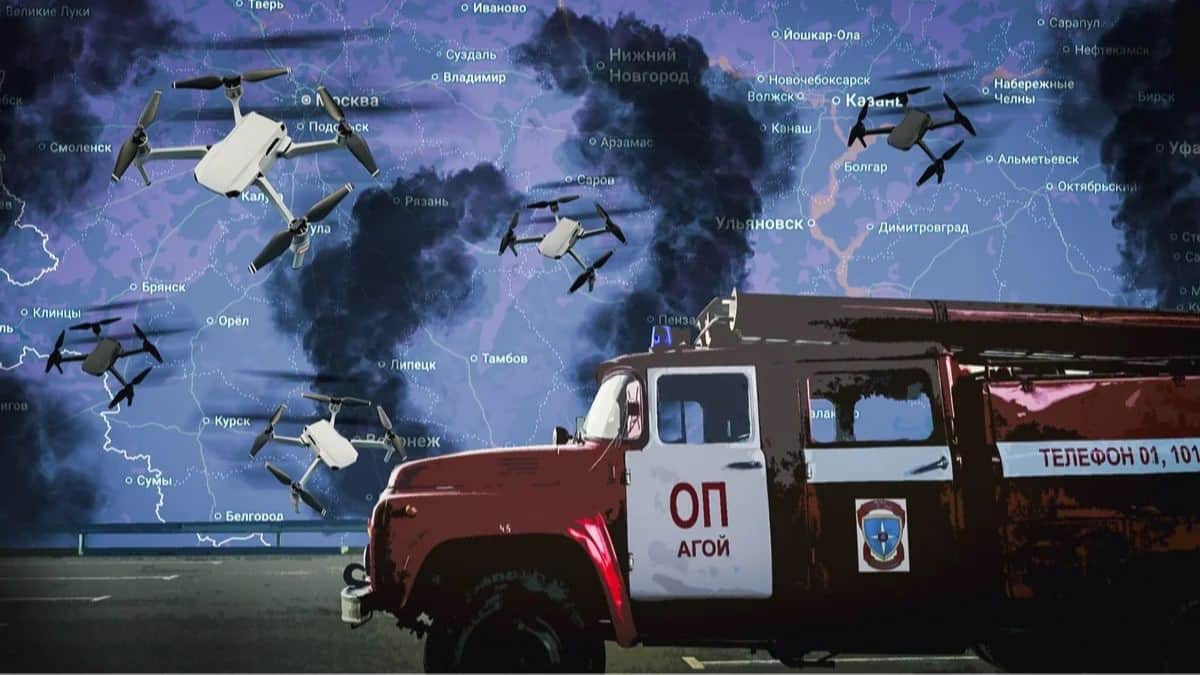
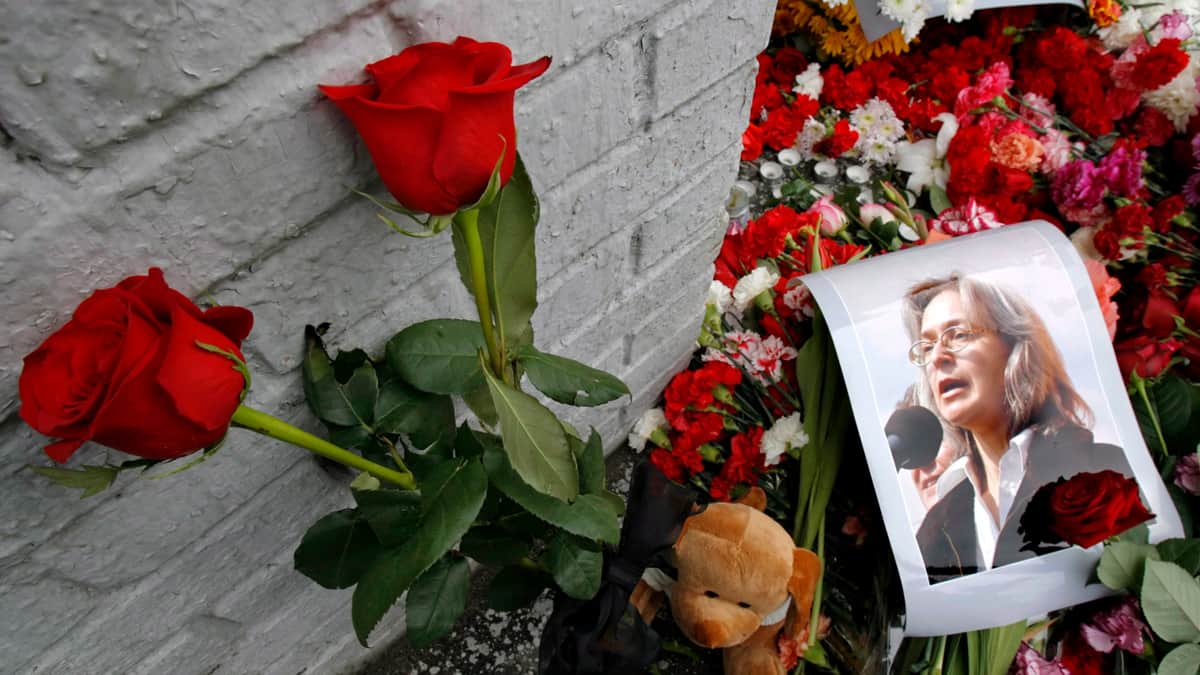
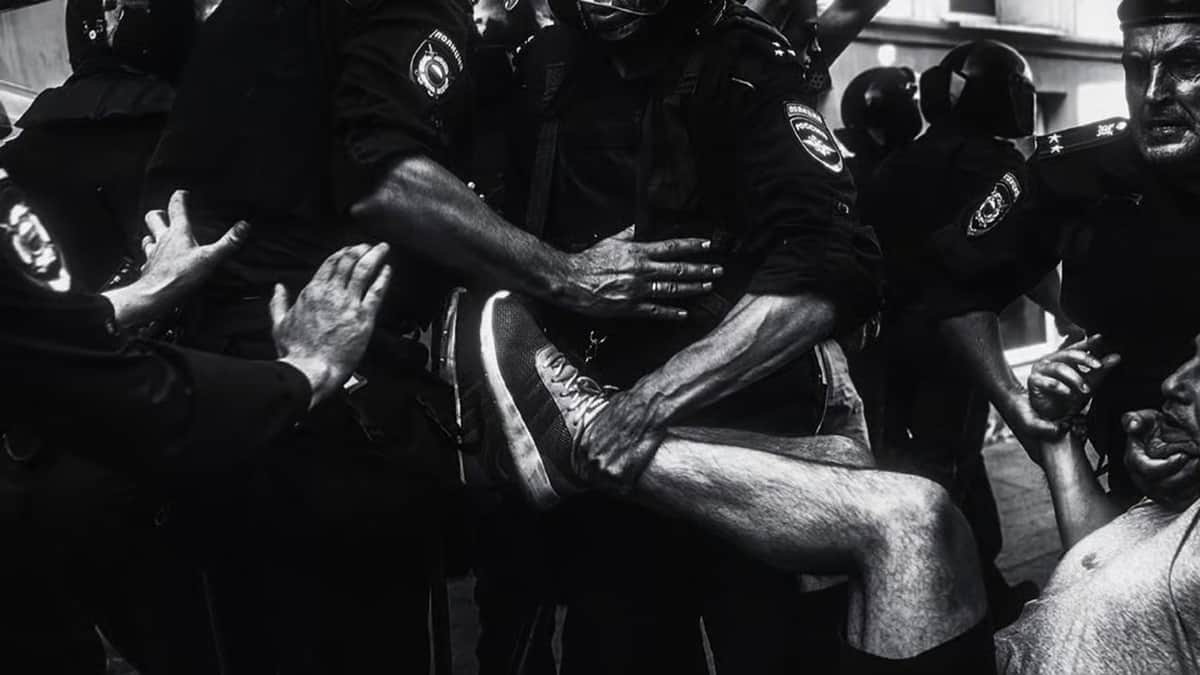
In an attempt to trace how hostility towards the political opposition, migrants and people with so-called “non-traditional values” has evolved since 2019, Novaya Gazeta Europe has analysed 5 million Telegram posts published by Russian pro-Kremlin channels.
Having identified the groups most frequently targeted by pro-government media, we next took a closer look at how the Russian state’s hatemongering propaganda has developed, and how at certain times it has been deliberately redirected in line with changing political circumstances.
Between 2019 and 2024, we analysed over 5 million Telegram posts published by nearly 100 pro-government outlets. These ranged from official state agencies such as TASS and RIA Novosti, to television propagandists like Vladimir Solovyov, as well as various anonymously run Telegram channels aligned with the Kremlin.
The pattern is strikingly consistent. Hostility intensifies ahead of repressive legislation, peaks during moments of political uncertainty, and is channelled towards groups least able to defend themselves.
Weaponising homophobia
By 2019, Russia was already experiencing a new wave of repression against LGBT people. In Chechnya, human rights organisations documented renewed mass detentions, torture and so-called “honour killings”. In Moscow, the LGBT film festival Side by Side was held for the last time, amid attacks by far-right groups operating with tacit official approval. That same year, sportswear brand Reebok was forced to withdraw a feminist advertising campaign after a coordinated backlash.
At that point, however, anti-LGBT rhetoric had not yet become dominant in pro-government media. In 2019, 46% of posts referring to LGBT people or women’s rights were negative. By 2022, that figure had climbed to 65%.
The shift coincided with legislative changes. In 2020, Russia amended its constitution to define marriage exclusively as a union between a man and a woman. According to a lawyer from the LGBT advocacy group Vykhod, who asked to remain anonymous, the escalation in hostile coverage was partly linked to preparations for these amendments. The state set the tone, and the media followed.
By 2020–2021, attacks on LGBT people had also been woven into a broader ideological narrative. Russia was increasingly portrayed as defending its sovereignty not only militarily, but morally — resisting what was described as the West’s “ideological expansion”.
When Russia’s full-scale invasion of Ukraine began in February 2022, coverage of LGBT issues briefly faded from view, overshadowed by the media fixation on Ukraine. Yet despite the lack of news triggers, the proportion of posts about LGBT people that were negative reached a historic high — 72% — in the first half of that year.
Just weeks later, lawmakers began discussing legislation to completely ban so-called “LGBT propaganda”.
“The war was framed as a confrontation with the West as a whole,” the Vykhod expert explains. “By the summer, the initial rally-around-the-flag effect had worn off. The authorities needed a way to keep that sense of threat alive — and this initiative served that purpose perfectly.”
Since 2022, posts describing restrictions on LGBT rights or outright repression have consistently accounted for between 60% and 70% of all coverage the topic has received. Legislative activity follows a recognisable rhythm. In July 2023, Russia banned gender-affirming medical care. In June 2024, lawmakers began discussing a ban on so-called “child-free propaganda”. In November 2023, the authorities went further still, declaring the nonexistent “international LGBT movement” an extremist organisation.
While pro-government media continue to portray the West as a place “captured by perverts”, their language towards LGBT people inside Russia has grown noticeably harsher — and increasingly explicit.
Migrants as a political target
In September 2021, a murder in the Moscow region marked a turning point. In the village of Buzhaninovo, two citizens of Tajikistan raped and killed a local pensioner. News of the crime sparked a spontaneous protest by residents, who demanded the expulsion of all migrants from a nearby workers’ dormitory. The authorities complied within a single day — even though it later emerged that the perpetrators of the crime had never even lived there.
The case was one of dozens involving migrants that dominated federal headlines in late summer and autumn 2021. Crimes committed by “non-Slavs” received disproportionate attention, while Russian citizens were increasingly portrayed as victims — not only at home, but throughout the former Soviet region.
As a result, the share of negative reporting on migrants rose from around 22% in 2020 and early 2021 to 34% between August 2021 and October 2021. In other words, every third mention of migrants or ethnic minorities carried a negative tone.
This first major wave of anti-migrant sentiment coincided with discussions of a new migration law that proposed expanded digital surveillance and simplified deportation procedures. Valentina Chupik, a human rights lawyer who provides free legal assistance to migrants, believes the media campaign was designed to smooth the law’s passage.
The statistics tell a different story. According to joint research by independent media outlets IStories and Novaya Gazeta, migrants commit crimes at roughly half the rate of Russian citizens. Fights that allegedly triggered public outrage often involved just two or three people, Chupik says. What changed in 2021 was not reality, but emphasis, according to Roman Stepanov, another migration lawyer.
“Migrants are targeted because they are defenceless,” Chupik says. “They are visible, perceived as foreign — and therefore even easier to turn into enemies.”
A second wave followed in spring 2023 — this time driven not by crime stories, but by state action. Police raids targeting migrants became routine, including operations in mosques where worshippers were forced to lie face-down while their documents were checked, sometimes in the middle of prayer. Smaller stories received similar treatment: for example, a family from Tajikistan was expelled after their children were accused of begging and misbehaviour. By September 2023, negative coverage of migrants had reached a new peak of 41%.
Once again, the timing aligned with legislative plans. At the end of 2023, the authorities returned to a draft migration bill closely resembling the one shelved before the war.
“Migrants are targeted because they are defenceless,” Chupik says. “They are visible, perceived as foreign — and therefore even easier to turn into enemies.”
Normalising repression
In August 2020, Alexey Navalny was poisoned and hospitalised in the Siberian city of Omsk. For a brief moment, something unexpected happened: pro-government media lowered the temperature. Negative coverage of the opposition fell sharply, dropping to 45% by the end of the month.
Even so, hostility towards the opposition had long been entrenched. As early as 2019, 60% of posts mentioning opposition activists were negative. By 2024, that figure had grown still further.
Navalny’s poisoning marked a strategic shift. Previously, his name had often been avoided or downplayed. Now it had become unavoidable. State media covered his poisoning, his arrest upon returning to Russia, and the subsequent court cases, helping to normalise repression itself.
Before 2020, only 30% to 35% of opposition-related posts mentioned searches, arrests or trials. Even during the mass protests of 2019, the figure rarely exceeded 45%. By mid-2021, it had reached around 50%, as Navalny’s organisations were labelled extremist and independent media outlets began to be designated “foreign agents”.
Hate speech escalated alongside repression. From late 2020 to late 2021, the share of posts containing explicit hostility — insults, approval of repression, dehumanising language — nearly doubled, from 7.5% to 13%. Notably, this did not happen immediately after the poisoning. Instead, it began after Navalny returned to Russia.
Political scientist Ilya Matveyev suggests the delay was intentional. “The authorities were wary of provoking strong emotions,” he says. “Open hatred might have turned Navalny into a martyr.”
“If you cannot rely on genuine popular support, you must demonstrate repression as publicly as possible.”
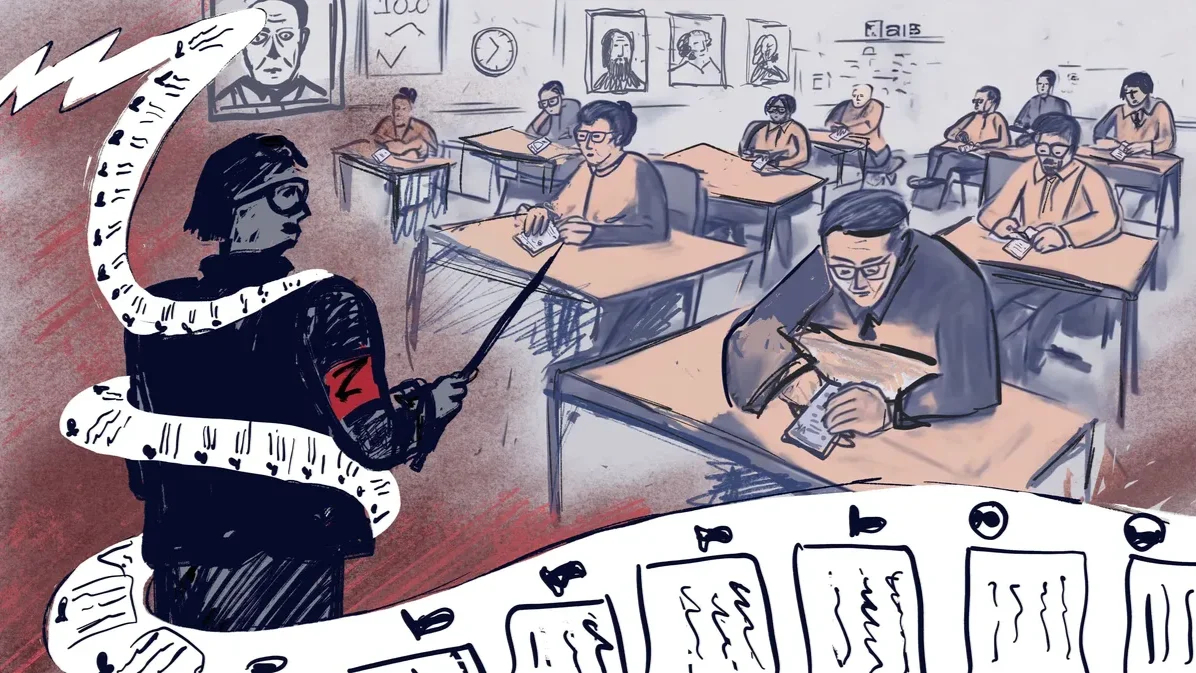
After the invasion of Ukraine, the category of “internal enemy” was expanded. Navalny’s supporters were replaced by “traitors” — Russians accused of siding with Ukraine and the West. By spring 2022, every fifth post about the opposition contained accusations of betrayal, dehumanisation or approval of repression.
That summer, hostility towards the opposition peaked — roughly in parallel with the surge in anti-LGBT rhetoric. Public figures were designated “foreign agents” en masse, and pro-government media began openly endorsing personalised repression.
Today, between 50% and 70% of all posts about the opposition describe arrests, court cases or other forms of punishment. Political scientist Yekaterina Schulmann argues that this visibility is deliberate: “If you cannot rely on genuine popular support, you must demonstrate repression as publicly as possible.”
Manufactured enemies
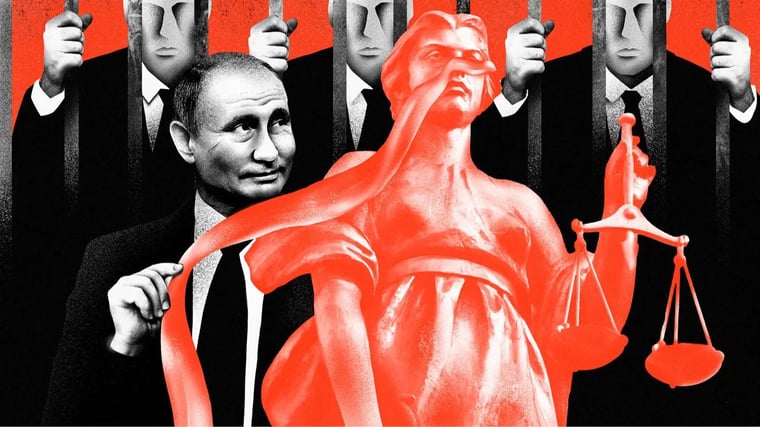
The mobilisation of hatred is a familiar feature of authoritarian systems. According to Matveyev, it has become essential to the Russian political model. “Everything rests on hate,” he says. “Support is manufactured through the image of a shared enemy.”
The long-term consequences may be severe. Schulmann warns that war has normalised violence and collective aggression. “Large numbers of people have learned how to use weapons, how to participate in organised violence. Where will that energy go once the war ends?”
One of the most likely scenarios, she warns, is a functional degradation of the political system, accompanied by pockets of social brutalisation — a fragmentation in which violence becomes localised, habitual and increasingly detached from formal political control.
There is, however, room for cautious optimism. Propaganda narratives often fail to take deep root. Tolerance continues to grow in Russia’s major cities, Matveyev argues, but it has to be constantly suppressed. “Homophobia is not a natural state,” he says. “It requires continuous reinforcement.”
The same logic applies to migrants. If state-sponsored hostility disappears, Chupik says, attitudes will shift quickly. “Without propaganda, people stop hating.”
Join us in rebuilding Novaya Gazeta Europe
The Russian government has banned independent media. We were forced to leave our country in order to keep doing our job, telling our readers about what is going on Russia, Ukraine and Europe.
We will continue fighting against warfare and dictatorship. We believe that freedom of speech is the most efficient antidote against tyranny. Support us financially to help us fight for peace and freedom.
By clicking the Support button, you agree to the processing of your personal data.
To cancel a regular donation, please write to [email protected]