


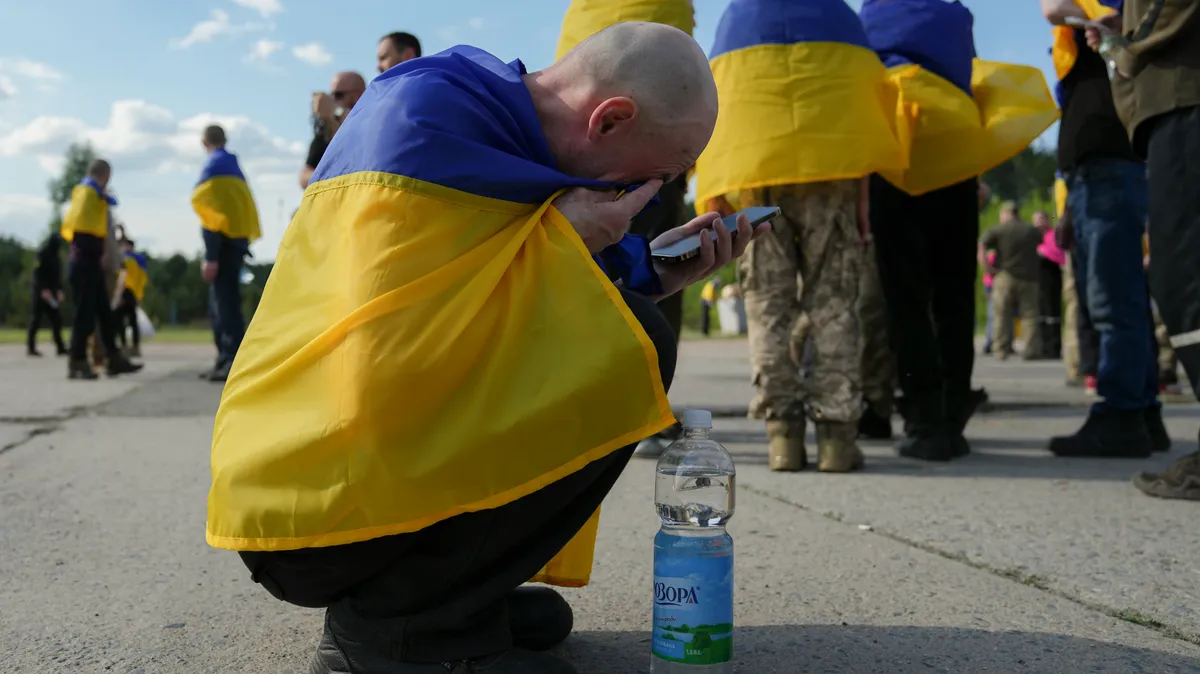
Ukrainian soldier Stanislav Panchenko spent six-and-a-half long years in a Russian prison after being captured in eastern Ukraine’s Donetsk region in 2019. Convicted by a court in the self-proclaimed Donetsk People’s Republic, a Russian-backed breakaway region, for attempting to alter its borders and for breaching its constitution, Panchenko was suddenly released as part of a large-scale prisoner of war exchange in August.
During their time in captivity, Panchenko and his fellow Ukrainian POWs were repeatedly used in Russian propaganda videos in breach of the Geneva Conventions. In one, Panchenko was erroneously identified as a member of Ukraine’s Azov Battalion, a frequently evoked bogeyman in pro-Kremlin mythology that has been deemed a “terrorist organisation” in Russia.
In another video, a visibly coerced Panchenko confirms that Azov fighters are vodka-drinking drug addicts who would freely abandon their positions and discharge their weapons at will. In yet another, he unconvincingly says that his unit had been preparing to use chemical weapons on the battlefield.
Panchenko, now 26, told Novaya Gazeta Europe about his long ordeal and the years of his life he has lost to captivity, years in which he was unable to see his mother, and during which his older brother was killed in the defence of the city of Avdiivka, a short distance from the penal colony in which Panchenko spent much of his prison sentence.
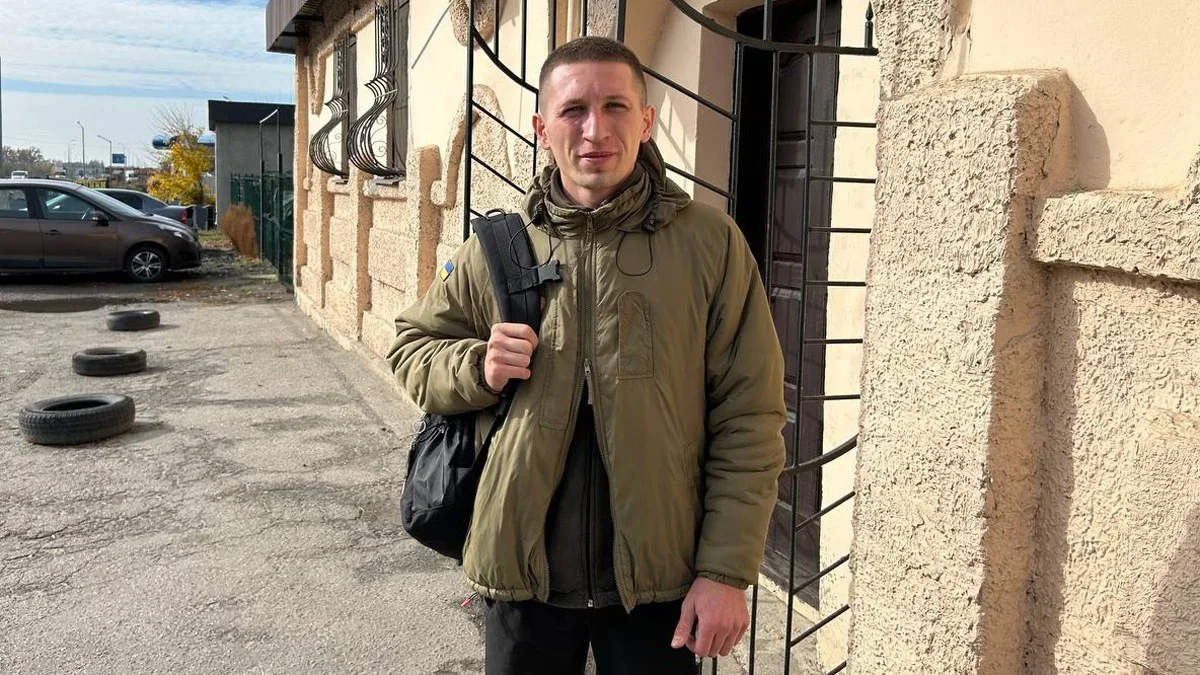
Stanislav Panchenko. Photo: Dmitry Durnev / Novaya Gazeta Europe
Stanislav’s story
After joining the 58th Motorized Brigade and completing his basic military training, Panchenko was sent to Luhansk. “We were held up there for around four and a half months, and then for the same period near Donetsk. I have some regrets now about joining the 58th. I don’t think they treated me very well: they didn’t help my mother when I was in prison and even since my release they’ve barely acknowledged my existence.”
On 17 January 2019, Panchenko was heading to his post at around 10pm ahead of his watch duty, which began at midnight. “As I later told our counterintelligence services, I can’t remember what happened next. I woke up in a basement with no idea how I got there. I was questioned for a while, but once they established that I was just a regular private, they sent me straight back to the basement.”
“When the sun started to come up the next morning, some older guys turned up, took pictures of me and confiscated my patches.” After the soldiers took more photos of Panchenko, he was tied up using duct tape and forced into the back of a car. “God knows where they took us. I was riding in the back between two guys in balaclavas who kept punching me in the stomach the whole way.”
“We arrived and they took me into a building, where some masked guy was waiting in a small room. He removed the tape from my head and neck, but my hands were still bound behind my back. When they saw the tattoo on my neck, they didn’t hold back and beat me to within an inch of my life. I screamed at them that my tattoo wasn’t a swastika, and that they should google it.”
Propaganda tool
After a month in military detention, Panchenko recalls getting a visit from a Russian man who would hit him for the fun of it, beating what he needed out of him. “His accent was definitely not local, so he was almost certainly Russian,” Pancheko adds.
“Sometime in the morning he said that some people would be coming to teach me a lesson, and that I’d spill my guts when they did,” Panchenko says, adding that a journalist and propagandist named Daniil ‘Goodwin’ Bezsonov who worked with the DPR’s Information Ministry brought him a piece of paper, with everything they wanted him to say on camera written down on it.
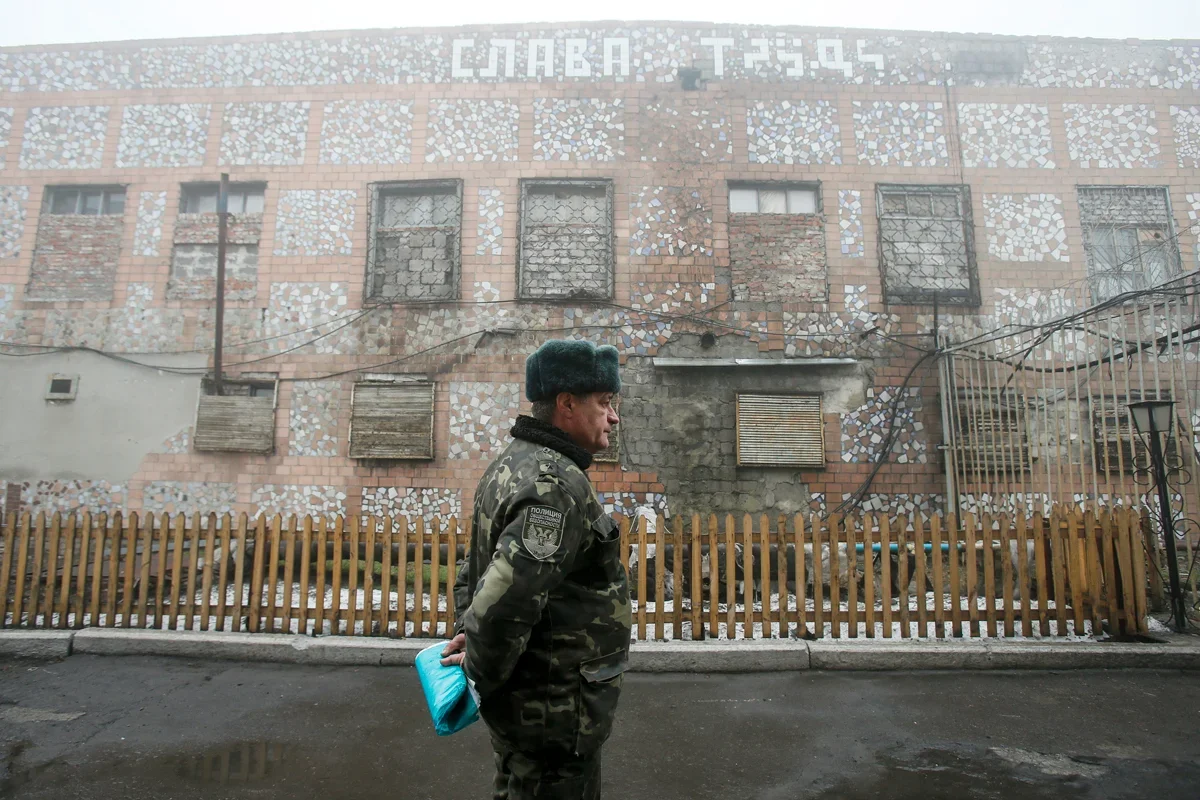
A police officer stands outside the penal colony in Makiivka where Panchenko was imprisoned, in Russian-occupied Donetsk. Photo: Maxim Shemetov / Reuters / Scanpix / LETA
“Bezsonov kind of saved me, you could say. He came in while I was on the floor with my hands tied behind my back. I was picked up by the handcuffs, but he said ‘What are you doing? He’s young. He’ll say what he has to say!’ I was very surprised.”
“They picked me up, and put me on a chair. I read the sheet of paper they gave me, and even laughed a bit. It was all in Russian and sounded very farfetched. They hit me, and told me that they didn’t give a fuck, that I had one hour to learn it by heart for the camera.”
“They filmed for a bit and put me back in the cell and only took me back out to record an interview with a female journalist two days later. But that time there was no sheet of paper to read off. They just told me what I had to say: that our brigade had been given protective kit, and we were going to be used as chemical warfare troops, but just didn’t have all the equipment yet.”
“It was at this point I asked if they were serious. I mean, I obviously had no choice, and I wanted to survive, but this was ridiculous. They told me not to worry about how it might come across, and reminded me that once I was exchanged, what I had said wouldn’t matter anyway.”
Trial & punishment
Panchenko’s trial was carried out by video link, although he says he was unable to hear most of the proceedings, which lasted for all of 20 minutes. “It was all very quick. In February, I was taken to a holding cell, and, from there, to an investigator. They tied me up again, put a bag over my head, and forced me into the boot of a car.”
“They took me to the military police, and there, while you’re waiting in line to see the investigator, they put you in a stress position against the wall. They constantly beat your legs, while your hands are cuffed behind your back.”
“The investigator kept me there until the evening and told me what I was being charged with: something about illegally attempting to seize power by force, illegal military training, and illegal possession of weapons. … Somewhere I still have that piece of paper and a pardon from Putin and another piece of paper saying I’m banned from entering Russia for 10 years. It’s ridiculous.”
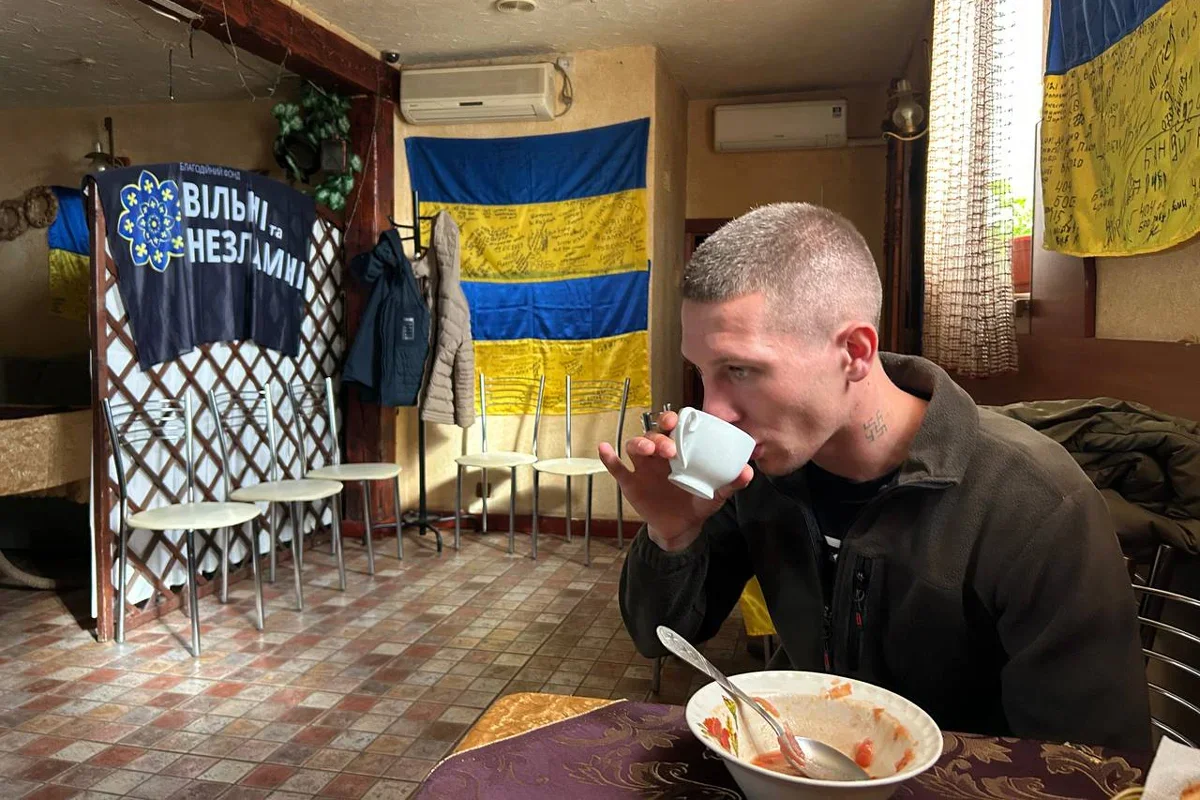
Stanislav Panchenko, following his release. Photo: Dmytro Durnev / Novaya Gazeta Europe
“The next day they took me to a pretrial detention centre in Donetsk. I was held there for eight months, but conditions were at least a little easier there. There were eight people in a cell, all soldiers, half of whom were exchanged at the end of that year.”
“The FSB harassed me before the prisoner exchange. … At first, they would come into the cell at night, wearing masks. Often they wouldn’t even hit me, they’d just look at my tattoo and call me a Nazi.”
Before the exchange, some masked guards asked Panchenko if he was a skinhead. “To which I said, ‘Of course I’m a skinhead! My head’s shaved! Everyone in Ukraine is like me!’ Let them be scared of us. That would stand us in good stead.”
One morning after roll call, names — including Panchenko’s — were read out from another list, and everyone on it was told they had two hours to pack up and get out. After signing paperwork saying that they had no complaints about their treatment in captivity, they were put in the back of a police van and driven to the Ukrainian border.
“Finally, I want to live a little. I’m 26 and have spent over six years in captivity. I’ve missed so much.”
Panchenko says that he’d already have returned to the army if his older brother Svyatoslav hadn’t already been killed in action. “My brother Svyatoslav died near Avdiivka, the day after our mother’s birthday. She has five sons and a daughter. Svyatyi died while fighting with the Azov Battalion and was just 12 kilometres away from my penal colony. That hurts.
“Three of us five boys went to the army. One died, and I was in captivity for so long. I talked to our counterintelligence service and said that I thought our family had done its duty for now.” Asked whether he dreams of avenging his brother, Panchenko says that he does, but worries that his mother wouldn’t cope if he died too. “Svyatyi has changed her fundamentally. She only has to hear something or see his photo and she bursts into tears.”
“Finally, I want to live a little. I’m 26 and have spent over six years in captivity. I’ve missed so much. But now I’ve met a girl. … She’s 24. I don’t want to say anything else about her, but it’s serious, I hope.
Join us in rebuilding Novaya Gazeta Europe
The Russian government has banned independent media. We were forced to leave our country in order to keep doing our job, telling our readers about what is going on Russia, Ukraine and Europe.
We will continue fighting against warfare and dictatorship. We believe that freedom of speech is the most efficient antidote against tyranny. Support us financially to help us fight for peace and freedom.
By clicking the Support button, you agree to the processing of your personal data.
To cancel a regular donation, please write to [email protected]


