Russia uses Oreshnik missile on Lviv in ‘response’ to alleged attack on Putin residence

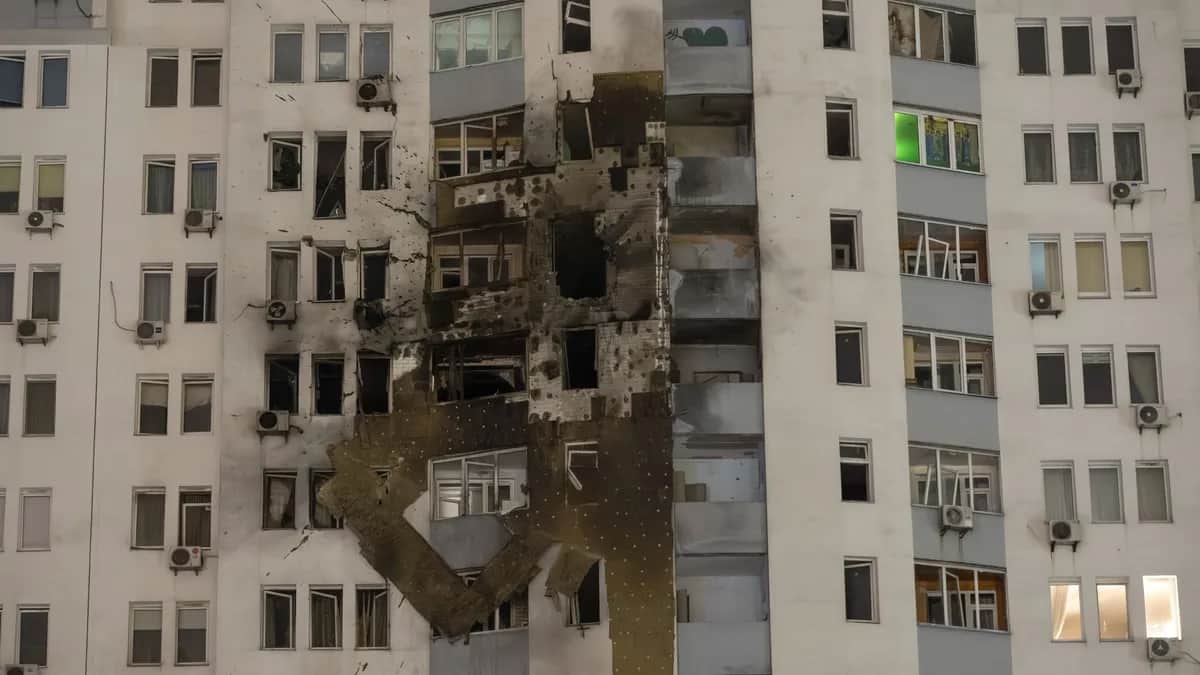
Four people were killed and 25 more were injured in an overnight Russian airstrike on Kyiv, the Ukrainian authorities said on Friday, while Russia also targeted the western city of Lviv with an Oreshnik ballistic missile in what it described as its “response” to a claimed Ukrainian drone strike on one of Vladimir Putin’s residences last month.
The State Emergency Service of Ukraine said that the Russian military had struck some 40 targets in the Ukrainian capital, 20 of which were residential buildings, with what it called the “inhuman goal of leaving millions of people without light, heat and water in the middle of a freezing winter”.
Kyiv Mayor Vitaliy Klitschko said Russia had carried out a double-tap strike on one apartment block it targeted, following up an initial missile strike with a second one as rescue operations were underway, killing one medic.
While Russia’s Defence Ministry did not comment on the Kyiv airstrikes, it did say on Friday that it had carried out a “massive strike with high-precision long-range land- and sea-based weapons” overnight, which it called a response to the “terrorist attack by the Kiev regime” on one of Putin’s presidential residences in Russia’s northwestern Novgorod region in December.
“The strike objectives were achieved. Facilities producing unmanned aerial vehicles used in the terrorist attack were hit, as well as energy infrastructure supporting Ukraine’s military-industrial complex”, the ministry’s statement continued.
Though the Defence Ministry didn’t specify the target of the strike, it appears to have been the western Ukrainian city of Lviv, whose Mayor Andriy Sadovyi said it was attacked by a missile travelling at around 13,000 km/h, a speed consistent with an Oreshnik ballistic missile.
“The city is located less than 70 kilometres from the border with the European Union. This is a clear signal to our international partners: Russia’s war does not stop at any borders”, Sadovyi said.
Lviv Governor Maksym Kozytskyi said the attack had targeted “critical infrastructure” in the region, which local media outlets reported was likely the Stryi gas field and storage facility.
Ukrainian President Volodymyr Zelensky confirmed Russia had used the Oreshnik in the attack, as well as 13 other ballistic missiles, 22 cruise missiles and 242 drones, and that among the buildings damaged in Kyiv was the Embassy of Qatar, “a state that does so much to mediate with Russia in order to secure the release of prisoners of war and civilians held in Russian prisons.”
“A clear reaction from the world is needed. Above all from the United States, whose signals Russia truly pays attention to”, Zelensky said. “Russia must receive signals that it is its obligation to focus on diplomacy, and must feel consequences every time it again focuses on killings and the destruction of infrastructure”.
On Thursday evening, Zelensky warned of a potential “massive Russian attack” overnight, while the US Embassy in Kyiv warned of a “potentially significant” airstrike on Ukraine in the coming days — a similar alert to the one it issued before Russia launched an Oreshnik at the city of Dnipro in central Ukraine in November, its only previous use of the missile in the war.
The Oreshnik is an intermediate-range, hypersonic ballistic missile, with a range of over 5,000 km. As well as being extremely difficult for defence systems to intercept, it is believed to have a warhead that deliberately fragments during its final descent into several, independently targeted inert projectiles, causing distinctive repeated explosions moments apart, according to the BBC.
Kyiv has repeatedly denied that it attempted to strike Putin’s Valdai residence in December, with Zelensky calling Russia’s claims of an attack a “complete fabrication intended to justify additional attacks against Ukraine” and derail peace negotiations.
The CIA, meanwhile, concluded that Ukrainian drones launched at the Novgorod region on the day of the alleged attack had actually been targeting a military facility in the same region.