


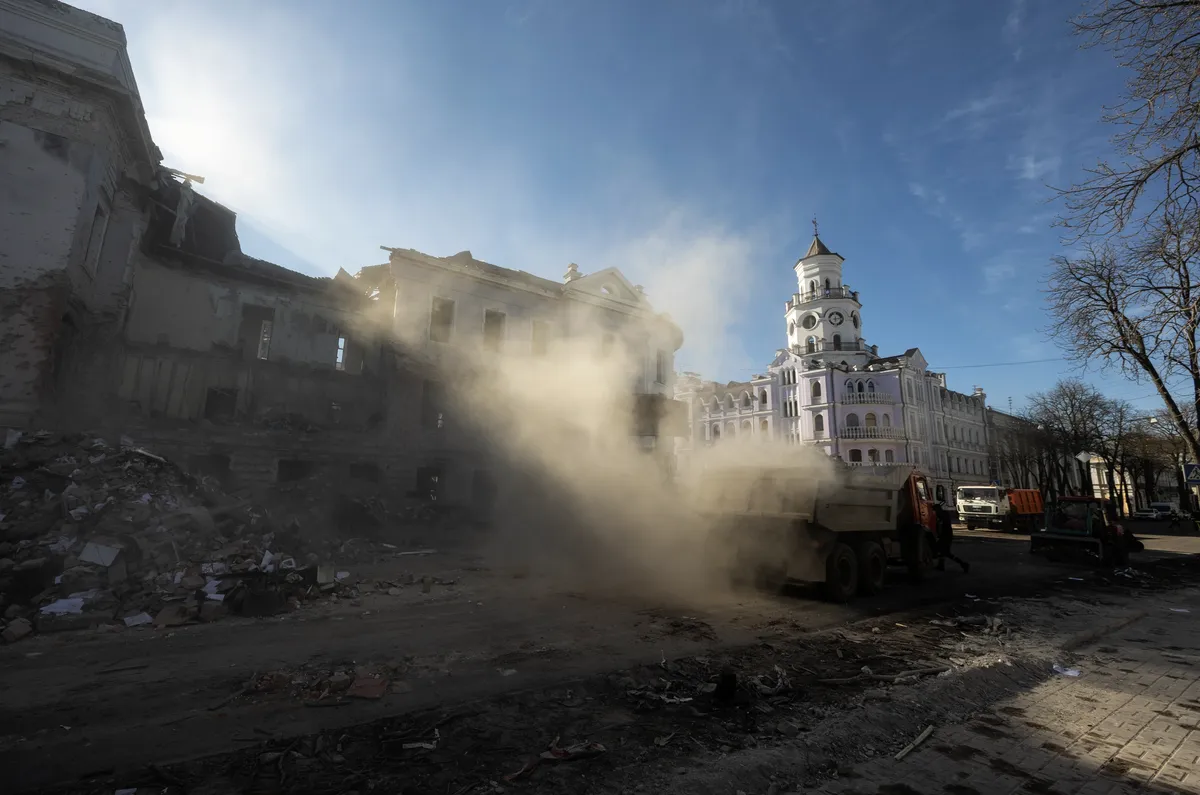
The aftermath of a Russian missile strike on the city of Sumy in northern Ukraine, 15 April 2025. Photo: EPA / Sergey Kozlov
The Russian Defence Ministry announced that its forces had captured the village of Hrabovske in Ukraine’s northern Sumy region on Monday, marking a potential advance by Russian troops in a region that had largely avoided fighting until now.
According to the ministry’s statement, Hrabovske was “taken under control as a result of active operations by units of the 34th Separate Guards Motorised Rifle Brigade”, and that after “destroying the main pockets of resistance with precision strikes from artillery and FPV drones, the enemy suffered losses and was forced to abandon its positions and leave the village.”
“Operating in small groups, the assault units were able to secure their positions in the village and conduct a sweep of buildings, basements and adjacent forest strips,” the ministry said, adding that units of the Sever military group were “advancing daily as part of the creation of a security zone in the border areas of the Sumy and Kharkiv regions of Ukraine.”
Despite being subjected to frequent Russian airstrikes, the Sumy region, which borders Russia, has largely been spared heavy fighting, and is not one of the four regions that Russia claimed to have annexed from Ukraine in 2022. It did, however, play a key role in the Ukrainian incursion into Russia’s Kursk region in August 2024, which lasted seven months.
In late December, Kyiv accused the Russian military of illegally kidnapping some 60 civilian residents of Hrabovske, noting that most of them were "elderly women”. Ukrainian Foreign Minister Andriy Sybiha said that such “medieval raids” simply showed that “Putin’s Russia” was “no different from terrorist groups like ISIS, Boko Haram, or Hamas”.


