StoriesSociety

Flight cancellation

An underground group that helps Russian activists flee the country is being forced to cease operations due to lack of funds

Flight cancellation

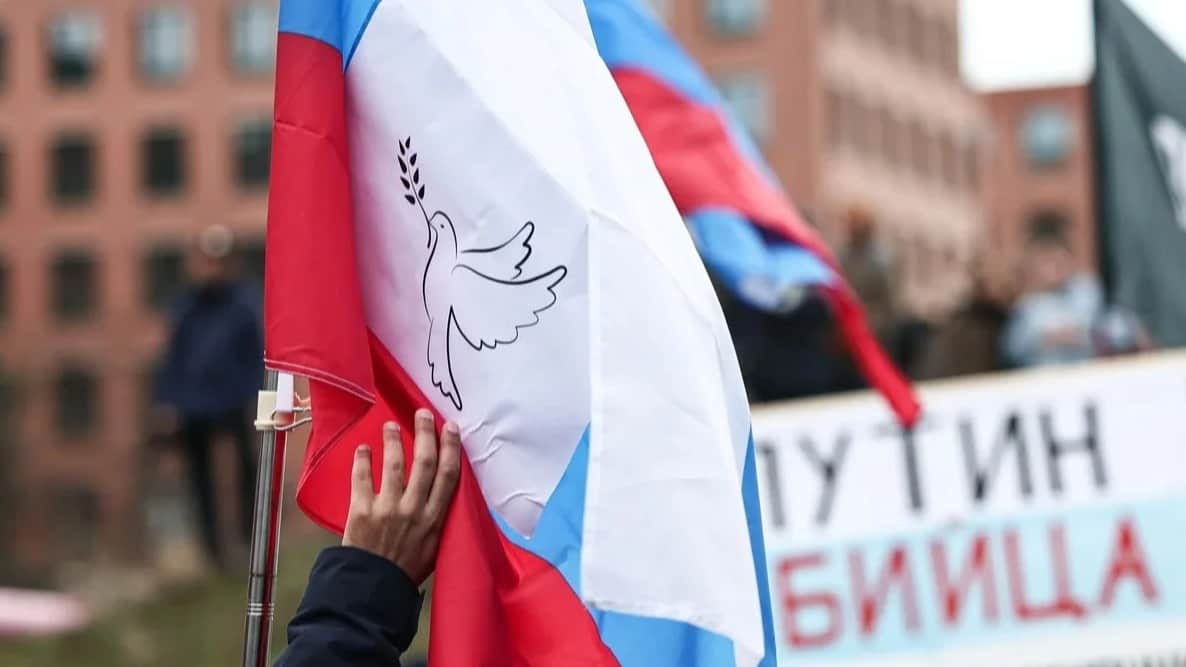
A protestor carries a Russian flag featuring a dove of peace, Berlin, Germany, 1 March 2025. Photo: Hannes P. Albert / dpa / Scanpix / LETA

Since Russia’s invasion of Ukraine began in 2002, one underground organisation calling itself Vyvozhuk has established itself as a key resource for anti-war activists, whom it helps flee the country at that crucial moment when their outspoken resistance to the Kremlin’s war-mongering is about to translate into a prison sentence. To date, its volunteers have helped over 200 people reach safety abroad.

Last week, the team announced that it would be ending all direct assistance, including legal and evacuation consultations and be closing its hotline for Russians facing political persecution at the end of the year.

“For three years, grant-awarding foundations have largely refused to cover the cost of evacuations. But this is our main focus, and it requires significant resources. A single evacuation can cost upwards of €800,” one member of the group told Novaya Gazeta Europe. “All our activities were possible thanks to caring people who donated specifically for evacuations. When our resources significantly dwindled, we had to make a decision.”

Vyvozhuk, an initiative created by multiple anti-war projects and individual activists, was born in October 2022. The organisation, whose name is a wordplay based on the words “evacuation” and “bug”, was created in response to the fresh wave of political repression that followed the Russian invasion of Ukraine earlier that year. When Vyvozhuk launched, it had six members of staff, most of whom worked anonymously, and the team remained purposely small to avoid taking unnecessary risks as it dealt with around 60 to 70 flight requests per month.

The group’s work often didn’t end once an evacuation was complete, as those facing criminal prosecution in Russia often remain at risk even after leaving the country.

Whereas prior to 2022, it was mainly journalists, activists, and human rights activists wanting to flee abroad, the outbreak of war changed that, when the persecution of anybody who disagreed with state policy began.

One such person was Lidia Prudovskaya, a railway dispatcher in the closed city of Mirny in the Russian Arctic who was prosecuted for posts she made on social media. Now she and her children are waiting for a decision on their French political asylum application.

The group’s work often didn’t end once an evacuation was complete, as those facing criminal prosecution in Russia often remain at risk even after leaving the country. The activists say the longest case they took on went on for over two years.

Lidia Prudovskaya and her children. Photo: VK

Lidia Prudovskaya and her children. Photo: VK

Northern light

Olesya Krivtsova, 22, from northern Russia’s Arkhangelsk region, fled the country two years ago while still under house arrest as she awaited trial for anti-war social media posts she had made. Indeed, when Krivtsova fled, she was still wearing an ankle bracelet.

“I was accused of discrediting the army and justifying terrorism in online posts. I was looking at up to 10 years in prison in total,” she says. She contacted Vyvozhuk via a friend who had already left the country with the group’s help.

“I had all these ideas about what the evacuation would be like, wandering through the forest in camouflage and crossing the border illegally. But it wasn’t like that at all,” Krivtsova says. “When I got in touch with the activists, my route was unclear. My mother was very much afraid that nothing would come of it. I didn’t really care who I trusted to get me out — I just knew that if I didn’t escape, I would go to jail. And if they caught me along the way, they’d put me in prison anyway. It was just a matter of time.”

Krivtsova began preparing to leave Russia. She had her passport, which her mother had prudently hidden when the criminal cases against her daughter were opened. She left home wearing the ankle bracelet at 4am and with a new phone.

Krivtsova says that she can now look at Russia from a European perspective and is not in prison thanks to Vyvozhuk. They literally saved my life, she says.

“Leaving with it on wasn’t difficult. It doesn’t have GPS. At home, I have a large penitentiary service device that looks like a phone, which the bracelet attaches to. It can see when you’re at home, but it doesn’t track your location when you leave.”

She said Vyvozhuk activists coordinated with her all the way to the border, telling her where she could stop for food, cigarettes and even to get a little sleep. At Vyvozhuk’s request, we won’t share any further details of the evacuation route for security reasons, and so that it can be used again in the future.

Krivtsova managed to make it across the border into Lithuania where she was eventually joined by her husband. She subsequently moved to Norway after being offered a job by The Barents Observer, an independent newspaper based in the city of Kirkenes, where she now works just 15km from the Russian border. Her mother and 10-year-old sister also both joined her in Norway, and are currently awaiting a decision on their asylum application.

Krivtsova says that she can now look at Russia from a European perspective and is not in prison thanks to Vyvozhuk. They literally saved my life, she says.

Olesya Krivtsova. Photo:  Telegram

Olesya Krivtsova. Photo: Telegram

All walks of life

Forty-seven-year-old Roman, from the city of Gagarin in western Russia’s Smolensk region, fled Russia in January. Though arduous and nerve-racking, his escape was successful and he now lives in Armenia.

Roman fled as he was being prosecuted for comments he made on a Telegram post about the terror attack on Moscow’s Crocus City Hall in March 2024, which he accused Russia’s Federal Security Service (FSB) of carrying out, before publicly regretting his own vote for Vladimir Putin in the presidential elections earlier that month, given that he had been unable to prevent the attack.

Members of the Smolensk branch of the FSB appeared at his front door in October 2024. They took all his electronic devices, while Roman himself was taken away for hours of interrogation and ultimately charged with justifying terrorism and placed under house arrest. Roman began looking for activists who could help him leave the country, and came across Vyvozhuk.

Roman was already in Yerevan by 20 January, though he had difficulty opening an Armenian bank account as the Russian authorities had placed him on its list of extremists and terrorists.

“I bought a second phone to communicate with them. We were constantly in touch. And then I deleted all our messages every time I went to see the FSB investigator. The guys said they were collecting donations to evacuate five people, including me. Evacuating a single person cost 60,000 rubles (€640),” says Roman.

Between the rather peculiar conversations he would have with the FSB investigator assigned to his case, who wouldn’t let Roman change his state-appointed lawyer and urged him not to speak to anybody about the case — Roman obviously made no mention of his plan to flee the country.

“I realise they wanted to lock me up quietly so that nobody would be any the wiser. The investigator tried to frighten me by saying that if I got human rights activists involved, they would also frame me for cooperating with the Armed Forces of Ukraine.”

His case was transferred to the Prosecutor General’s Office in January. The investigator promised that he would petition for a non-custodial sentence.

Passengers at Yerevan Airport, Armenia, 21 September 2022. Photo: Karen Minasyan / AFP / Scanpix / LETA

Passengers at Yerevan Airport, Armenia, 21 September 2022. Photo: Karen Minasyan / AFP / Scanpix / LETA

“He told me that he liked working with me so much that he was going to apply for a promotion. I don’t know what’s become of him now. He’s probably very angry,” says Roman.

Roman saw the investigator for the last time on 15 January, as Vyvozhuk prepared him to leave for Armenia just three days later. Roman was already in Yerevan by 20 January, though he had difficulty opening an Armenian bank account as the Russian authorities had placed him on its list of extremists and terrorists. Nevertheless, he was able to find work as a cleaner, and currently shares an apartment with several other Russian refugees.

“They’re like me. Deserters, extremists — Russians from all walks of life,” Roman jokes. “Now Vyvozhuk has found me a lawyer who’s submitted my documents to the local French consulate for a humanitarian visa. I’m waiting to hear from them,” says Roman.

Those they helped leave Russia faced a total of 768 years in prison.
A return to Russia isn’t on the cards for Roman any time soon, however. He has no close relatives in the Smolensk region, and says that he is considered a traitor by his distant relatives due to his participation in anti-government protests.

“I spent three months thinking about whether to leave or not. Heading into the unknown was scary. I hoped maybe I’d just get a suspended sentence or a fine. But I checked and almost everyone found guilty of those charges gets a custodial sentence,” says Roman. “I think they’d have made my life unbearable.”

Over the last three years, the Vyvozhuk activists have helped over 200 Russians flee the country safely and advised over 1,700 others on how to emigrate and establish themselves elsewhere. Those they helped leave Russia faced a total of 768 years in prison.
“Is that a lot? Yes, those are huge numbers, and each person has their own history of persecution by the state,” one activist says. “Just helping one person avoid prison is enough.”

shareprint
Editor in chief — Kirill Martynov. Terms of use. Privacy policy.