


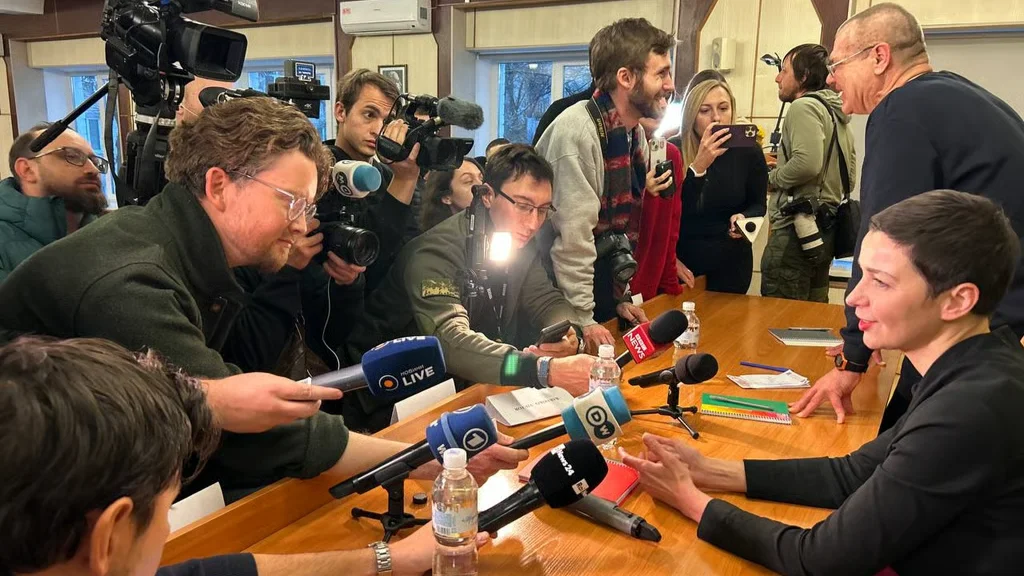
A press conference was held in the Ukrainian city of Chernihiv, north of Kyiv, on Sunday, after Belarusian dictator Alexander Lukashenko released some 123 political prisoners on Saturday in exchange for the United States agreeing to lift its sanctions on the key Belarusian export potash.
Among those released were some of the country’s highest-profile opposition politicians, including Maria Kalesnikava, one of the leaders of the 2020-1 mass anti-government protests that almost led to Lukashenko’s ouster; former presidential candidate Viktar Babaryka; and Ales Bialiatski, who was awarded the 2022 Nobel Peace Prize for his work with Belarusian human rights organisation Viasna.
In a change from previous political prisoner releases by the Minsk regime, the majority of those freed on Saturday were sent to Ukraine rather than Lithuania, in an 11th-hour script flip by Lukashenko, who, according to Belarusian opposition leader Sviatlana Tsikhanouskaya, “changed his mind at the last moment” to show that “he controls everything”.
Free at last
Kalesnikava, who was convicted of “extremist activity and attempting a coup” and sentenced to 11 years in prison in 2021 for her role in organising the nationwide protests that broke out across Belarus following the stolen August 2020 presidential elections, was the first to address journalists at the press conference, telling them that it was still difficult for her and her fellow political prisoners to find the words to describe how happy they were to be free.
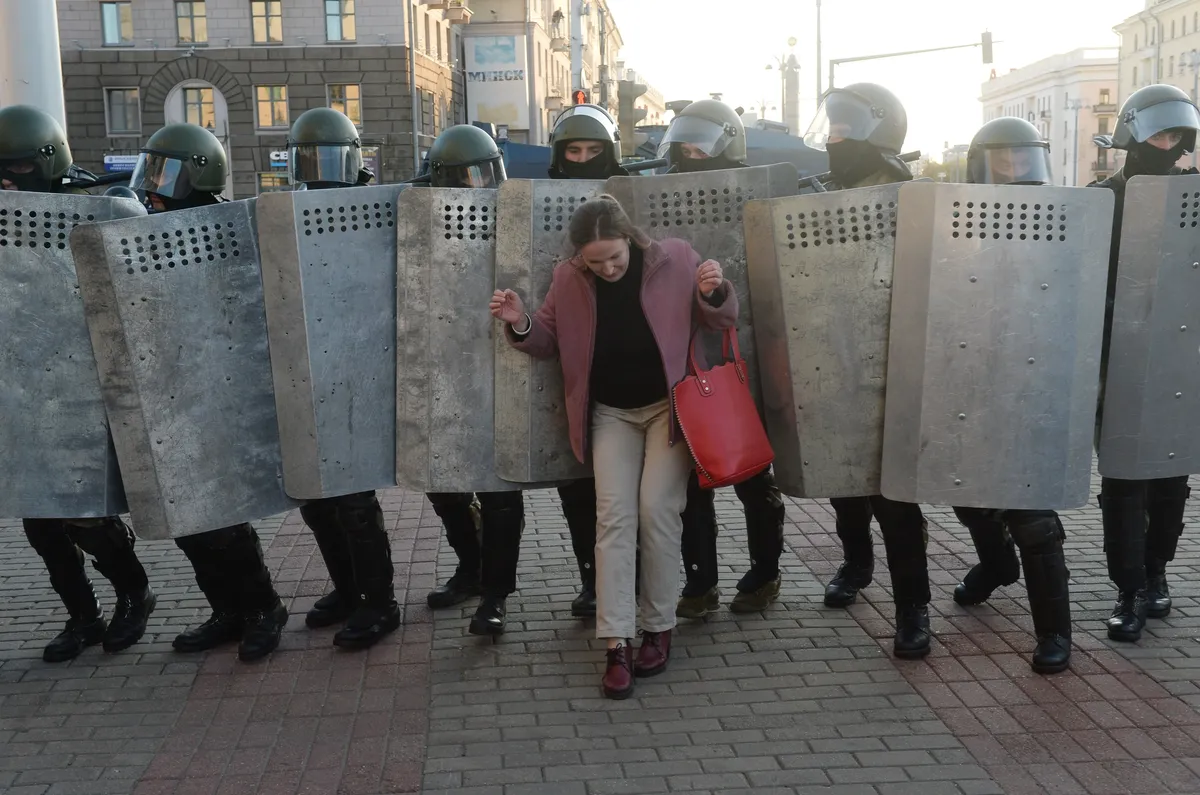
Riot police surround a protester during a rally against the presidential election results in Minsk, Belarus, 20 September 2020. Photo: EPA
As well as her family and supporters, Kalesnikava thanked US President Donald Trump, Ukrainian President Volodymyr Zelensky, and the Ukrainian nation that had welcomed them all the previous evening. Perhaps more surprisingly, she also thanked Alexander Lukashenko and expressed her hopes that the waves of political prisoner releases would continue, noting that there were still over 1,000 people being held in Belarusian prisons on political charges.
Kalesnikava confirmed that none of those being released had been informed in advance what was going on, and that none of them had known where they were going, adding that the political prisoners had been aware that negotiations were ongoing between Lukashenko’s regime and the Trump administration, but that they had not known of Ukraine’s involvement until they were transported to the Ukrainian border.
Father without son
Former Belarusian presidential candidate Viktar Babaryka, who was at one point considered the most likely opposition candidate to beat Lukashenko in 2020, also spoke to the press. He was arrested two months before the 2020 elections, and was subsequently sentenced to 14 years in prison, having been found guilty of accepting bribes in a politically motivated case.
The erstwhile opposition leader’s release was clearly bittersweet however, as his son Eduard remains in prison, his name not being added to the list of those suddenly set free on Saturday, and who is, according to his father, in a penal colony in eastern Belarus, where he is not permitted contact with the outside world.
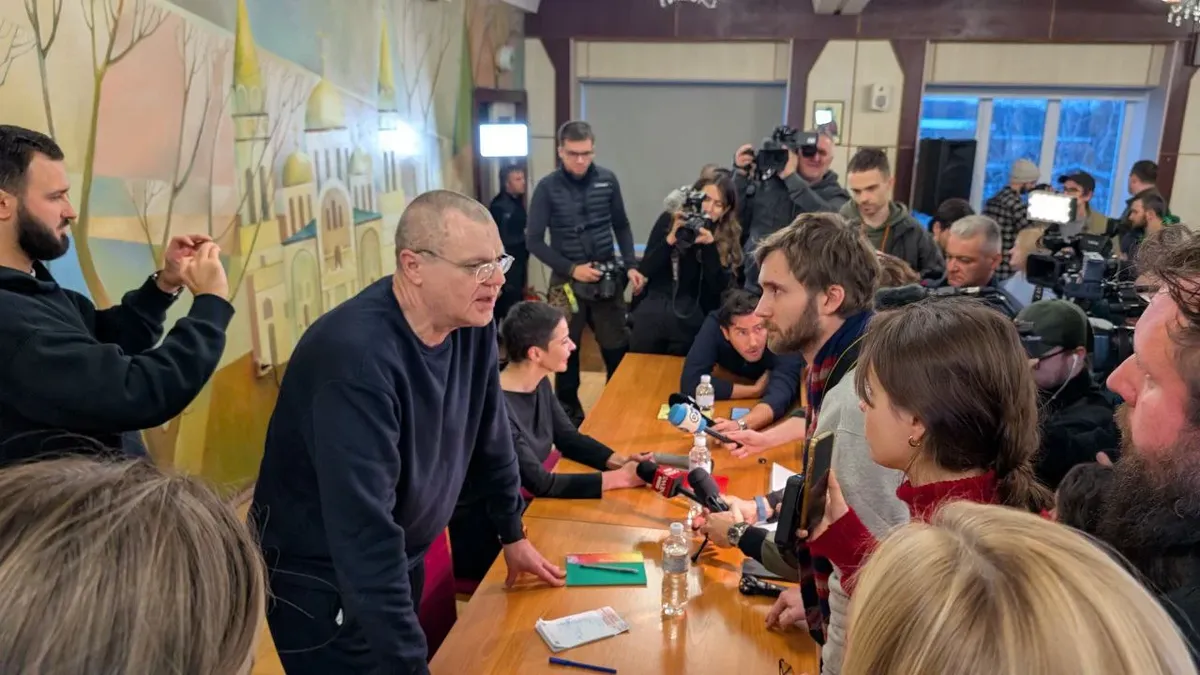
Viktar Babaryka speaks to journalists in Chernihiv, Ukraine, following his release, 14 December 2025. Photo: Dmytro Durnev
Babaryka stressed how proud he was of his son and how he was enduring his incarceration, and called on the international community not to forget the other prisoners who remain locked up in Belarus. “I won’t rest until not only my son, but also the thousands of other people are no longer there,” he said.
According to Babaryka, in 2023 he began to experience regular losses of consciousness, including one episode after which he regained consciousness to find himself with broken ribs, 23 cuts on his body, and a damaged lung.
Babaryka said that he was unable even to confirm that he had been beaten: “I don’t know what happened at the moment I lost consciousness”, though he thanked the medics who assisted him, including draining liquid from his lungs and transferring him to hospital. He said he had not experienced any other uncontrolled loss of consciousness.
Babaryka’s sole source of information about the war in Ukraine was Belarusian state media, he said. “I don’t think you’ll be hearing much from us regarding current affairs, especially on controversial matters,” he joked.
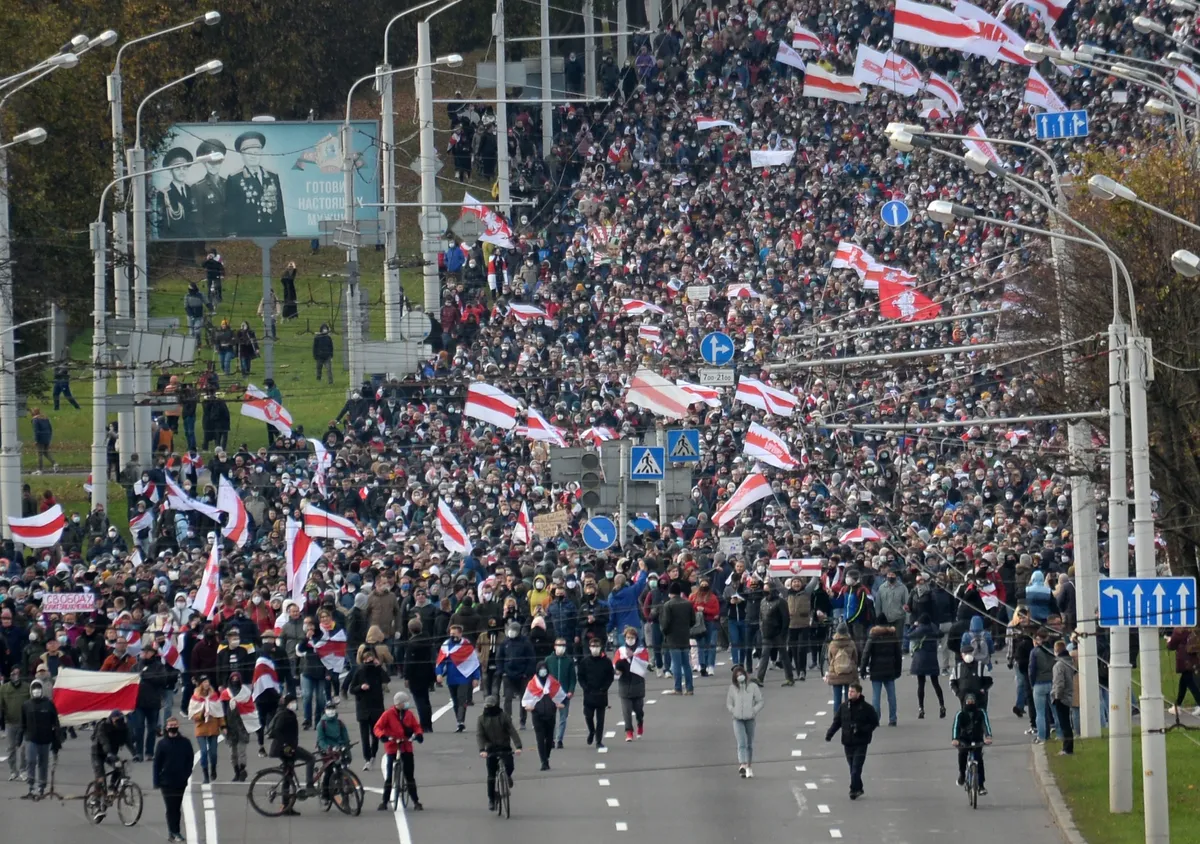
A march in Minsk protesting against the presidential election results, 18 October 2020. Photo: EPA
Uladzimir Labkovich, a Belarusian activist who worked for human rights group Viasna and was sentenced to seven years in prison in March 2023, thanked Kyiv for its involvement in securing their release.
“We understand how difficult and important this is in view of Ukraine’s current situation,” he said. “I can say that while I was in prison, I didn’t meet a single person among the 80%–90% of prisoners I was thrown together with who didn’t share Ukraine’s pain and take an unequivocal position on this war.”
Political scientist and literary critic Aliaksandr Feduta, who was sentenced to 10 years in prison in September 2022 for “conspiracy to seize power by unconstitutional means” said that he had seen TV reports alleging that Europe was tired of Ukrainians. “Volodymyr Zelensky is the best answer to that propaganda, he said, adding that Ukrainians were noble and selfless people.
Feduta said that he too intended to focus on his health for now. He said that while notes he had made were left behind in Belarus, he planned to write several more books. He said the books would not be about politics, saying he was willing to leave politics behind. His previous books include a 2005 political biography of Lukashenko.
Uladzimir Labkovich, Viktar Babaryka, Kalesnikava and Aliaksandr Feduta at a press conference in Chernihiv, Ukraine, 14 December 2025. Photo: Novaya Gazeta Europe
A notable absence
One political prisoner who wasn’t part of this release was former Belarusian presidential candidate Mikalai Statkevich, who was part of a group of 52 political prisoners who were released by Lukashenko in September.
However, when Statkevich was dumped on the Lithuanian border and ordered to cross it into exile, he refused and spent several hours in limbo on the Belarusian-Lithuanian border before returning to Belarusian territory, where he was detained and taken to an unknown destination by masked men.
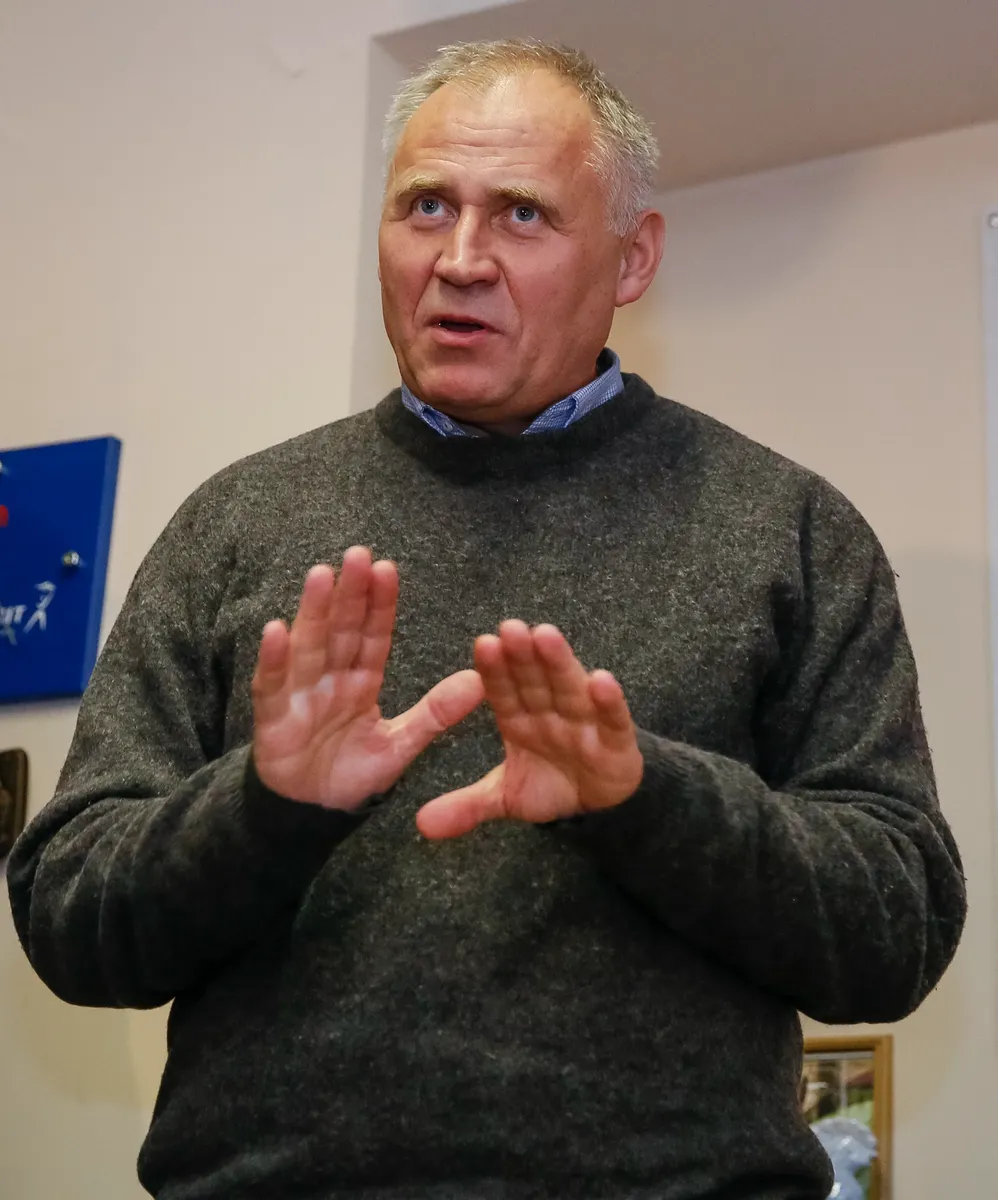
Mikalai Statkevich in 2015. Photo: EPA
Statkevich, who ran unsuccessfully against Lukashenko in 2010, was sentenced to 14 years in prison in 2021 for organising “mass riots” over his role in the massive anti-government protests that convulsed the country following Lukashenko’s fraudulent re-election the previous year.
He was tried alongside Siarhei Tsikhanouski, who at the time was the highest-profile opposition figure in Belarus, and the blogger Ihar Losik, who ran independent Telegram channel Belarus of the Brain. The political prisoners at this conference had little information on Statkevich’s current wellbeing, however, with Labkovich saying nobody knew where he was currently being held.
Living by faith
Babaryka said that for three years he had learned to live “not by knowledge, but by faith”, having been cut off from any reliable source of information, adding that he had decided while still in prison that he would need a month to catch up after his release. However, he said after making several phone calls since his release, he realised that he could “catch up in an hour as it was all just the same old same old”.
When Kalesnikava was asked about her decision to stay in Belarus despite being given the chance to leave, she said that this was the question that her fellow prisoners had most frequently asked her over the last five years.
After detaining her in September 2020, the Belarusian security forces attempted to force Kalesnikava to leave the country by taking her to the Ukrainian border, where she destroyed her own passport and climbed out of the window in the car she was travelling in to avoid deportation.
Babaryka said that once he had heard that Kalesnikava had ripped up her passport, he had also understood that he was doing the right thing.
“I made that difficult choice very easily,” Kalesnikava said, adding that she did not regret her decision and that though her personal suffering was now at an end, it continued for thousands of others. “If you can act, you must,” she said.
Babaryka said that once he had heard that Kalesnikava had ripped up her passport as she was being taken to the Ukrainian border, he had also understood that he was doing the right thing, adding that it was essential to “trust a woman’s intuition.”
Asked whether he would have stood in the 2020 election had he known how it would turn out, Babaryka answered simply that the decision had been “correct at the time” and that he didn’t regret it. “We didn’t lose. We won. We didn’t get our hands on the prize, but we emerged stronger.”


