Russian students and teachers are coming under increasing institutional pressure to download the country’s new super-app, MAX, with the threat of exclusion and even expulsion being leveraged to achieve compliance. Though educational institutions were initially free to choose how much they integrated its use into their day-to-day routines, both students and teachers are increasingly coming into conflict with this sinister tool of government control.
Much has changed since the roll-out of Russia’s state-backed messaging app MAX was first announced in March. Equipped with a payment system and dozens of other in-built features, in some quarters it was predicted to become the Russian equivalent of China’s WeChat: an all-in-one interface used for everything from online shopping and job applications to renewing documents and scheduling doctor’s appointments. Though that hasn’t happened yet, the state has been aggressively pushing Russians to adopt this latest tool of control. However, their efforts have met considerable push-back.
Though MAX was only added to Russia’s domestic software register in mid-June, by September the app was being pre-installed on all phones and tablets being sold in Russia. Simultaneously, the Russian authorities began introducing incremental restrictions on the use of foreign messaging apps, with state media regulator Roskomnadzor blocking calls on Telegram and WhatsApp in August, and Apple’s FaceTime being blocked altogether earlier this month.
Russian schoolgirls walk past a military conscription poster in St. Petersburg, Russia, 1 September 2023. Photo: EPA/ANATOLY MALTSEV
Cybersecurity experts have expressed concerns that downloading MAX would mean that all online activity including messages and calls would be recorded and made available to the authorities upon request. Although this has not been independently confirmed, it’s easy to understand why so many Russians are reluctant to have the app on their phones.
Soon, however, downloading MAX may no longer be a question of personal choice, as state employees have already been told to start using the national messenger for all their communications, as have school pupils and university students.
Illegal threats
Students at Moscow’s Medical College No.1 described not being allowed to have lunch or go to the toilet unless they download the app, and automatically receiving low grades if they refused. Despite widespread resistance, students at the college have been warned that MAX will soon be the only way to receive their course materials, as all previously used academic WhatsApp and Telegram groups are set to be deleted.
Such stories are becoming increasingly common, according to human rights organisation Po Sobstvennomu Zhelaniyu (PSZ), which confirms the widespread resistance to the forced adoption of MAX.
“Someone said that they didn’t have enough storage on their phone, and in response they were told to delete WhatsApp; it wouldn’t be needed anymore.”
“Someone said that they didn’t have enough storage on their phone, and in response they were told to delete WhatsApp; it wouldn’t be needed anymore,” said one student at university in Novosibirsk, in western Siberia.
To avoid being forced to adopt the app, some students are swapping out their smart phones for old “brick” models, while others are only installing MAX on an older smartphone that they no longer use.
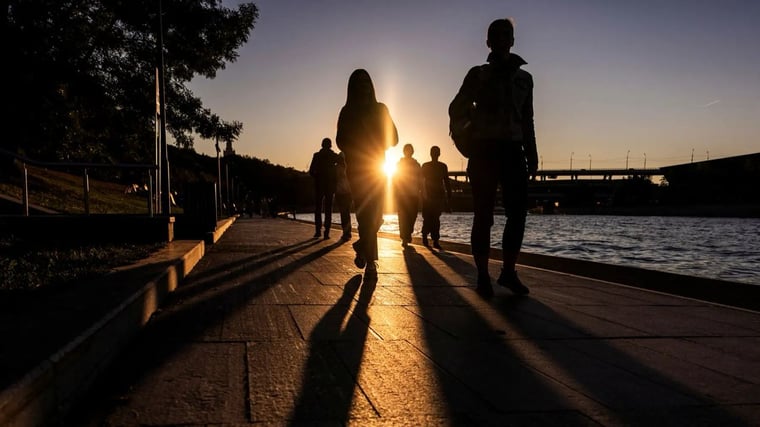
People walk in a park outside the main building of Moscow State University on 20 October 2025. EPA/MAXIM SHIPENKOV
PSZ has been contacted by students from 25 higher learning institutions in the past three months who have reported experiencing administrative pressure to adopt the app, with some students being warned they’ll face “problems” if they don’t.
In some cases, a PSZ spokesperson told Novaya Europe, students have been told that non-compliance could lead to them being barred from sitting exams or even expulsion, while resistant faculty staff have also been threatened with dismissal, though this doesn’t yet appear to have graduated from threats to action.
According to activists who started an online petition against the use of MAX being made compulsory, such coercion would violate the Russian Constitution, specifically its clauses guaranteeing citizens the right to personal privacy, as well as protections against the collection, storage and use of personal information without consent.
Guinea pigs
On 10 November, the Russian Science and Higher Education Ministry wrote to the institutions under its control detailing MAX’s rollout, which it described as an “experiment”. The letter also instructed academic institutions to register themselves on MAX, as well as to monitor its level of uptake among students, and ordered them to have created MAX chats for sharing academic materials within a week, with a review due by mid-December.
When some institutions voiced concerns at the apparently compulsory nature of the app, the ministry issued a statement stressing that “registering on MAX in public education institutions is not compulsory as per Russian law.”
Anthropologist Alexandra Arkhipova has published data from Moscow’s Department of Education on the uptake of MAX among parents, pupils and teaching staff in the Russian capital showing that sign-up rates are far lower than expected. So far, just 7% of Moscow schoolchildren, 20% of Moscow parents and 62% of Moscow school staff have downloaded the app, less than 20% of the target figures set by the government.
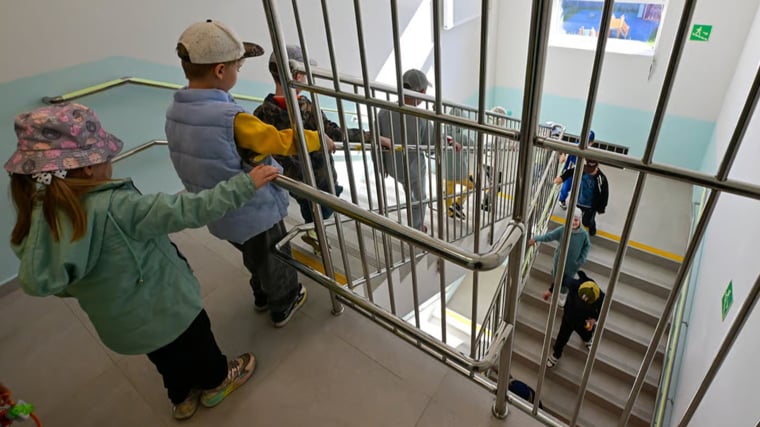
Children at a school in Moscow, 14 April 2024. Photo: AGN Moskva
Defiant children
Moscow native Erika told Novaya Gazeta Europe that the teaching assistant at her eldest son’s school had asked her personally to download the super-app. “She told me quite frankly that they were being threatened with losing their bonuses if they didn’t convince parents and students to download MAX, and, due to my good relationship with her, I downloaded it onto a fully-reset phone, which only had MAX on it,” Erika recalls. “Either way, we still got school materials via WhatsApp and Telegram, which the teacher sent himself.”
“There was nobody actually in this chat, no students whatsoever. But nevertheless the school reported 100% of students had subscribed.”
Shortly afterwards, another at the school told Erika that soon school work would only be shared on MAX, something she was dismayed to hear as she didn’t want the app on her phone, fearing it would spy on her and her children. “My children are also against it, they have a very clear opinion on it: ‘It’s all rubbish, why on earth do we need it?’”
Tatyana, whose son goes to school in Siberia’s Krasnoyarsk region, says that pupils were coming under pressure from the school administration to adopt MAX, and that those who resisted were essentially being blackmailed.
“Children from this one class pushed back against MAX strongly, and the school administrators ultimately forced them all to download it. They sent out a message after the school holidays, saying that on 3 November the whole school would work online apart from this one class, who would have to come in regardless,” Tatyana says. “They said something along the lines of ‘because of you, all the teachers, caretakers and canteen staff will have to come into work, and then they’ll surely find some way to get back at you.”
According to her, “There was nobody actually in this chat, no students whatsoever. But nevertheless the school reported 100% of students had subscribed,” recalls Tatyana.
Moscow resident Yulia refused to download MAX, disregarding demands made to her children by their teacher: “This app was hastily made, unreliable, and, just like everything actively promoted by the government, has been met with rejection. I don’t want to have an app on my phone which is trying to find out everything about me.” According to her, all but five or six of the parents in her son’s class have now downloaded MAX, having been pressured into it by their teacher.