On 28 November, Yevgenia Khasis was released from a penal colony in the western Russia region of Mordovia after serving a 16-year sentence for being an accessory to the murder of human rights lawyer Stanislav Markelov and Novaya Gazeta journalist Anastasia Baburova.
Though she acknowledges her role in the killings, Khasis is far from repentant, and why should she be? After all, the Russia into which she is now being released is one that aligns far more with her beliefs than its forerunner a decade and a half ago did.
In 2011, Khasis and her boyfriend, Nikita Tikhonov, a leader of the Battle Organisation of Russian Nationalists (BORN), were convicted of murdering Markelov and Baburova. Tikhonov was sentenced to life imprisonment for committing murder, while Khasis received 18 years for her complicity in their deaths.
According to investigators, Khasis followed Markelov and Baburova as they left a press conference in Moscow on 19 January 2009, and gave a signal to Tikhonov, who shot them several minutes later. Baburova was shot in the back of the head after rushing to Markelov’s aid when he was shot.

A march in Moscow in memory of Markelov and Baburova, 15 February 2009. Photo: Sergey Mikheev / Kommersant / Sipa USA / Vida Press
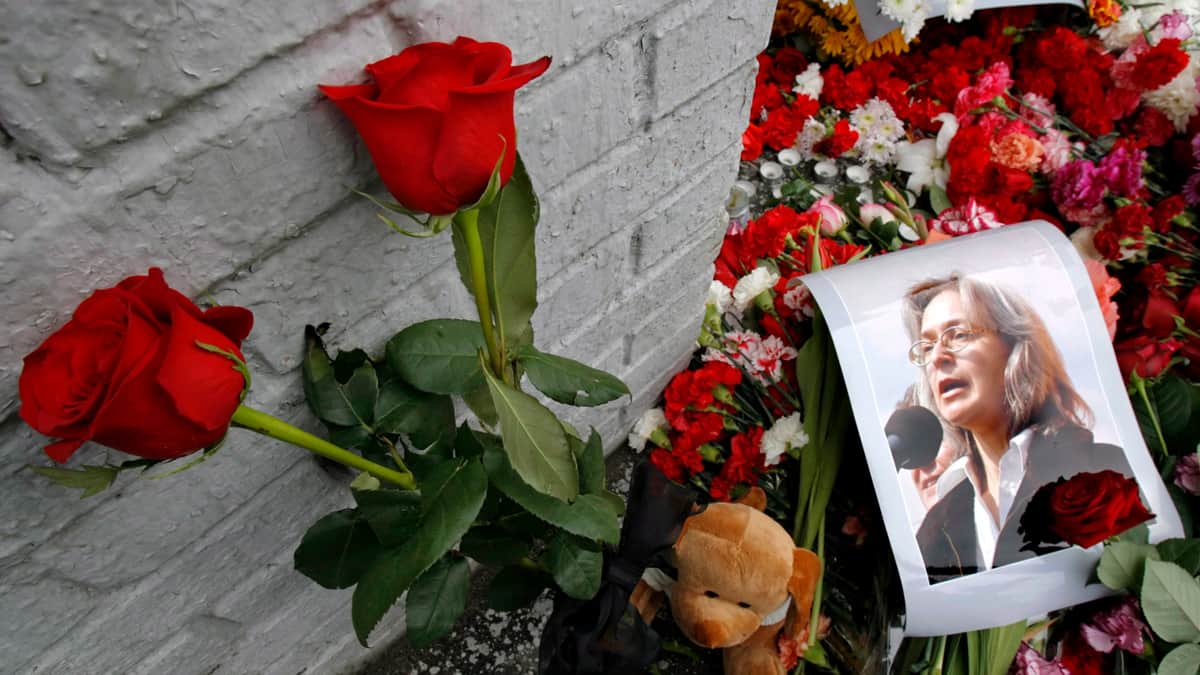
Stanislav Markelov was a prominent human rights lawyer who represented Novaya Gazeta journalist Anna Politkovskaya before her murder in 2006, as well as various left-wing and anti-fascist groups. Anastasia Baburova, who wrote about informal youth movements, including neo-Nazi ones for Novaya Gazeta, held similarly staunch anti-fascist views.
The BORN identity
In total, BORN was responsible for at least 10 murders in the 2010s. In addition to Markelov and Baburova, BORN members also assassinated federal judge Eduard Chuvashov, three well-known anti-fascists, and four men from the Caucasus and Central Asia whom they believed had “behaved improperly towards ethnic Russians”.
“BORN weren’t the first Nazis to kill anti-fascists, but they committed the crimes that resonated the most within the anti-fascist community,” Semyon, an anti-fascist who took part in street clashes with neo-Nazis in Moscow in the 2000s, told Novaya Europe. In his opinion, the arrests of Tikhonov and Khasis, followed by other BORN militants, ultimately avoided the prosecution of a long and bloody vendetta between rival youth groups in Russia.

Participants in the now-banned Russian March shout ultranationalist slogans as they march through the centre of Moscow, 4 November 2008. Photo: EPA / YURI KOCHETKOV
The BORN case greatly increased Russian law enforcement’s interest in the ultra-right scene, leading to members of other Nazi groups being arrested as well. Following the crackdown in the early 2010s, racist violence in Russia declined significantly, and only re-emerged as a mass phenomenon following the invasion of Ukraine.
Even the legal activities of Russia’s far right were curtailed in the 2010s — within a few years the annual Russian March, demonstrations held by far-right nationalist and neo-Nazi organisations in major Russian cities, found itself reduced to a marginal phenomenon before being banned altogether by the authorities.
However, that did not spell the end of fascism in Russia: within a decade and a half, the state began to occupy the ideological niche once filled by the ultra-right itself.

Yevgenia Khasis. Photo: Ostorozhno Sobchak / YouTube
Extreme patriotism
In an interview with Russian journalist and socialite Ksenia Sobchak a few days after her release from prison, Khasis admitted her guilt as an accomplice in Markelov’s murder, but denied any responsibility for the murder of Baburova.
“I am guilty to the extent that I am guilty, I have taken responsibility for it, and I will carry it within me for the rest of my life. I am not denying anything, I am not trying to portray myself as some lovesick fool who knew and understood nothing. I knew, I understood, and I took responsibility,” Khasis said.
Khasis claimed that nationalists selected people who “triggered” society as “targets for political murders”. For example, she said, Markelov was not only a lawyer, but also a public figure who was very vocal about his “ideological views”.
“To use the language of the present day, Markelov openly discredited the actions of the Russian army during the Chechen War, and the veterans of that campaign. Those comments deeply offended their relatives and the patriotically-minded section of society,” Khasis told Sobchak.

Nikita Tikhonov and Yevgenia Khasis on trial in Moscow in January 2011. Photo: RFE/RL
In her interview with Sobchak, Khasis expressed no remorse for her violent acts, but did note that “Russian patriotism” had “flourished” in her absence. She also defended nationalism, which she called “an extreme form of patriotism” that came about “when people believe that Russia’s development should follow an exclusively national path”.
Perhaps unsurprisingly, she voiced her support for “instilling conservative values: family, faith”, and bringing up the younger generation in “the spirit of a culture that can be considered truly Russian”.
State policy in recent years has increasingly come to resemble the rhetoric and aesthetic motifs of the ultra-right.
Inevitably, Khasis also described her strong backing of Russia’s war in Ukraine. “Those guys on the frontlines who are genuinely risking their lives, who could have lived peacefully and done the things they love, but chose to be there in the interests of all of us… Not supporting them now, not helping them however we can, seems wrong to me,” she said.
“We all understand that I have certain views, and my views, you could say, are an extreme form of patriotism. I am where my country is, and that is not up for discussion. That’s all,” Khasis continued.
Displaced by the state
“State policy in recent years has increasingly come to resemble the rhetoric and aesthetic motifs of the ultra-right,” says Ksenia Links, who runs the Telegram channel Public Incitement, which tells the story of anti-fascist movements in the Post-Soviet Space. “But this isn’t BORN’s victory. The state has simply occupied the space once held by radical street nationalists, using its own methods of control and mobilisation.”
Left-wing politician Mikhail Lobanov, who takes part in annual events to commemorate the deaths of Markelov and Baburova, agrees: “For many years we’ve seen the Russian political system shifting further and further to the right. But only those who are fully loyal and cannot start their own game are incorporated into the system.”

Russian ultranationalists at the 4th Congress of Russian Nationalists in St. Petersburg, Russia, 6 December 1997. Photo: EPA / Anatoly Maltsev
“People from across the political spectrum have tried to be ‘Red Putinists’ or ‘Black-Hundred Putinists’, without success. … Neo-Nazis who kill people, including a federal judge, are undesirable for the authorities,” Lobanov says.
A long-defunct magazine run by the founders of BORN, Russian Image, once advocated for a return to imperial ideology, bans on abortion and the promotion of the large family as the ideal social unit, militaristic aesthetics, and the “coming together of the Russian world”. In the Russia of 2025 it reads more like a completed authoritarian wishlist.
Xenophobia is now one of the main channels through which the authorities direct popular discontent, and senior regime figures such as State Duma Speaker Vyacheslav Volodin and the head of Russia’s Investigative Committee Alexander Bastrykin now routinely use language that even many ultra-rightists in the 2000s wouldn’t have dared utter. This has helped create a new generation of young Nazis who once again maim and kill “aliens” in the streets, posting videos of their attacks.
It remains unclear whether Khasis will find a place in the Russian system, or whether the authorities may find it simpler to imprison her again. But she is being released into a Russia that has changed in accordance with the ideals for which she was ready to kill in 2009, and for which she served a sentence of just 16 years.
Join us in rebuilding Novaya Gazeta Europe
The Russian government has banned independent media. We were forced to leave our country in order to keep doing our job, telling our readers about what is going on Russia, Ukraine and Europe.
We will continue fighting against warfare and dictatorship. We believe that freedom of speech is the most efficient antidote against tyranny. Support us financially to help us fight for peace and freedom.
By clicking the Support button, you agree to the processing of your personal data.
To cancel a regular donation, please write to [email protected]