


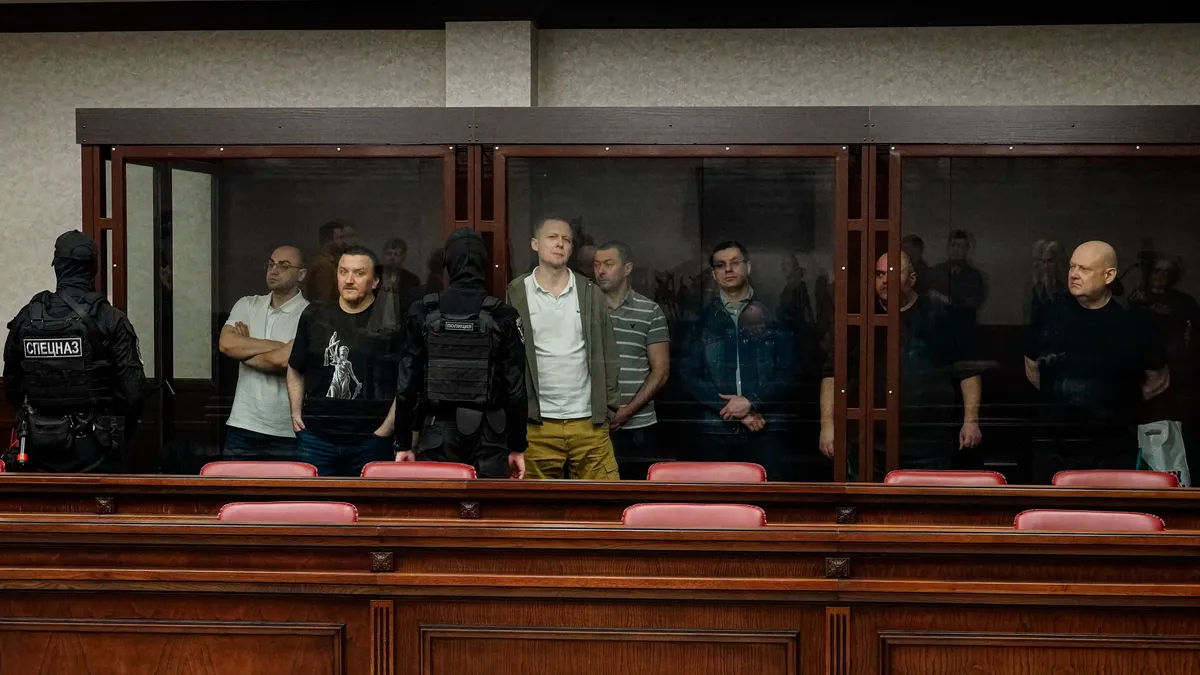
Last month, a military court in the southern Russian city of Rostov-on-Don sentenced eight men to life imprisonment after finding them guilty of causing the 2022 explosion on the Crimean Bridge, the controversial road and rail bridge that connects Russia’s Krasnodar region with the annexed Crimean Peninsula. While that explosion killed five people, caused two bridge spans to collapse and damaged 17 wagons of a freight train, the scapegoating of those with no knowledge of or involvement in planning the attack, has effectively ended the lives of another eight people.
In the half hour Judge Valery Opanasenko allotted for reading the sentences of all eight defendants aloud, “life imprisonment” is heard eight times: once for each of the accused. Though they are now officially terrorists, not one of them appears to be a fanatic ready to die for their cause. Their faces betray their exhaustion, and their general state of disbelief about what is happening to them.
Oleg Antipov, a businessman from St. Petersburg, speaks up, appealing to anyone willing to listen: “All the witnesses say we are innocent. All the testimonies say that we are innocent. All 116 volumes of evidence say we are innocent. Tell people the truth!”
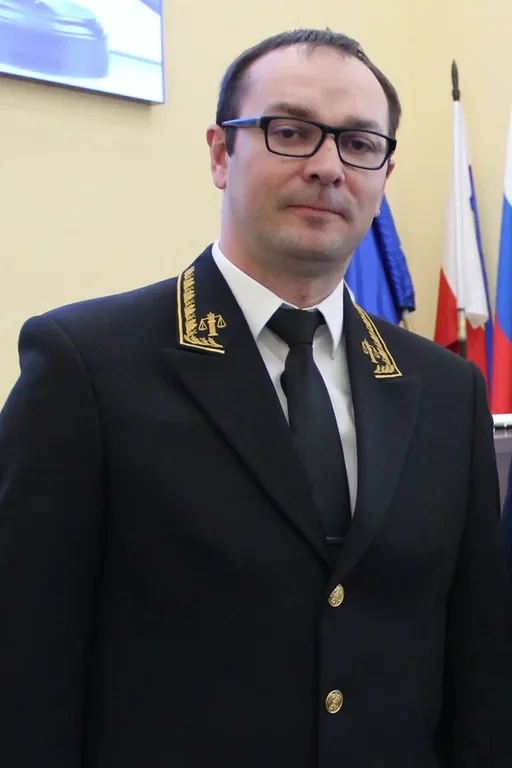
Judge Valery Opanasenko
The judge gathers his folders and leaves. For the prosecution, the eight people in the cage have long ceased to be living human beings.
The October 2022 attack on the Crimean Bridge was one of the most high-profile episodes of the hybrid war being fought between Russia and Ukraine. A truck loaded with 20 tons of hexogen disguised as rolls of construction-grade plastic film exploded as it drove over the bridge, bringing down two of its spans.
Later, the head of the Security Service of Ukraine (SBU), Vasyl Malyuk, would acknowledge that the SBU had carried out an extremely complex operation, using unwitting transport contractors. But the men who ended up in the dock in the southern Russian city of Rostov-on-Don were not the ones who plotted the route or who detonated the explosives.
The Russian Federation chose to prosecute a dispatcher, a farmer, a driver, warehouse staff, and even a man who sold virtual phone numbers. None of them had special training, political ambitions or access to state secrets. They were all simply living their lives until the war in Ukraine arrived, circuitously, at their door.
The court’s logic is terrifying in its bluntness: the bridge was blown up, so everyone in the logistics chain is guilty.
None of them tried to run, none of them changed their appearance or threw away their phones. They all trusted in basic common sense and believed that “the authorities would sort things out”. To be fair, the investigators did attempt to do just that: all eight suspects were given a polygraph test, and each one passed, confirming that there had been no intent in their actions, they did not know about the bomb, and that they had not lied.
A lie detector is not considered admissible evidence in Russian criminal proceedings, but it is still used as a way to establish a “background” convenient for the investigation. The mere fact that a suspect has taken a polygraph becomes part of a ritual: the investigators need to show they have “checked everything,” even if that check has no formal value in a court of law. So they checked — and confirmed the innocence of all the arrested men. After that, the polygraph reports simply disappeared from the case materials, so as not to interfere with the proceedings.
In their place, planted political memes appeared instead. Yes, political satire “showed up” on the defendants’ phones only after their arrest and the seizure of their devices. During the forensic examination, something astonishing emerged: despite never having met one another before, the eight suspects were all suddenly found to have identical memes on their phones.
A firefighting helicopter douses the Crimean Bridge with water to extinguish a fire caused by the explosion of a cargo truck, 8 October 2022. Photo: EPA
In terms of criminal law, what happened at the Southern District Military Court should be impossible. The court has effectively legalised objective imputation, or criminal liability for causing harm without guilt. Article 5 of the Russian Criminal Code explicitly forbids convicting a person for an action solely on the basis of its consequences unless their guilt has been established.
The court’s logic is terrifying in its bluntness: the bridge was blown up, so everyone in the logistics chain is guilty. By the same logic, a taxi driver who drove a terrorist to the metro, a cashier who sold him a ticket, or a postal worker who delivered a parcel without knowing what was inside could tomorrow be declared accomplices to a “terrorist act”.
In order to charge a person with terrorism, investigators and prosecutors are required to prove direct intent. One cannot carry out an act of terrorism through negligence, nor can one become a terrorist by accident. For the crime to exist, a person must understand the public danger of their actions, foresee the possibility of the consequences — an explosion, people’s death — and desire those consequences. This is a basic legal principle.
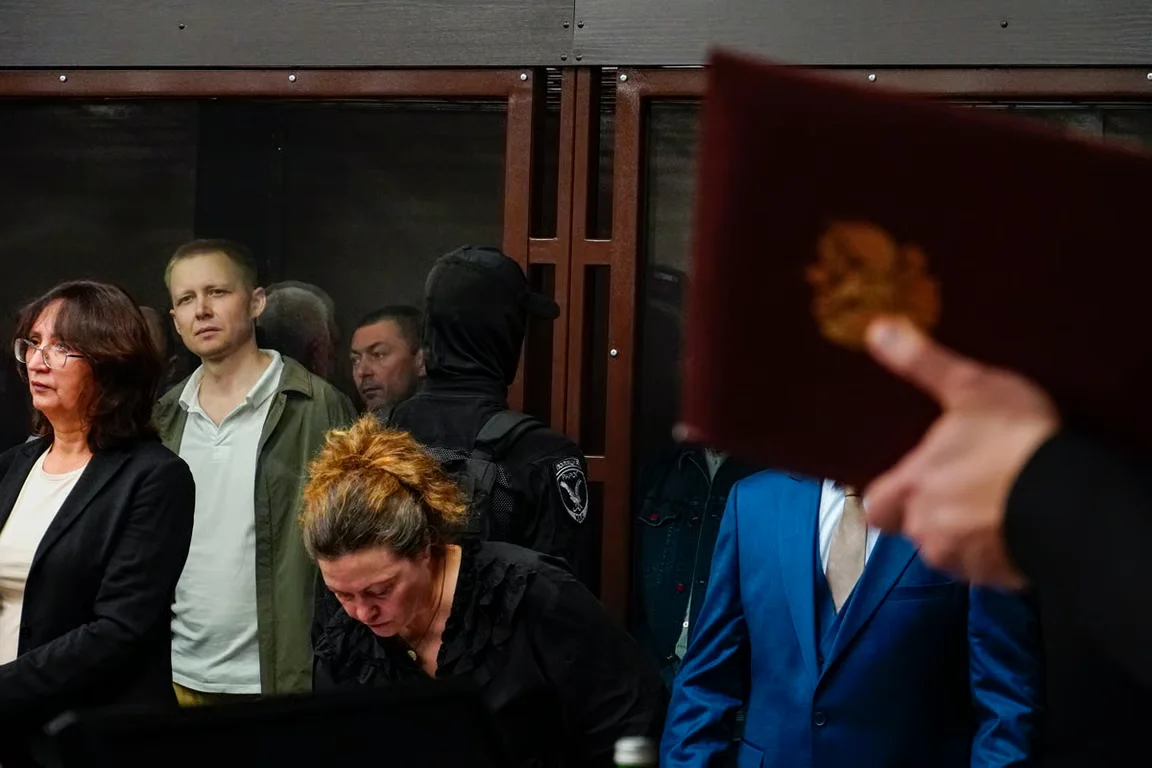
The defendants have their sentences read out, Rostov-on-Don, southern Russia, 27 November, 2025. Photo: EPA
The investigation was obliged to prove that Dmitry Tyazhelykh, who rented out SIM cards, and the Azatyan brothers, owners of a warehouse in the Krasnodar region town of Armavir, knew that a terrorist attack was being planned and that they had wanted the Crimean Bridge to collapse, or, at the very least, that they intended something, somewhere, to explode as a result of their actions, and that someone would die or be harmed.
Across all 116 volumes of case files, there is no such proof, only testimony showing that they had some involvement in transporting the cargo. This is what is meant by causing harm without guilt. Fully aware of this, the investigators fabricated criminal intent by planting anti-war memes on the defendants’ phones, which were used as “proof” of their supposed terrorist intent. The court in Rostov-on-Don ruled that such evidence was admissible.
The principle of individualised punishment has also been abolished. The Criminal Code requires the role of each person to be taken into account: organiser, perpetrator, accomplice. It is impossible for the mastermind of a terrorist act and a driver to bear the same degree of responsibility.
Nevertheless, the investigators lumped people who had never even met each other together into a single group that they alleged was controlled by the SBU. This legal fiction made it possible for them to charge the defendants with the most serious articles in the Criminal Code, which the court then dutifully rubber-stamped, handing down eight identical life sentences, and labeling each of the accused equally evil.
At the heart of this conveyor-belt slaughter lies fear. The bridge bombing, which took place the day after Putin’s birthday, was a public slap in the face for the security services that was witnessed around the world. Somehow, 20 tonnes of hexogen managed to pass unnoticed through Russia’s borders, X-ray scanners and police checkpoints. This was a collapse of competence, and a scapegoat had to be found.
Had the court acquitted the suspects, then awkward questions would immediately need answering, such as who was, in fact, guilty? Who let the truck through? Who failed to inspect it? According to the logic of shifting responsibility, the investigators would have inevitably clashed with the generals responsible for securing the perimeter of the bridge.
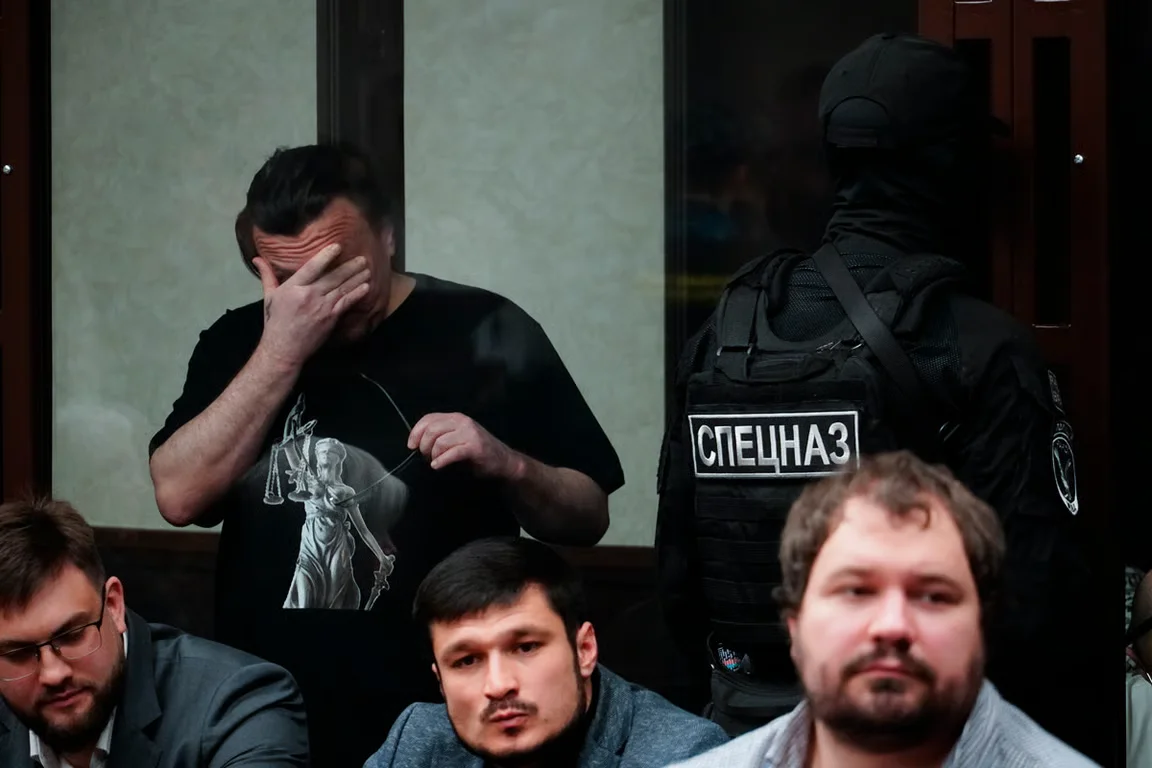
The defendants have their sentences read out, Rostov-on-Don, southern Russia, 27 November, 2025. Photo: EPA
To admit a mistake on the part of the authorities would mean betraying “their own”, and so an acquittal would have led to Russia’s security apparatus being purged, beginning with the operatives who didn’t notice the preparations for the attack, then the investigators who failed to find the real terrorists, before ending with the senior officers who assured their superiors that the bridge was “impregnable.” As a result, the system switched to self-preservation mode, in a desperate attempt to produce culprits as quickly as possible.
Designating those who unwittingly took part in the attack as an “organised terrorist group” is the perfect bureaucratic solution, as it ensures the case is solved, arrests are made, punishment meted out and that the “enemy” is neutralised.
What remains of the system’s honour is preserved. Those administering justice are fully aware of the unwritten rules: the court must not embarrass colleagues from related agencies. They are all in the same boat, bound together by the same blood — the blood of eight shattered lives simply used to plug a hole in the state security fence. For the machine that is Russia’s security apparatus, they are not people, but collateral damage in an operation carried out to prove that Russia’s siloviki do not abandon their own.
The tragedy here has nothing to do with legal technicalities, but lies instead in the reduction of human life to something of no value.
Meanwhile, there is another “terrorism” case connected with the Crimean Bridge bombing — one conducted in absentia. No materials are publicly available, and the names of the accused are unknown. The defence believes that this is the real investigation, aimed at identifying the actual organisers of the bombing from the Ukrainian security services. But those people are out of reach. And a report must still be filed. So the real case lies locked in a safe, while those who were simply in the wrong place at the wrong time find themselves carrying the can.
The tragedy here has nothing to do with legal technicalities, but lies instead in the reduction of human life to something of no value. The primary moral catastrophe of war is when a society accepts that individual lives are worth very little when compared to those of the population as a whole.
***
The air in the courtroom is stifling. The judge pointedly avoids looking in the direction of the “aquarium”, the glass box into which all defendants are placed in Russian courts. The transparent walls catch the light and reflect the masked bailiffs, lawyers, prosecutors, relatives, journalists, visitors, and even the defendants themselves. The reflections are so sharp that from certain angles it is hard to tell how many people are actually inside.
It feels as though not only the defendants are sitting behind the reinforced glass, but the entire courtroom. The line between captivity and freedom dissolves, turning the court hearing into a prison cell where some are shackled by handcuffs, and others by fear, silence, and the normalisation of what is happening.
The war will end when we stop believing that any of this is normal. On 8 October 2022, five people died on the Crimean Bridge: the driver of the truck, Makhir Yusubov; a Moscow judge, Sergey Maslov, two guides who led historical tours of St. Petersburg, Eduard Chuchakin and Zoya Sofronova, and a fitness trainer from Yevpatoria, Gleb Orgetkin. They were ordinary people with plans, families, and futures. They were killed by the Ukrainian security services, who used other ordinary people as unwitting tools. Now, the Russian security services and the Southern Military District Court have sentenced eight more people to life imprisonment, effectively adding their names to the list of victims.
Under international law, Crimea is sovereign Ukraine territory. The Russian occupation of the peninsula in 2014 and the subsequent construction of the Crimean Bridge were both illegal. The eight “terrorists” sentenced to life imprisonment could, in theory, have been prosecuted under the Ukrainian Criminal Code for illegal border crossing and smuggling, but they did not commit the crime for which they have now been convicted in Russia.


