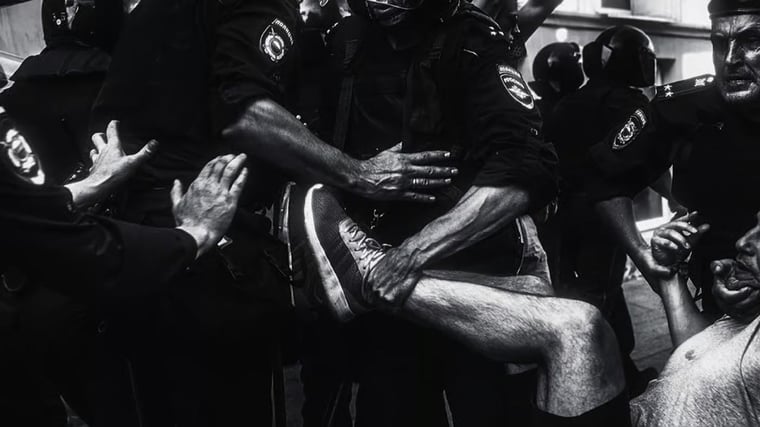
Since the invasion of Ukraine began, thousands of Russians have faced prosecution for public protest and dissent. More than a thousand people have ended up behind bars, while many others have been forced to leave the country. It might therefore surprise some people then that there’s still one legal party in Russia that regularly holds fundraising events for political prisoners.
That social-liberal party, Yabloko — which means Apple in Russian — also doesn’t recognise Russia’s illegal annexation of Crimea, and has spent the last three years taking a principled stand against the invasion of Ukraine.
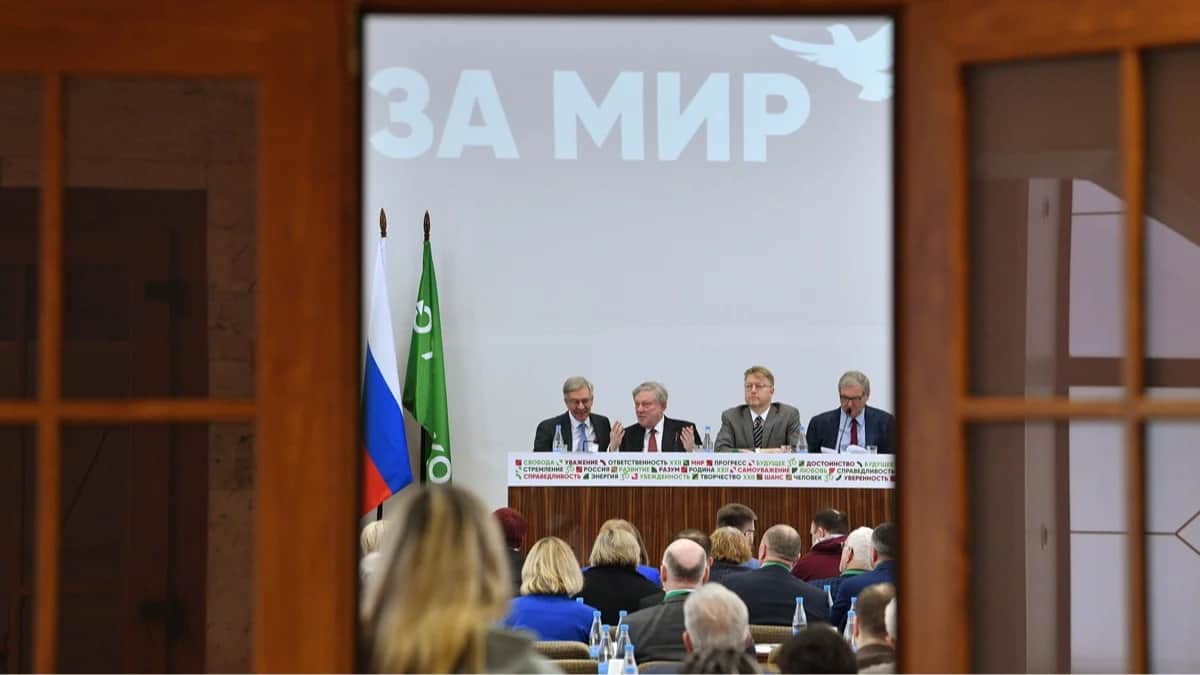
With Russia’s next nationwide election scheduled to take place by September 2026, Novaya Europe examines Yabloko’s prospects — and asks in particular whether a “party of peace” will be tolerated in the country at all today.
Losing liberally
The party, which was founded as Russia’s main liberal party in 1993, has gradually lost its once significant voter share, and currently doesn’t even have any sitting members in the State Duma and is limited to just six deputies in a handful of regional assemblies in Russia’s northwest.
Though there are fewer than 50 Yabloko members in Russia’s entire system of legislative bodies, the party does still enjoy significant funding and donations from its members. In 2024 alone, the party spent over €2.1 million, and it’s a safe bet that Yabloko plans to take part in next year’s elections.
“Elections held during a war have nothing to do with particular candidates. Their purpose is to speak out loudly for peace and freedom.”
“The designation of some of our leaders and activists as ‘foreign agents,’ and the criminal prosecution of several of them, deprives these people of the chance to stand as candidates,” one Yabloko source told Novaya Europe. “But elections held during a war have nothing to do with particular candidates. Their purpose is to speak out loudly for peace and freedom — something we have been doing for the past three years through regional and municipal campaigns.”
Another party member speaking to Novaya Europe said that Yabloko’s main goal was simply to survive the present era, adding that he believed that when the war ends, the party’s principled stance would help rebuild relations between Russia and Ukraine.
“I don’t think they’ll shut us down, but they will remove as many prominent people as possible. They’ll allow a heavily truncated list,” a senior member of Yabloko predicted.
That prediction is borne out by recent moves against prominent party members — on 25 November, two Yabloko politicians accused of spreading “fake news about the army” both had their pre-trial detention extended, while party leader Nikolay Rybakov has been charged with “displaying extremist symbols” for sharing a photograph of Alexey Navalny online. If the charge is upheld in court, he will face a one-year ban on running for office.
“Yabloko is unlikely to have any obstacles put in its way simply because no one is planning to approach those obstacles in the first place.”
On top of that, a book by former St. Petersburg deputy Boris Vishnevsky has been declared extremist, three members of Yabloko’s leadership have been designated “foreign agents” by the Russian government, while Pskov politician Lev Shlosberg, one of the party’s best-known figures, is being prosecuted for “repeatedly discrediting” the Russian army.
According to human rights organisation OVD-Info, which has monitored political persecution in Russia since December 2011, 17 Yabloko members are currently facing prosecution, six of whom are in detention.
Grigory Yavlinsky (L) and Nikolay Rybakov (R) lay flowers at the site where Russian opposition politician Boris Nemtsov was assassinated, in Moscow, Russia, 27 February 2023. Photo: EPA/SERGEI ILNITSKY
The race to the starting line
Several people who previously worked with Yabloko told Novaya Europe that the party tends to prepare poorly for elections in general, without even taking into account the additional pressure it will inevitably face as a war-critical movement in next year’s ballot.
“It’s sad, but Yabloko is unlikely to have any obstacles put in its way simply because no one is planning to approach those obstacles in the first place,” said one person involved in local elections in the Moscow region city of Podolsk, where the party lost its only municipal deputy in the region in September’s municipal elections.
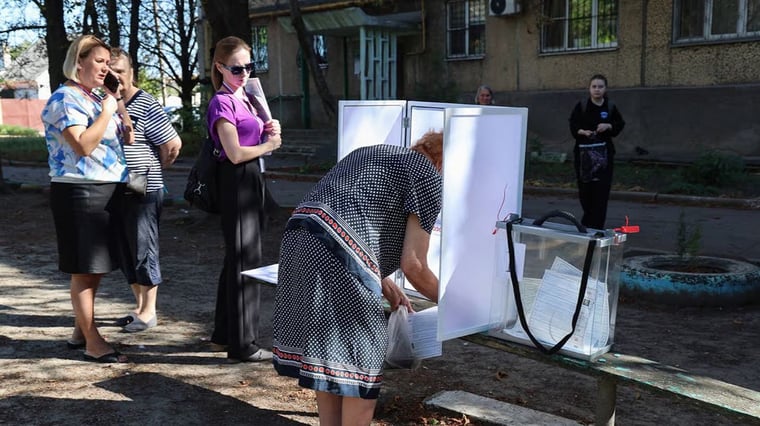
Doing so meant that Yabloko forfeited its right to nominate candidates for the Moscow Region Duma without first having to collect some 250,000 signatures: over 30,000 signatures in support of the party list and roughly 10,000 signatures in support of each candidate in the 25 single-mandate districts.
“This is the first and probably the biggest obstacle for the party. Signatures are very easy to invalidate, and it is almost impossible to challenge such decisions by the electoral commission,” the Podolsk source said. “Even collecting 30,000 signatures for the party list will be extremely difficult, as, judging by the 2025 municipal elections, Yabloko has serious organisational problems.”
According to one former Yabloko municipal deputy in Moscow, the case against Moscow branch head Maxim Kruglov for “spreading false information about the army” was only opened as the authorities were not able to prove that he had been receiving foreign funding.
Maxim Kruglov, former head of the Yabloko Moscow branch, in the dock during a hearing at the Zamoskvoretsky District Court in Moscow, 2 October 2025. Photo: Vladimir Astapkovich / Sputnik / Imago Images / Scanpix / LETA
The recent selection of Kirill Goncharov to replace Kruglov as the head of Yabloko’s Moscow branch was “understandable”, the same municipal deputy said, explaining that Goncharov was “loyal to the Moscow mayor’s office and sufficiently flexible”.
“As far as I know, the Moscow branch is in crisis; it has only a couple of hundred members left,” the deputy continued. “To build effective management, you obviously need experienced and capable administrators. That requires money — and there is none. All this is happening at a time when the party is coming under aggressive pressure for its anti-militarist position.”
Another former Yabloko associate from Russia’s northwest also pointed to Yabloko’s skinflint approach to disbursing its party funds: “They try to save every last ruble on printing costs, and attempt to force designers, artists, and journalists to work for the party for free, or in all seriousness offer salaries of 20,000 rubles [€220]. Meanwhile, the staff at Yabloko’s central office earn market-level salaries.”
A Yabloko party supporter holds a placard reading ‘Zeroing presidential terms is usurpation of power’ as he protests against the constitutional amendments that allowed Vladimir Putin to run for a fifth presidential term in 2024, in front of the State Duma in Moscow, 11 March 2020. Photo: EPA/SERGEI CHIRIKOV
Special military obfuscation
Preparations for next year’s elections are further complicated by the fact that it remains to be seen what state Russia and its economy will be in by then.
“In the presidential administration there’s a kind of paralysis about the 2026 elections, because nobody knows whether the ‘special military operation’ will be ongoing. So they keep crushing Yabloko just in case. Under the inertia scenario, there’s no ‘party of peace’ at all, everyone must be ‘for victory’,” one source who works on political strategy projects in Russia told Novaya Europe.
“Both in government circles and among many ordinary Russians, there is a clear understanding that military spending is undermining the country’s development.”
Another political strategist told Novaya Europe that if circumstances permit, the New People party could also become a “party of peace”, given that their criticism of the authorities had been similar in tone to Yabloko’s, if far less confrontational.
“A peace-oriented agenda will in any case be in demand in the 2026 elections, even if the conflict in Ukraine is not over by then. Both in government circles and among many ordinary Russians, there is a clear understanding that military spending is undermining the country’s development.”
“New People talk about ‘peace on our terms’: this allows them to avoid criticising the decision to launch the ‘special military operation’ in the first place, while also sending signals to those who simply want peace,” he explains.
Former State Duma deputy Dmitry Gudkov told Novaya Europe that if there’s no sign of the war ending by next autumn, it would be unlikely that opposition candidates in the vein of Yekaterina Duntsova or Boris Nadezhdin, both of whom briefly managed to shake up the 2024 presidential election, would be permitted to stand.
This, he added, would be mainly to ensure that anti-war feeling would not be allowed to surface in the election campaign, precisely because so many Russians now want the “special military operation” to end. Indeed, the recent pressure brought to bear on Yabloko suggests that the authorities have no intention of loosening its repressive screws on the body politic before the elections take place.